


EN
AI Hardware Joint Venture Might Change The Case For Investing In Jabil (JBL)
- Jabil reported that its board approved a quarterly dividend of US$0.08 per share and, earlier in October 2026, the company signed a non binding 50:50 MoU with Adani Enterprises to build an AI and data center hardware manufacturing joint venture in India.
- The planned Adani partnership would give Jabil on the ground access to India’s growing data center build out, including AI racks, servers, cooling systems and installation services that could reshape the mix of its Intelligent Infrastructure work.
- We will look at how Jabil's investment narrative is affected by the planned Adani AI hardware joint venture in India.
Scan how other AI infrastructure players stack up to Jabil by filtering for 55 AI infrastructure stocks that is built to capture this same build out theme.
Jabil Investment Narrative Recap
To own Jabil, you need to believe the AI infrastructure ramp, regulated industries work and automation programs can sustain higher margin engineering-centric manufacturing without choking on supply or working capital. The Adani MoU fits that story by pointing Jabil’s India footprint even more directly at AI data center hardware, but it is still early stage and non binding.
Over the next year, the key swing factor is execution on large AI orders while keeping inventory days moving toward the 55 to 60 target so free cash flow supports buybacks. The biggest risk is component tightness or weaker Connected Living demand dragging on Intelligent Devices and Robotics, which could offset Intelligent Infrastructure strength.
The Adani Enterprises MoU is the clearest operational link to the current AI infrastructure debate around Jabil. It sketches a path to multi-gigawatt AI rack capacity in India, tied to servers, storage, networking gear and liquid cooling equipment. That sits directly on top of the firm’s existing AI revenue guidance and India expansion plans.
For catalysts, that MoU could matter if it converts into definitive agreements and tangible orders that support the guided AI revenue ramp and factory utilization in India. The flip side is execution risk. Any delay in approvals, build out or export demand would blunt the benefit, particularly if component supply tightness or high inventory days are still in focus.
Jabil's current narrative ties together analyst expectations that revenues reach US$57.4b and earnings come to US$2.3b by 2029, built on a 16.9% yearly revenue growth assumption and an earnings increase of about US$1.3b from the US$1.0b reported today.
Uncover why Jabil's fair value indicates a 54% potential upside to its current price, which could narrow quickly as AI hardware orders firm up.
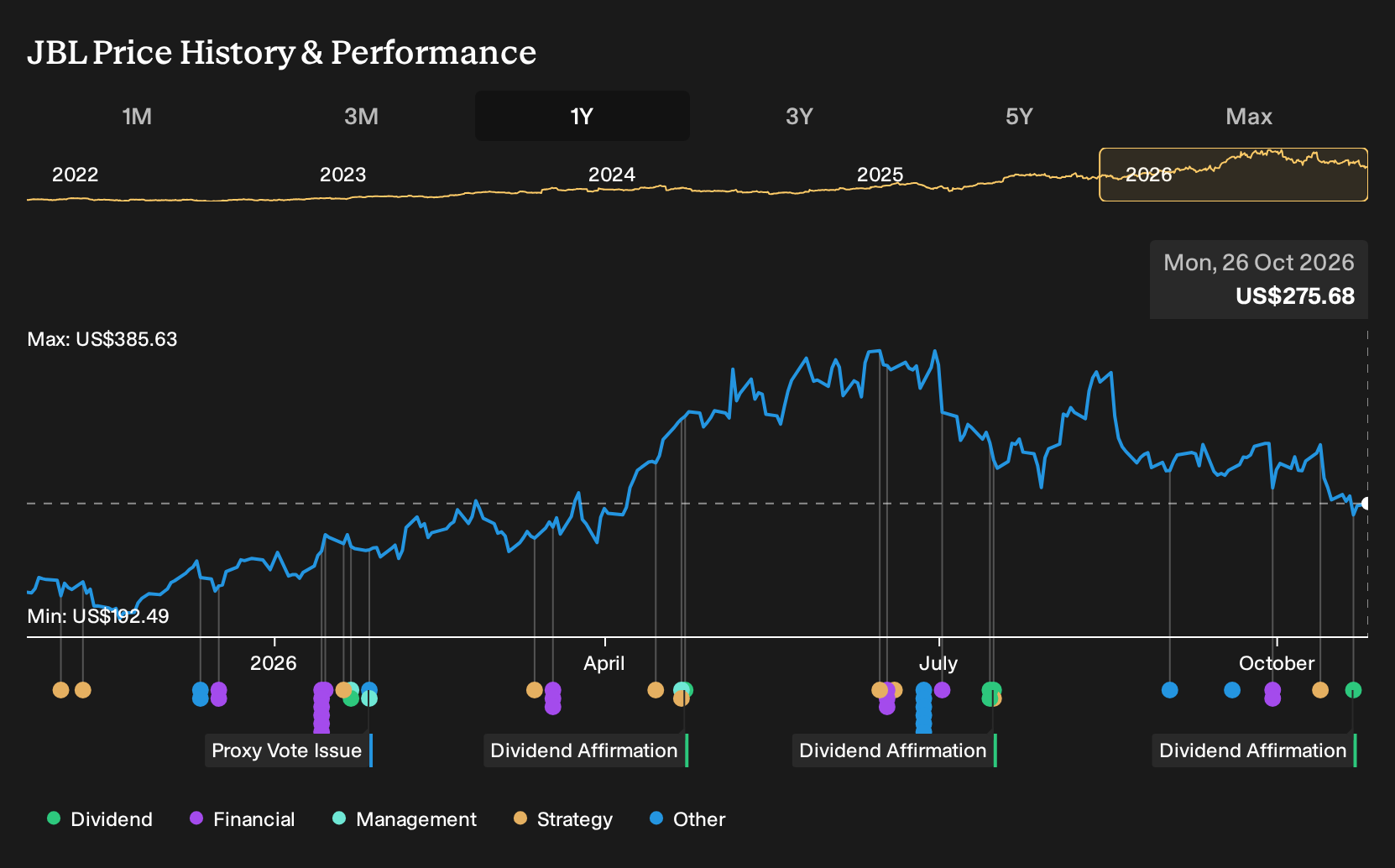
Exploring Other Perspectives
Some of the lowest Jabil forecasts lean hard into the risk that AI hardware proves cyclical. Those analysts were pencilling in about US$53.9b of 2029 revenue and US$2.1b of earnings before this dividend and Adani MoU, which is a more cautious story. Use that gap in expectations as a prompt to explore multiple viewpoints.
Explore 2 other Jabil fair value estimates, including one that suggests it could be worth just $425.00!
Reach Your Own Conclusion
Disagree with existing narratives? Extraordinary investment returns rarely come from following the herd, so go with your instincts.
- A great starting point for your Jabil research is our analysis highlighting 4 key rewards and 1 important warning sign that could impact your investment decision.
- See our latest analysis for Jabil. The report includes a comprehensive fundamental analysis summarized in a single visual, the Snowflake, making it easy to evaluate Jabil's overall financial health at a glance.
Looking For More Investment Ideas Beyond Jabil?
Once you have a view on Jabil, it often helps to benchmark that opinion against other companies with very different risk and return profiles. The Simply Wall St screener lets you filter the market quickly so you can build a watchlist that actually matches your goals and risk appetite.
- If capital preservation is high on your list, start with companies that score well on balance sheet strength through the list of solid balance sheet and fundamentals (24 results).
- If income is the priority, scan for higher yielding payers that still clear quality checks using the 5 dividend fortresses.
- If you want to look where fewer investors may be paying attention, broaden your research with the 21 high quality undiscovered gems.
Have feedback on this article? Concerned about the content? Get in touch with us directly. Alternatively, email editorial-team@simplywallst.com