


EN
Learn Why The Bull Case For Marathon Petroleum (MPC) Could Change Following Garyville Throughput Expansion
- Marathon Petroleum is benefiting from tight refining capacity, constrained fuel inventories and high US fuel prices, with its large and flexible system positioned to supply a strained market.
- The Garyville Feedstock Optimization project, targeting an extra 30,000 barrels per day of crude throughput by year end 2027, highlights how operational tweaks can influence refining economics and sentiment.
- We will look at how Marathon Petroleum's refining flexibility and Garyville throughput project feed into the broader investment narrative today.
Scan how Marathon Petroleum's setup compares across the sector by running the same playbook on a curated shortlist of 42 power grid technology and infrastructure stocks.
Marathon Petroleum Investment Narrative Recap
To own Marathon Petroleum, you need to be comfortable with a pure refining and fuels business that is tightly linked to product spreads, export flows and how hard the plants can run. Tight refining capacity and low fuel inventories currently support that setup. The key near term swing factor is whether Marathon Petroleum can keep utilization high while protecting reliability as markets stay tight.
The biggest operational risk is compression in the spread between crude costs and refined product prices, especially if policy limits diesel exports or crude supply into key hubs loosens. Recent ETF net selling around MPC does not materially alter this, since it reflects fund flows rather than a clear change in the underlying operating story.
The Garyville Feedstock Optimization project is the clearest operational tie in to this backdrop. It is aimed at lifting crude throughput by 30,000 barrels per day by year end 2027 and improving the feedstock slate, which directly affects how much value Marathon Petroleum can extract from advantaged North American crude.
For you, the question is execution and timing. Garyville follows other refinery yield projects at sites such as Garyville and Robinson that target returns of 25% or more, as well as specialty gasoline work at El Paso. If tight capacity and low inventories persist while these projects stay on track, they remain important levers for refining economics and system wide margin capture.
Marathon Petroleum's narrative projects US$139.6b in revenue and US$7.8b in earnings by 2029. This aligns with analysts’ expectations that revenue will decline by 3.2% per year and earnings will decrease by about US$0.7b from US$8.5b today.
Uncover why Marathon Petroleum's fair value indicates an 8% potential downside to its current price, suggesting a premium that may not hold.
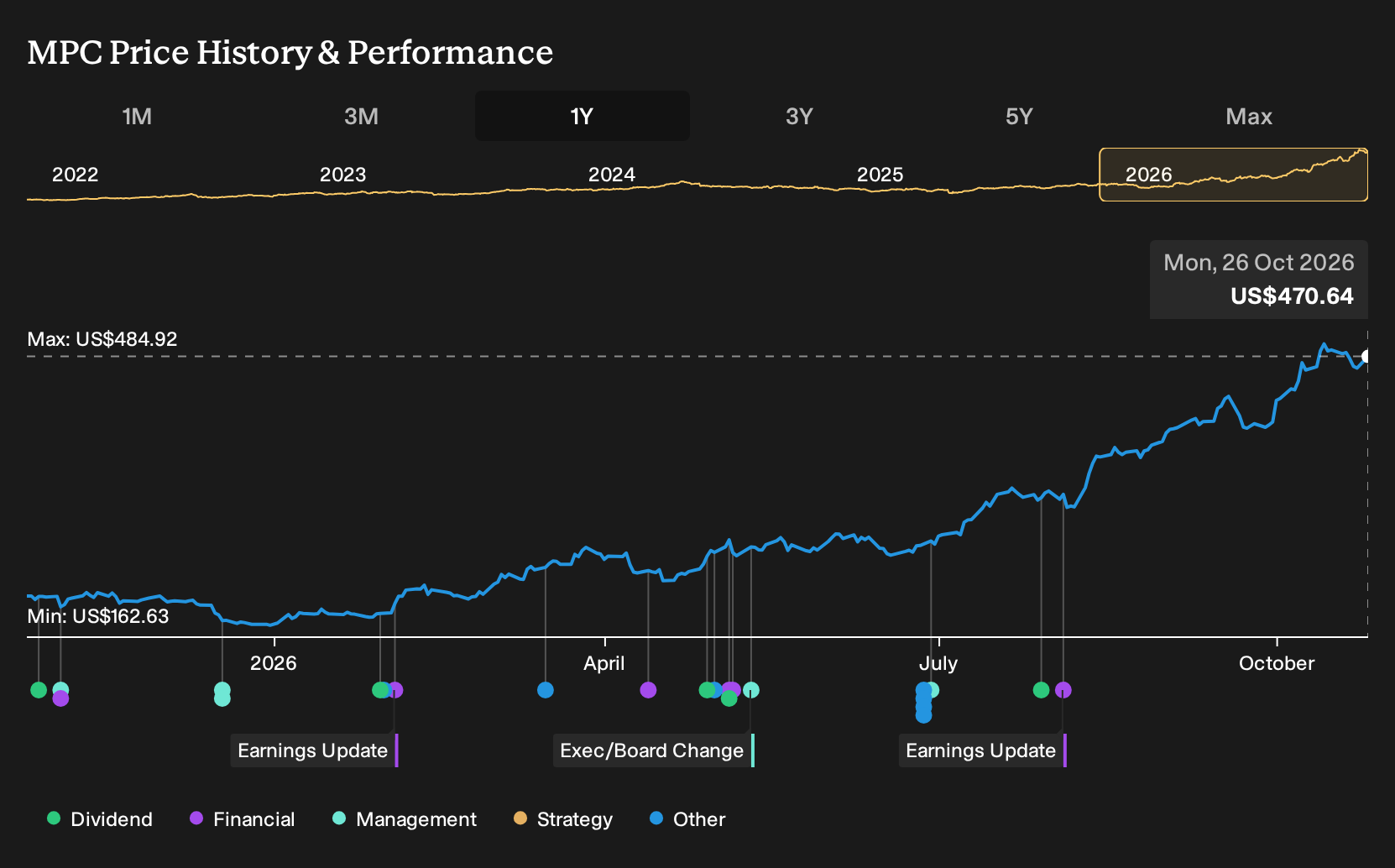
Exploring Other Perspectives
One contrasting angle on Marathon Petroleum focuses on the risk that refining projects end up underused if global fuel tightness eases. The most pessimistic analysts were already bracing for revenue to reach only about US$127.8b and earnings of US$6.5b by 2029. Those views, formed before this news, could shift meaningfully.
Explore 4 other Marathon Petroleum fair value estimates, including one that suggests as much as 8% downside from the current price.
The Verdict Is Yours
Disagree with existing narratives? Extraordinary investment returns rarely come from following the herd, so go with your instincts.
- A great starting point for your Marathon Petroleum research is our analysis highlighting 2 key rewards and 3 important warning signs that could impact your investment decision.
- See our latest analysis for Marathon Petroleum. The report includes a comprehensive fundamental analysis summarized in a single visual, the Snowflake, making it easy to evaluate Marathon Petroleum's overall financial health at a glance.
Looking for more Marathon Petroleum style ideas?
If the Marathon Petroleum story has sharpened your view on refining, use that same lens to scan other opportunities with the Simply Wall St Screener. Pick the angle that fits your approach and pressure test a wider watchlist.
- For investors who want resilient balance sheets and steadier fundamentals, start with a curated list of solid balance sheet and fundamentals (24 results) that can help you filter for financial strength first.
- If your focus is on valuation and trying to avoid overpaying, work through a targeted universe of 29 high quality undervalued stocks that already clear several quality hurdles.
- For readers who like backing under followed stories with room for fresh coverage, scan a focused pool of 21 high quality undiscovered gems and see which ones merit a deeper look next.
Have feedback on this article? Concerned about the content? Get in touch with us directly. Alternatively, email editorial-team@simplywallst.com