


EN
What UBS Shares Job Cut Risk Means For Shareholders
- UBS Group faces rising regulatory pressure in Switzerland after the Swiss Bank Employees Association warned that up to 12,000 domestic roles could be at risk if stricter capital rules prompt the bank to relocate its headquarters, in addition to around 3,000 redundancies already expected from the Credit Suisse integration.
- The potential requirement to hold 90% Common Equity Tier 1 capital against foreign subsidiaries highlights how regulatory decisions in Switzerland may influence UBS Group’s cost base, organisational footprint and long term approach to running a global wealth and investment banking platform.
- We will assess how UBS Group's investment narrative evolves as investors weigh tighter Swiss capital rules and the risk of large scale job cuts.
Scan beyond UBS Group and pressure from tighter Swiss rules by lining up other heavily regulated financials that are screened for balance sheet resilience in our list of solid balance sheet and fundamentals (207 results).
UBS Group Investment Narrative Recap
To own UBS Group, you need to be comfortable with a global wealth and investment banking platform that is still digesting Credit Suisse while leaning on cost efficiency, digital tools and fee income to support earnings. The big short term swing factor is how quickly integration savings and Non Core and Legacy wind down feed into cleaner margins and return on equity.
The recent threat of tighter Swiss capital rules and potential domestic job cuts sits directly against that. If extra Common Equity Tier 1 is required or headquarters decisions disrupt operations, the main risk is reduced flexibility for reinvestment and capital returns, as well as execution strain on management that is already managing a complex merger.
The capital discussion lands directly on top of UBS Group’s recently announced US$3b share repurchase program, which is intended to run to 2Q 2027, around a CET1 target near 14%. This plan currently frames how much excess capital can realistically go back to shareholders while integration work continues.
If Swiss rules require materially higher CET1, that buyback timetable or size could be adjusted, which may be important for your view on potential catalysts. Any shift would sit alongside other moving parts, such as earnings forecasts of 12.3% annual profit growth and analyst expectations for rising margins, all of which depend on predictable regulation, steady wealth flows and controlled compliance costs.
UBS Group Analyst Expectations In Context
UBS Group's current analyst playbook leans heavily on gradual top line expansion and fatter profit margins over the rest of the decade, even while Swiss regulators debate higher capital buffers. Consensus assumes revenue grows by 2.2% per year and that profit margins rise from 17.9% today to 25.0% in about three years, which is a sizeable lift in profitability for a bank already working through the Credit Suisse combination and potential domestic headcount cuts.
Earnings form the backbone of this story. Analysts are looking for profit of US$14.2b by around 2029, up from US$9.5b today, which implies an earnings increase of roughly US$4.7b over that period. That forecast lines up with expectations for earnings per share of US$4.87 and a gradually shrinking share count, with outstanding shares projected to fall by about 2.51% a year for the next three years as buybacks chip away at the equity base.
Valuation assumptions tie those earnings targets to a specific multiple. The consensus view anchors on UBS Group trading on a P/E of 14.1x by 2029, slightly lower than the 14.9x applied today, yet still above the current P/E of 13.2x cited for the broader GB Capital Markets peer group. For equity holders, that means analysts are effectively pricing in both higher profits and a modest premium multiple, even as capital requirements and political scrutiny remain active swing factors.
UBS Group's narrative projects US$56.6b revenue and US$14.2b earnings by 2029. This requires 2.2% yearly revenue growth and an earnings increase of about US$4.7b from US$9.5b today.
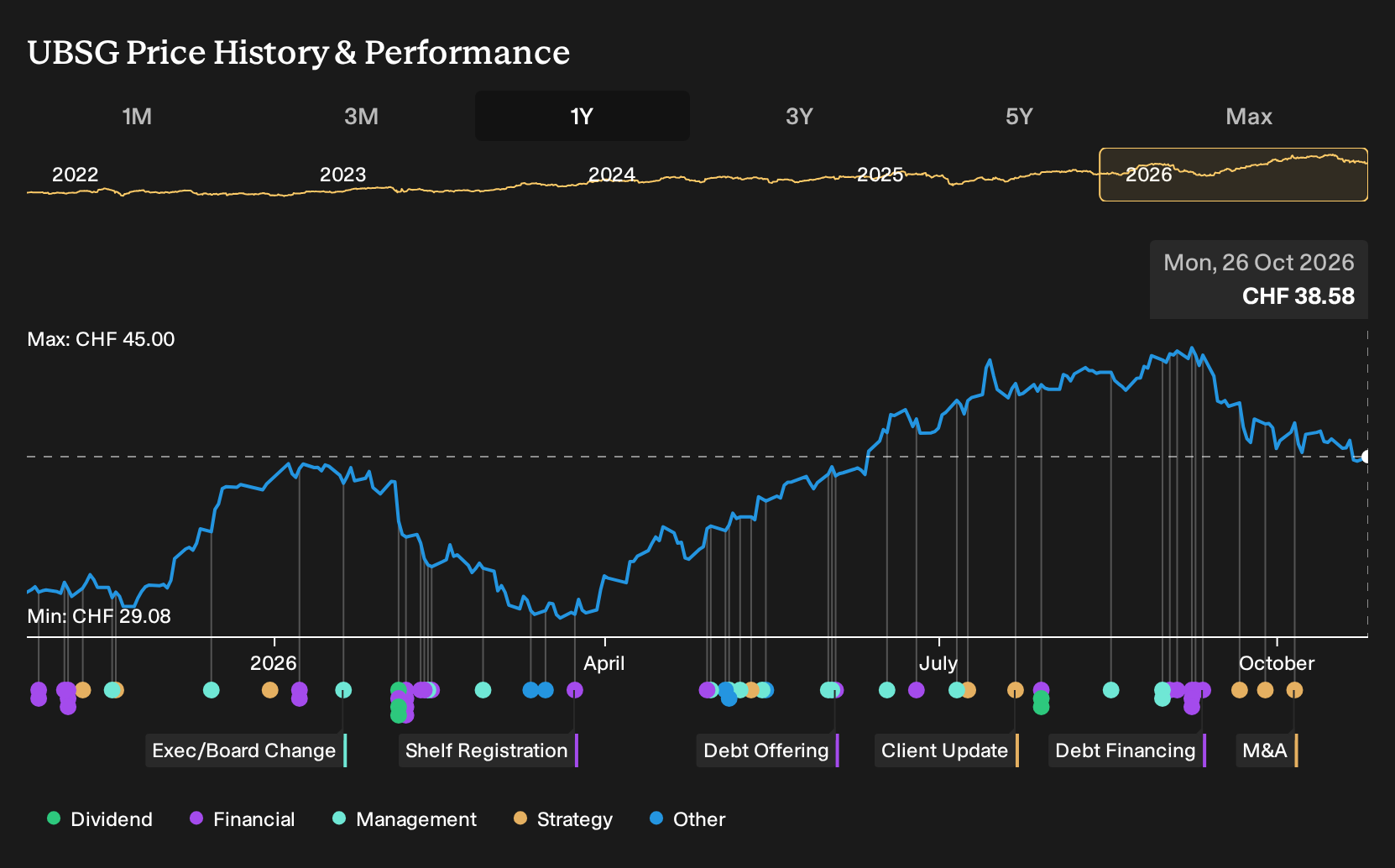
Target prices then build off these building blocks. The consensus price target sits at CHF44.87 per share against a current price of CHF38.32, with the most optimistic analysts at CHF60.00 and the most cautious at CHF33.99. That spread shows opinion is far from uniform, which makes the underlying inputs, such as revenue growth, margin expansion and the assumed P/E level, more important to stress test against your own expectations for regulation, integration costs and capital returns.
For anyone tracking UBS Group, the key question is how those projected earnings and valuation multiples square with today’s capital debate in Switzerland. A requirement to hold materially more Common Equity Tier 1 capital, or to assign 90% CET1 against foreign subsidiaries, could limit how much cash flows back to shareholders through that US$3b buyback program and future dividends. If excess capital is locked up on the balance sheet rather than returned, the assumed share count reduction and the 2029 P/E framework become more sensitive to regulatory decisions than to pure business performance.
Uncover how UBS Group's fair value indicates a 16% potential upside to its current price before the market closes that gap in valuation.
Exploring Other Perspectives
One alternate UBS Group storyline puts the risk of a forced headquarters move front and centre. That bearish camp already assumed only about US$54.0b revenue and US$14.3b earnings by 2029, plus a lower 10.5x P/E. With fresh talk of 12,000 domestic jobs at stake, those already cautious analysts may revise their story again. Readers should treat this as a reminder that views can differ widely and should explore several scenarios before deciding which narrative feels closest to their own expectations.
Explore 4 other UBS Group fair value estimates, including one that suggests there may be as much as 12% downside from the current price.
Form Your Own Verdict
Don't just follow the ticker; dig into the data and build a conviction that's truly your own.
- A great starting point for your UBS Group research is our analysis highlighting 3 key rewards and 4 important warning signs that could impact your investment decision.
- See our latest analysis for UBS Group. The report includes a comprehensive fundamental analysis summarized in a single visual, the Snowflake, making it easy to evaluate UBS Group's overall financial health at a glance.
Looking for more investment ideas beyond UBS Group?
Once you have a view on UBS Group, it can help to line it up against other opportunities that fit different risk and income profiles. The Simply Wall St Screener lets you quickly filter the market by balance sheet strength, potential value, or income focus so you can spot candidates that match your own playbook.
- If capital preservation comes first for you, start with a 223 resilient stocks with low risk scores that may appeal if you prefer steadier business models and more measured volatility.
- For investors hunting for mispriced opportunities, scan a 195 high quality undervalued stocks that combine healthier fundamentals with what could be more appealing entry points.
- If reliable cash payouts matter most, focus on a 224 dividend fortresses that emphasise higher yields backed by underlying financial strength.
Have feedback on this article? Concerned about the content? Get in touch with us directly. Alternatively, email editorial-team@simplywallst.com