


EN
Does Wholesale Revenue Drop Change The Bull Case For PVH Stock (PVH)?
- PVH Corp reported a 6% year over year drop in wholesale revenue in the second quarter of 2026 as retailers pulled back orders and shipment timing shifted, prompting management to lean harder on improved assortments and in season replenishment to support this channel.
- The wholesale softness at PVH contrasts with healthier wholesale momentum at Vince Holding Corp, which underlines how brand positioning and order patterns can diverge sharply across similar apparel players even when they sell into many of the same retail partners.
- We will look at how PVH's investment narrative holds up against this wholesale revenue pressure from cautious retailers and shipment timing.
Compare PVH's wholesale pressure with peers that currently show stronger momentum by scanning our curated list of 21 high quality undiscovered gems in apparel and adjacent consumer brands.
PVH Investment Narrative Recap
To own PVH, you need to buy into a story that its core brands and higher average unit retail can offset pressure in weaker regions and channels. In the near term, a key swing factor is whether direct to consumer and e commerce keep gaining share while wholesale stays soft. The latest 6% wholesale decline looks manageable if retailers treat this as timing and inventory control rather than a signal of fading brand interest.
The biggest near term risk remains a mix of EMEA exposure and limited volume growth, especially if wholesale and D2C in that region stay under pressure. Tariff refunds of about US$100 million of EBIT in 2026 also matter. Once that temporary lift rolls off, PVH will rely more heavily on cost savings and channel mix to support margins.
With no fresh announcements tied directly to the wholesale update, the most relevant existing piece of context is PVH's planned US$250 million of 2026 capital spending on e commerce and store renovation. That plan speaks to where management wants the business weighted: more toward company controlled distribution and less reliant on volatile wholesale orders.
For you, this matters because the main catalysts analysts highlight, such as higher margin D2C, operational simplification and a growing licensing fee stream, all depend on consistent execution while wholesale partners stay cautious. Any delay in those projects, or weaker returns on that spend, would make the current wholesale softness more painful and could limit how quickly earnings recover from recent losses.
PVH's current analyst script points to revenues of US$9.4b and earnings of US$647.0 million by 2029, anchored on yearly top line growth of 1.7% and an earnings swing of about US$816.0 million from today’s US$169.0 million loss.
Uncover how PVH's fair value indicates a 5% potential upside to its current price that could narrow quickly.
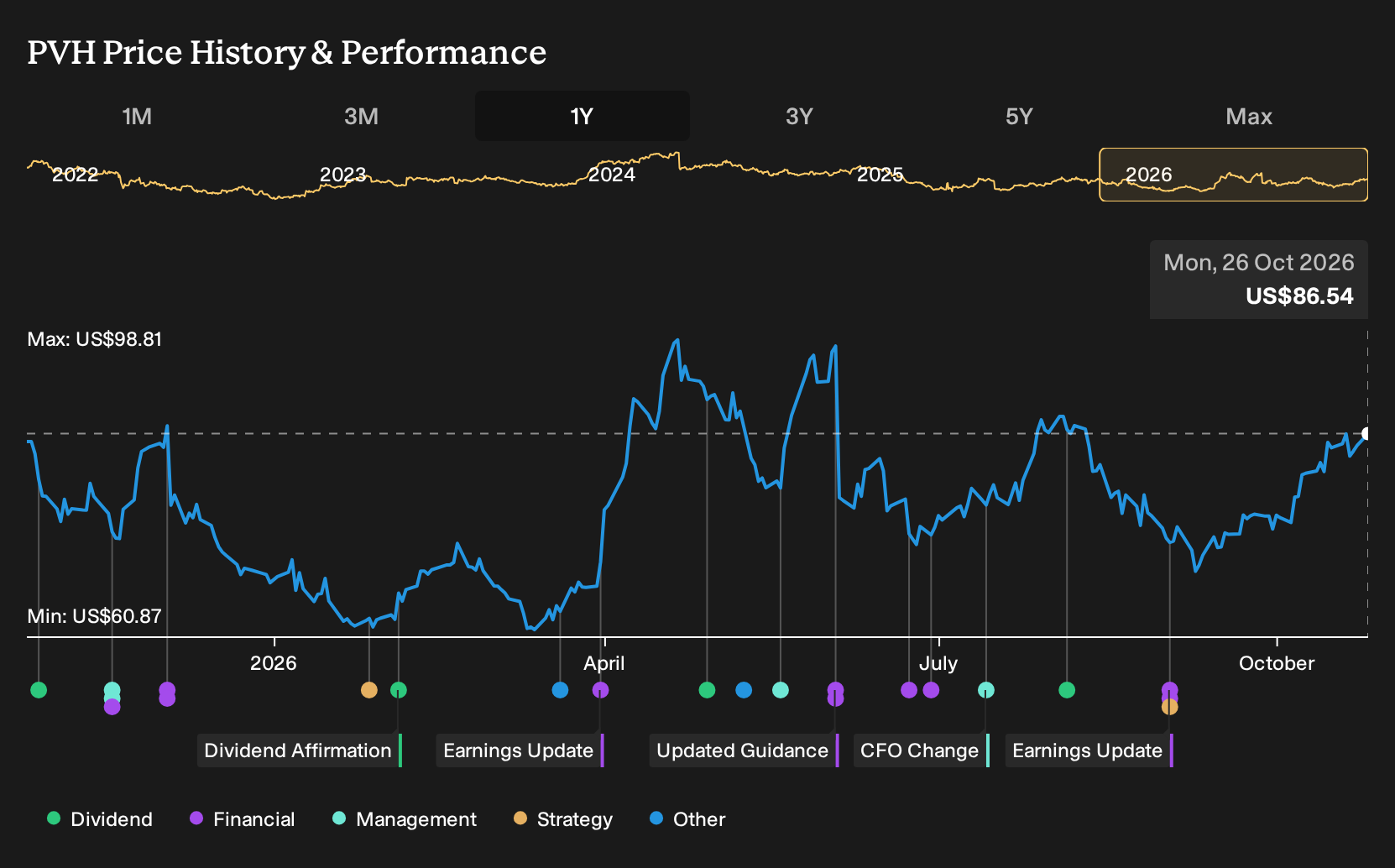
Exploring Other Perspectives
Some of the most optimistic PVH analysts were leaning hard on D2C and margin expansion as a catalyst, penciling in roughly US$10.0b of revenue and US$709.8 million of earnings by 2029. You can see how that upbeat story might look different after a 6% wholesale drop, so it is worth comparing several viewpoints before you allocate any capital.
Explore 2 other PVH fair value estimates, including one that suggests as much as 87% above the current price!
Form Your Own Verdict
Disagree with existing narratives? Extraordinary investment returns rarely come from following the herd, so consider your own analysis carefully.
- A great starting point for your PVH research is our analysis highlighting 3 key rewards that could impact your investment decision.
- See our latest analysis for PVH. The report includes a fundamental analysis summarized in a single visual, the Snowflake, making it easier to review PVH's overall financial health at a glance.
Looking For More Ideas Beyond PVH?
PVH may be your starting point, but your portfolio will likely benefit from a wider bench of opportunities across different business models, balance sheets and income profiles. Use the Simply Wall St Screener to line up a few contrasting candidates and see how they stack up on quality, value and resilience.
- If you want low volatility to sit alongside PVH, start with a group of companies that historically score well on risk metrics and financial robustness by scanning 30 resilient stocks with low risk scores.
- For investors who care most about business strength and staying power, focus on companies with cleaner leverage profiles and healthier fundamentals through our list of solid balance sheet and fundamentals (24 results).
- If income is your priority, round out your watchlist with companies that pair higher yields with an emphasis on sustainability by reviewing a focused set of 5 dividend fortresses.
Have feedback on this article? Concerned about the content? Get in touch with us directly. Alternatively, email editorial-team@simplywallst.com