


EN
Pipeline Filing Might Change The Case For Investing In Chesapeake Utilities Stock (CPK)
- Chesapeake Utilities’ Delaware Division has already filed a Motion to Intervene with FERC in Docket CP26-585-000, seeking a voice in the approval process for Eastern Shore Natural Gas’s Delmarva Regional Enhancement Project, a pipeline expansion that supports the utility’s transportation needs.
- This regulatory move underlines how Chesapeake Utilities ties its long term service reliability and future capacity planning directly to access on key transmission infrastructure.
- We will now examine how Chesapeake Utilities’ move to intervene in the Delmarva Regional Enhancement proceeding could shape the wider investment narrative.
Chesapeake Utilities Investment Narrative Recap
For Chesapeake Utilities, the core belief is simple. You need to think a heavily regulated, project driven utility can keep turning a large capital program into usable pipes, wires and storage that actually earn a fair return. The FERC intervention around the Delmarva Regional Enhancement pipeline fits that story because it targets transportation capacity that underpins existing service, not a new growth bet. On its own, this filing does not look like a major near term catalyst.
The near term swing factor still sits in broader execution on the US$2.2b 2024 to 2028 capital plan and related rate cases, especially in Florida and Delmarva. The biggest risk stays the same. High capex and debt funded buildout could strain cash flows and leave Chesapeake Utilities more exposed if projects face delays, cost pressure or slower regulatory cost recovery, as already seen with the WRU LNG timing.
The FERC motion to intervene is most relevant when you line it up against the wider pipeline of regulated projects that are expected to feed rate base and gross margin in 2026 and 2027. Delmarva Regional Enhancement sits alongside the WRU LNG facility, Accomack County expansion and the US$1.2b Florida Energy Pathway project. All of these depend on clean approvals and timely construction.
For you as a potential or existing shareholder, the question is whether Chesapeake Utilities can keep threading that needle. The business is investing heavily, with 2026 capex guidance lifted to US$550 million to US$600 million. At the same time, earnings forecasts, rate cases and cost discipline need to keep pace. Each regulatory win, including this intervention, slightly improves visibility. Execution missteps or policy shifts toward faster electrification remain the pressure points.
Chesapeake Utilities' current analyst framework points to revenue of US$1.2b and earnings of US$210.0 million by 2029. That setup assumes yearly top line growth of 5.6% and an earnings increase of about US$59.8 million from US$150.2 million today.
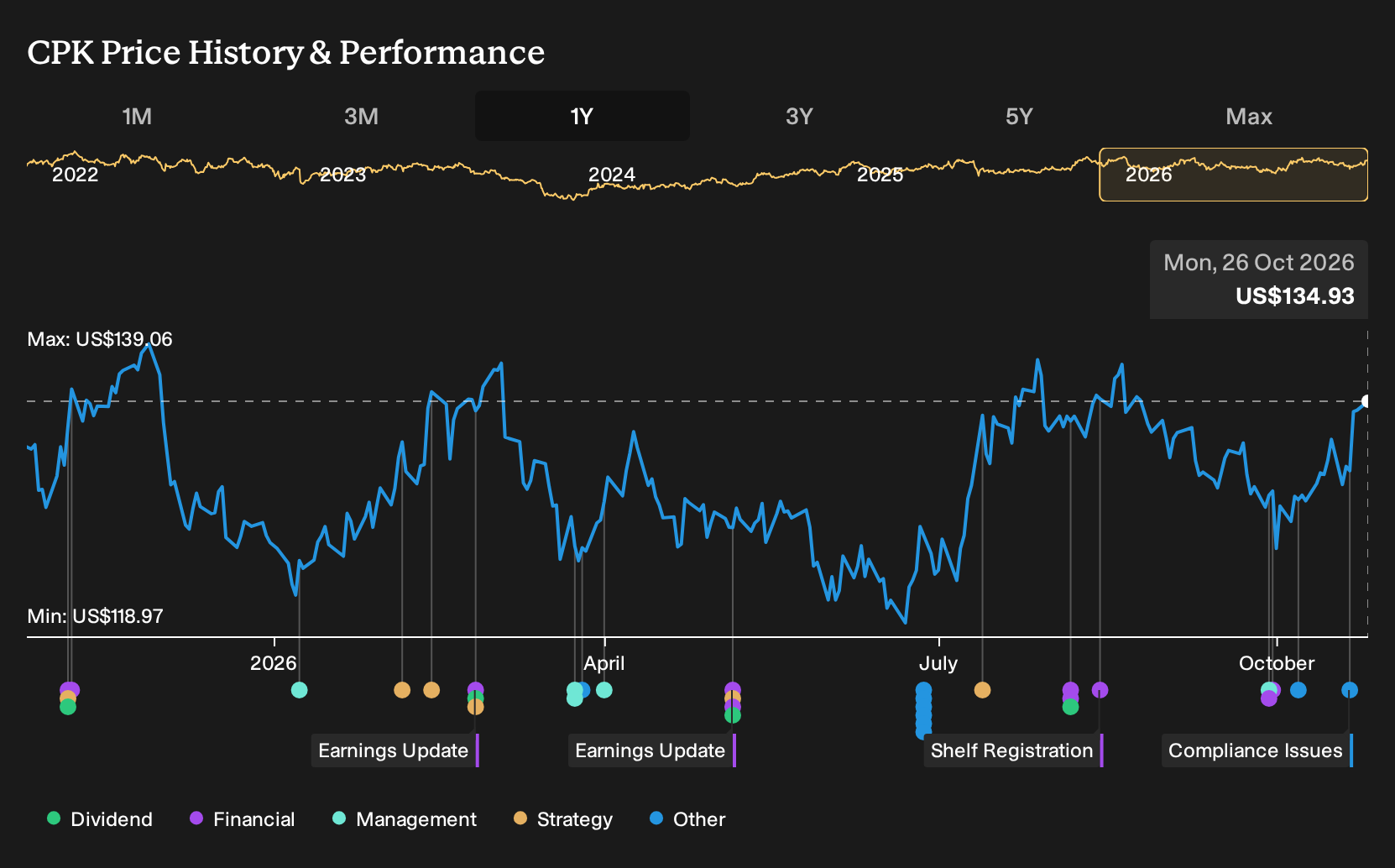
Uncover how Chesapeake Utilities' fair value indicates a 10% potential upside to its current price while the discount still appears open to being closed.
Reach Your Own Conclusion
Don't just follow the ticker. Dig into the data and build a conviction that's truly your own.
- A great starting point for your Chesapeake Utilities research is our analysis highlighting 2 key rewards and 2 important warning signs that could impact your investment decision.
- See our latest analysis for Chesapeake Utilities. The report includes a comprehensive fundamental analysis summarized in a single visual, the Snowflake, making it easy to evaluate Chesapeake Utilities' overall financial health at a glance.
Looking for more Chesapeake Utilities style ideas?
If you want to put Chesapeake Utilities in context, it helps to line it up against other companies with clear balance sheets, different return profiles and varying levels of risk.
- For investors hunting for resilience first and upside second, start with a 30 resilient stocks with low risk scores that keeps volatility in check while still giving you room to put capital to work.
- If income is a priority, look at companies offering stronger yield profiles by scanning a 5 dividend fortresses that focuses on higher payout potential.
- To round out your watchlist with compelling fundamentals, broaden your scope using a 21 high quality undiscovered gems that highlights quality that is not yet crowded with attention.
Have feedback on this article? Concerned about the content? Get in touch with us directly. Alternatively, email editorial-team@simplywallst.com