


EN
Microsoft (MSFT.US) offered a voluntary buyout to approximately 60,000 employees: covering more than a quarter of the global workforce, reducing costs to make room for AI capital expenses
The Zhitong Finance App learned that Microsoft (MSFT.US) said on Monday that it will open a voluntary separation compensation plan to about 60,000 employees to reduce costs, reshape personnel structures, and adapt to the business layout in the artificial intelligence (AI) era.
A Microsoft spokesperson said that some employees in the US, Canada, India, and the UK can participate in this program, and the maximum rank level is vice president and below. That number is more than a quarter of its total global workforce.
People familiar with the matter revealed that Xbox, Windows, Copilot, finance and other departments are all included in this plan; some positions related to data centers, sales, marketing, cybersecurity, and quantum computing are not within the scope of application. Microsoft declined to comment on these details.
Chief Personnel Officer Amy Coleman said in a memo sent to employees on Monday: “For eligible employees who are already considering leaving the company and starting a new career path, this plan provides a new option, allowing everyone to make a smooth transition with supporting support.” The spokesperson added that participating employees can receive benefits in accordance with the standard severance plan.
As the world's largest software manufacturer, Microsoft has reduced its workforce size through multiple rounds of layoffs in recent years. In July of this year, Microsoft launched a voluntary separation plan for employees nearing retirement. Out of about 8,750 eligible employees, more than 30% chose to accept it. A Microsoft spokesperson predicted that the acceptance rate for this round of voluntary separation programs will be far lower than previous voluntary retirement programs.
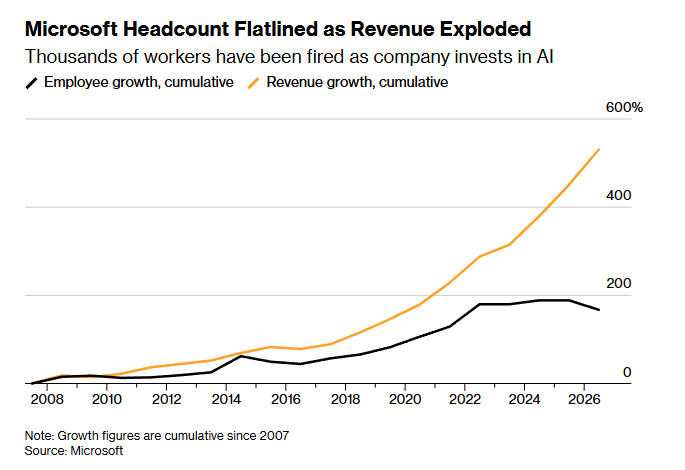
By the end of June, the total number of Microsoft employees was 223,000. Since 2022, that number has remained flat, and around 2022 is when Microsoft began investing heavily in AI and data centers — this squeezed budgets and prompted the company to tighten recruitment in other areas.
The company is scheduled to announce first-quarter results after the US stock market on Wednesday EST, and has predicted that capital expenditure for the 2026 calendar year will reach 175 billion US dollars. Investors will keep an eye out for signs that their massive investment in AI is paying off.
As capital continues to lean towards AI infrastructure, many tech companies are also streamlining personnel. According to reports, Google (GOOGL.US) launched voluntary termination plans in several business units last year; Meta (META.US) reduced the number of employees by more than 20,000 compared to its peak at the end of 2022, and the two companies are also major investors in data center infrastructure.
A Microsoft spokesperson said the company wants to retain employees who are willing to tackle core problems. This statement is consistent with that of other tech giants: if you want to stay in office, you must adapt to a faster pace of work and continuous change.
According to reports, Elon Musk gave Twitter employees two similar choices in 2022: either work extremely hard or get a severance pay to leave. Earlier this year, it was reported that a Google executive told employees in his department that employees who are unable to fully invest in the AI business can apply for voluntary termination compensation.
When deciding whether to accept a voluntary separation plan, employees usually evaluate their savings and the risk of being forced to be laid off in the future; middle-aged workers also consider the job market environment, re-employment cycle, or whether this compensation can support their career transformation. Voluntary termination programs are generally aimed at more experienced employees with higher labor costs (Microsoft's previous early retirement plan was also the same), and compensation conditions are usually superior to passive layoffs.
The spokesperson also mentioned that if core talents apply to leave their jobs voluntarily, Microsoft will try to retain them depending on the circumstances.
Coleman wrote in the memo that the buyout program provided Microsoft departments with “another way to adapt the workforce to changing needs.”