


EN
3 US Dividend Stocks To Watch As Inflation Tests Income Investors
Inflation at 3.7%, louder talk of extra Fed rate hikes, and rising political pressure on the central bank are pulling income focused investors in two directions at once. Cash suddenly feels safer, yet inflation risk keeps eroding idle money. This article looks at three large cap value and dividend stocks exposed to these crosscurrents and explains how their current profiles might appeal to, or concern, investors watching today’s macro backdrop.
The three stocks below are only a sample of what fits this income and value brief, and the full filter on Simply Wall St surfaced 14 more large caps with similar cash return profiles and balance sheet characteristics that are not covered here.
If you want to identify stronger matches for your own watchlist and analyze how they stack up on yield, payout and valuation, head straight to the US Large-Cap Value and Dividend Stocks screener.
Comcast (CMCSA)
Comcast slots into this large cap value and dividend screen as a mature media and telecom group that earns its keep through broadband, content and experiences rather than headline grabbing growth stories. This is exactly why income focused investors pay attention to it during inflation and rate worries.
Comcast is a global media and technology group that earns most of its roughly US$69b in annual turnover from Residential Connectivity & Platforms, with further billions from Business Services Connectivity, media networks, studios and Universal theme parks, and it currently carries a market value near US$80.6b.
"Comcast's ongoing investments in network innovation, including rapid deployment of DOCSIS 4.0, expansion of gig+ broadband speeds across its footprint, and focus on intelligent WiFi and seamless mobile integration, remain aimed at supporting multi-product broadband and wireless bundles. Broadband competition from fiber, fixed wireless and satellite providers is intensifying, with rival fiber build visible across more homes each year and some competitors offering gigabit service at everyday prices as low as US$30 to US$40."
The real swing factor for income investors is how one unresolved pressure on Comcast’s pricing power ultimately feeds through to cash flow resilience.
That pricing pressure debate is exactly what the full narrative for Comcast unpacks, separating short term noise from the longer term cash and capital return story Comcast is building.

Southwest Airlines (LUV)
Southwest Airlines gives this large cap value and dividend screen direct exposure to US air travel, where fare setting and add on services can matter as much as fuel in a period of sticky inflation and higher rate debate.
"Planned introduction of premium and assigned seating, along with basic economy offerings, can enhance revenue yield through differentiated pricing strategies catering to varied consumer preferences, thereby potentially boosting net margins and overall earnings."
The overlooked variable is how one shift in customer mix and loyalty behavior interacts with those new fare tiers to shape margins.
Southwest Airlines is a US based passenger carrier with a US$20.4b market value, earning its roughly US$31.5b in annual revenue almost entirely from its Transportation, Airlines segment across domestic routes and select near international destinations.
That hinge point on customer behavior is exactly what the full narrative for Southwest Airlines unpacks. It reveals where Southwest Airlines loyalty economics could be accelerating or quietly stalling.

FedEx (FDX)
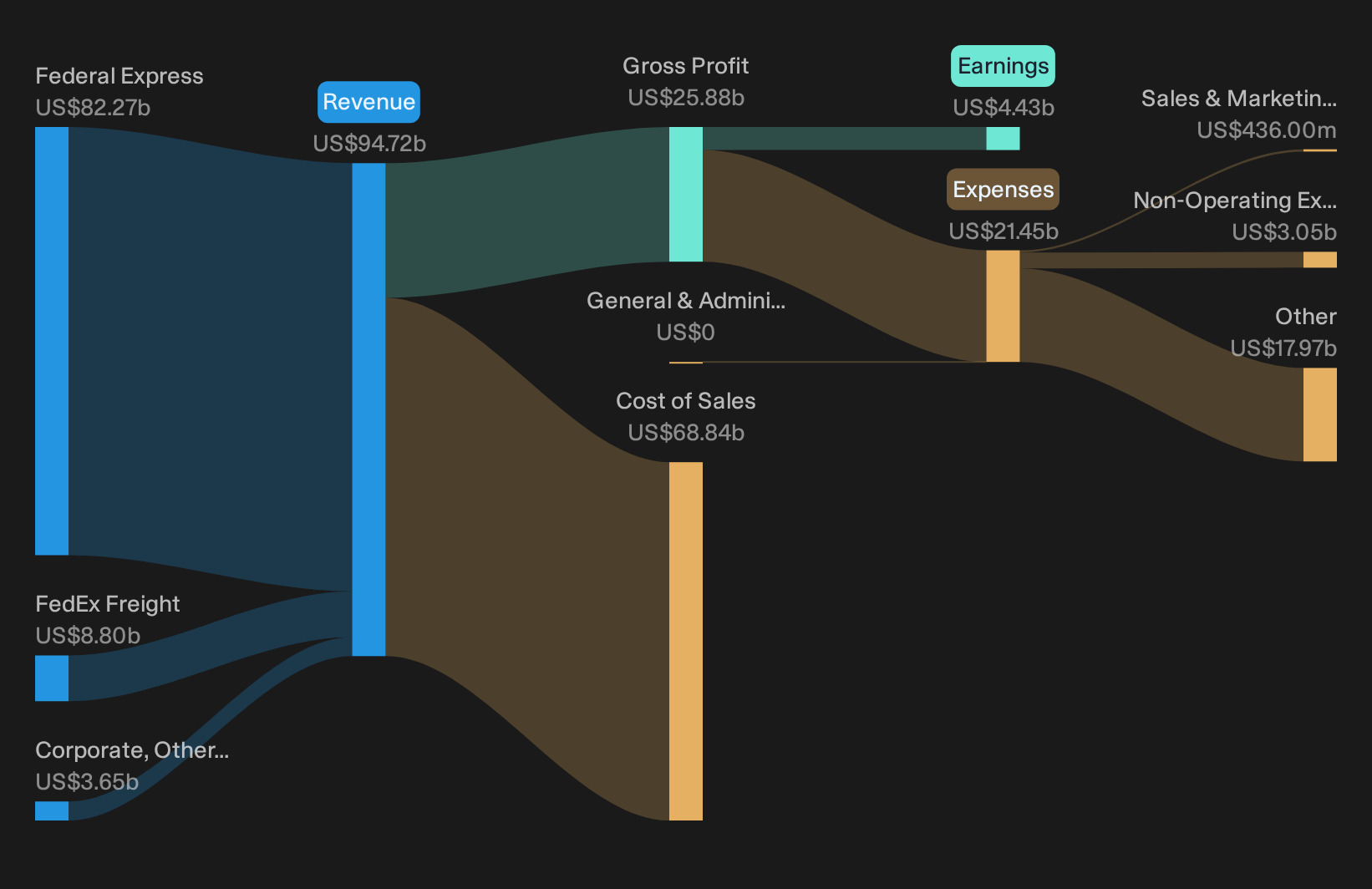
FedEx is the logistics heavyweight in this large cap value and dividend screen, offering investors exposure to global shipping, e commerce services and supply chain management. Most of its roughly US$82.3b in annual revenue comes from Federal Express, with FedEx Freight contributing about US$8.8b, and the stock valued near US$70.7b.
FedEx gives income focused investors a way to link inflation sensitive shipping rates and global trade volumes to a large cap that leans on cost control and cash generation rather than headline growth stories.
"FedEx's DRIVE and Network 2.0 programs continue to reshape the cost base, with billions of dollars already removed and a further US$2b of Network 2.0 savings targeted by the end of 2027, which could support higher net margins and earnings."
What happens to FedEx profitability if one key effort to squeeze more out of each shipment falls short of management’s ambitions?
If that risk-reward balance matters to you, the full narrative for FedEx shows where FedEx efficiency gains could be accelerating, stalling, or quietly decoupling from headline cost targets.
Seeking Fresh Alternatives Before They Fly
New themes gain momentum while older ideas cool off. Fresh opportunities often get caught under the radar for now. Scan these ideas before the crowd moves and consider your approach carefully.
- Spot stronger balance sheets early by running the list of solid balance sheet and fundamentals (24 results) while the market focus is still elsewhere.
- Explore potential AI-related companies by checking the 39 profitable AI stocks that aren't just burning cash to review businesses with established profitability.
- Prepare for possible changes in metal prices by reviewing the 35 elite gold producer stocks while these producers remain under the radar for now.
Have feedback on this article? Concerned about the content? Get in touch with us directly. Alternatively, email editorial-team@simplywallst.com