


EN
Is Nomura Real Estate Master Fund (TSE:3462) Fairly Valued On Full Year Results?
Nomura Real Estate Master Fund (TSE:3462) just put fresh numbers on the table, reporting full year 2026 figures alongside its Q2 2027 earnings call on October 16, 2026.
Despite the fresh results, Nomura Real Estate Master Fund’s 1-year total shareholder return is down 19.25%, with the share price falling 17.55% over 3 months and 25.52% year to date. This points to fading momentum even after a 0.86% 1-day share price gain to ¥128,700.
Scan how Nomura Real Estate Master Fund stacks up against a hand-picked list of solid balance sheet and fundamentals (23 results) as investors reassess listed property plays after these fresh earnings.
For Nomura Real Estate Master Fund, the question is whether the drop in returns reflects cracks in the real estate engine or a reset in investor mood. The valuation work is where that gap starts to show.
Price-to-Earnings of 20.9x: Is it justified for Nomura Real Estate Master Fund?
On simple valuation metrics, Nomura Real Estate Master Fund trades on a P/E of 20.9x, which screens as expensive against both its direct peers and the wider Asian REIT group.
The P/E ratio compares what investors are paying today for each unit of earnings. For a real estate investment trust, it effectively tells you how much the market is willing to pay for the current profit stream from its property portfolio.
For 3462, that 20.9x tag comes with mixed signals. On one side, the SWS DCF model and fair value work suggest the units are trading at a 9.4% discount to an intrinsic value of ¥141,976.39. This implies the market price of ¥128,700 sits below that estimate. On the other side, the same 20.9x earnings multiple is above the estimated fair P/E of 21.4x by only a narrow margin and remains higher than both the peer average of 18.7x and the broader Asian REITs benchmark of 14.7x, so investors are paying a richer multiple than those groups for each yen of earnings today.
Set against that, management has produced earnings growth of 4.4% per year over the past 5 years and the business currently distributes a 5.79% dividend yield, supported by what is assessed as high quality earnings. Profit growth is forecast at 6.1% per year, which is slower than the wider JP market forecast of 9.5%, and returns on equity are described as low at 4.8% with a 5.1% figure expected in three years. The premium P/E compared to the sector therefore suggests the market is comfortable paying more than the sector median for earnings that are not projected to grow faster than the market overall.
Compared with its direct REIT peers, that gap is clear. A 20.9x P/E sits above the 18.7x peer group average and well above the 14.7x Asian REITs average, so the units look expensive relative to sector benchmarks even though they are assessed as good value versus the estimated fair P/E of 21.4x. This is the level the market could eventually lean toward if that relationship holds.
Explore the SWS fair ratio for Nomura Real Estate Master Fund.
Result: Price-to-Earnings of 20.9x (OVERVALUED)
Still, the reliance on a single Japan focused leasing portfolio, along with a 3 year total shareholder return that declined 10.34%, both challenge the premium P/E story.
Find out about the key risks to this Nomura Real Estate Master Fund narrative.
Another View on Nomura Real Estate Master Fund’s Value
The SWS DCF model paints a softer picture than the headline 20.9x P/E. On that framework, Nomura Real Estate Master Fund trades about 9.4% below an estimated fair value of ¥141,976.39, which frames the current ¥128,700 unit price as modestly undervalued rather than stretched.
DCF work leans heavily on long term cash flow assumptions and discount rates. For investors weighing an apparently expensive earnings multiple against a DCF signal that points to value, the real question is which set of assumptions feels more realistic for a single country REIT with muted return on equity.
Look into how the SWS DCF model arrives at its fair value.
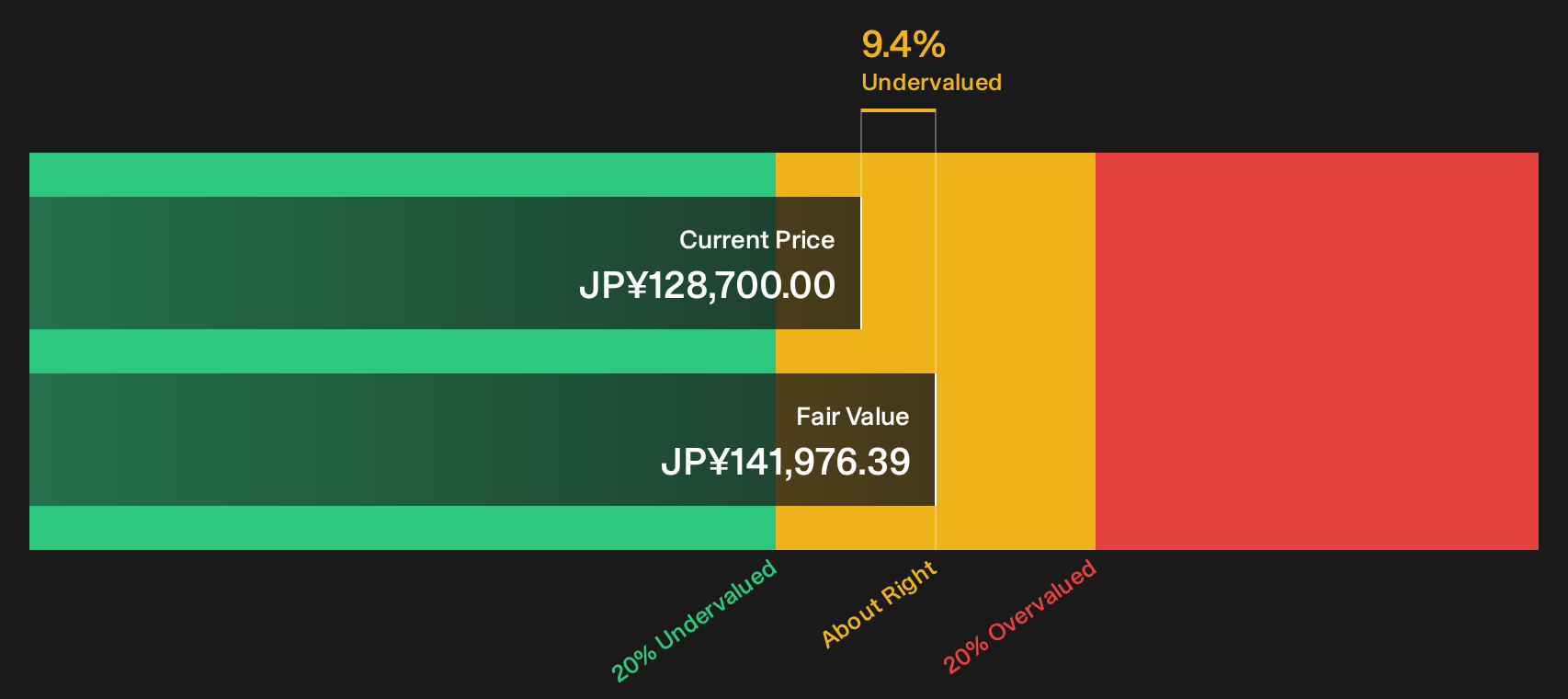
Simply Wall St performs a discounted cash flow (DCF) on every stock in the world every day (check out Nomura Real Estate Master Fund for example). We show the entire calculation in full. You can track the result in your watchlist or portfolio and be alerted when this changes, or use our stock screener to discover 16 high quality undervalued stocks. If you save a screener we even alert you when new companies match - so you never miss a potential opportunity.
Next Steps
Mixed signals on Nomura Real Estate Master Fund’s valuation can feel confusing, so move quickly, review the figures yourself and pressure test both sides of the story. To weigh up the full picture of risks and potential upsides, start with the 4 key rewards and 1 important warning sign.
Looking for more investment ideas beyond Nomura Real Estate Master Fund?
If Nomura Real Estate Master Fund feels finely balanced on valuation, broaden your watchlist with fresh ideas built from clean balance sheets, income strength, and potential mispricing.
- Target resilience first and stress test your portfolio against shocks by using a focused 22 resilient stocks with low risk scores that filters for sturdier businesses when conditions turn.
- Hunt for mispriced quality and compare Nomura Real Estate Master Fund with a curated 16 high quality undervalued stocks set that screens for solid fundamentals at marked down valuations.
- Lock in income potential by scanning a 29 dividend fortresses that highlights yield focused opportunities you might overlook if you only watch headline stories.
Have feedback on this article? Concerned about the content? Get in touch with us directly. Alternatively, email editorial-team@simplywallst.com