


EN
Earnings Beat Might Change The Case For Investing In Spotify Stock (SPOT)
- Spotify Technology reported third-quarter 2026 revenue of €4.969b and net income of €518m, with premium subscribers reaching 306 million and total monthly active users at 788 million.
- Despite third-quarter net income being lower than a year earlier, Spotify’s nine-month profit rose to €1.784b, while management projected about €5.2b in fourth-quarter revenue and €820m in operating income, which underlines confidence in the current product and monetisation setup.
- Attention now turns to how Spotify Technology’s investment narrative could be influenced by strong third-quarter revenue and the new fourth-quarter guidance.
Scan how Spotify Technology’s latest earnings compare with other media and tech platforms by reviewing the 28 high quality undervalued stocks that combine solid cash flows with robust balance sheets.
Spotify Technology Investment Narrative Recap
To own Spotify Technology, you need to believe the platform can turn its huge user base into higher quality earnings through better pricing, advertising and paid add ons without eroding engagement. The third quarter showed that revenue and users are still growing, although net income for the quarter was lower than a year earlier, which keeps execution under the microscope.
The key near term catalyst is whether higher premium revenue, stronger ad tools and AI features can support margins even as content and compute costs stay heavy. The biggest risk remains that licensing terms, podcast and audiobook economics and extra AI spending compress profitability, in which case this latest quarter does not meaningfully change the underlying concern.
The most relevant recent announcement is Spotify Technology’s fourth quarter 2026 outlook, with management pointing to about €5.2b of revenue and €820m of operating income. That guidance ties directly into the margin story, because it reflects how leaders see the balance between growth investments and near term profitability.
For you as an investor, this forecast becomes a clear checkpoint on the catalysts already in play. It gives a concrete reference for how the rebuilt ad stack, AI driven personalization and higher ARPU products such as Audiobooks+ are flowing into operating income, while also highlighting the risk that extra AI expense or content costs could still weigh on earnings if execution slips.
Spotify Technology Forecasts and Valuation Checkpoint
Analysts are effectively asking you to picture Spotify Technology as a much larger business by the back half of this decade, with expectations anchored on both higher revenue and higher earnings rather than just more users. The story hinges on whether the current mix of premium subscriptions, advertising tools and add on products can support that scale without eroding profitability.
On the top line, the consensus view assumes Spotify Technology can lift revenue by 13.6% a year over the next three years. That is a relatively brisk pace for a platform already serving hundreds of millions of listeners, so it sets a high bar for continued product adoption, pricing power and ad demand.
Profitability expectations are more muted. Analysts see margins stepping down from 18.4% today to 16.0% in three years. That implies the market is already baking in heavier spend on AI features, content and marketing, and it leaves less room for error if user monetisation or cost discipline falls short of plan.
On earnings specifically, forecasts point to €3.3b today rising to €4.3b by 2029, an increase of about €1.0b. That earnings bridge is central to the Spotify Technology pitch because it needs to absorb higher AI related expense and content payments while still delivering the profit scale implied in the current valuation.
Analysts also assume only a small reduction in share count, with expectations that outstanding shares decline by about 0.24% per year for the next three years. That helps at the margin for earnings per share, but most of the heavy lifting in this scenario still comes from operating performance rather than financial engineering.
Valuation expectations then stack on top of these operating assumptions. To line up with the consensus price targets, you would need to be comfortable with Spotify Technology generating about €26.6b of revenue and €4.3b of earnings in 2029. On those numbers, the shares would trade around 32.9x earnings, compared with 29.3x today and above the 22.2x P/E cited for the wider US Entertainment sector.
That prospective multiple effectively prices Spotify Technology as a higher quality or faster compounding business than the sector average. For an investor, the key question becomes whether the mix of revenue growth, margin profile and capital allocation outlined above is enough to justify paying a premium P/E over time.
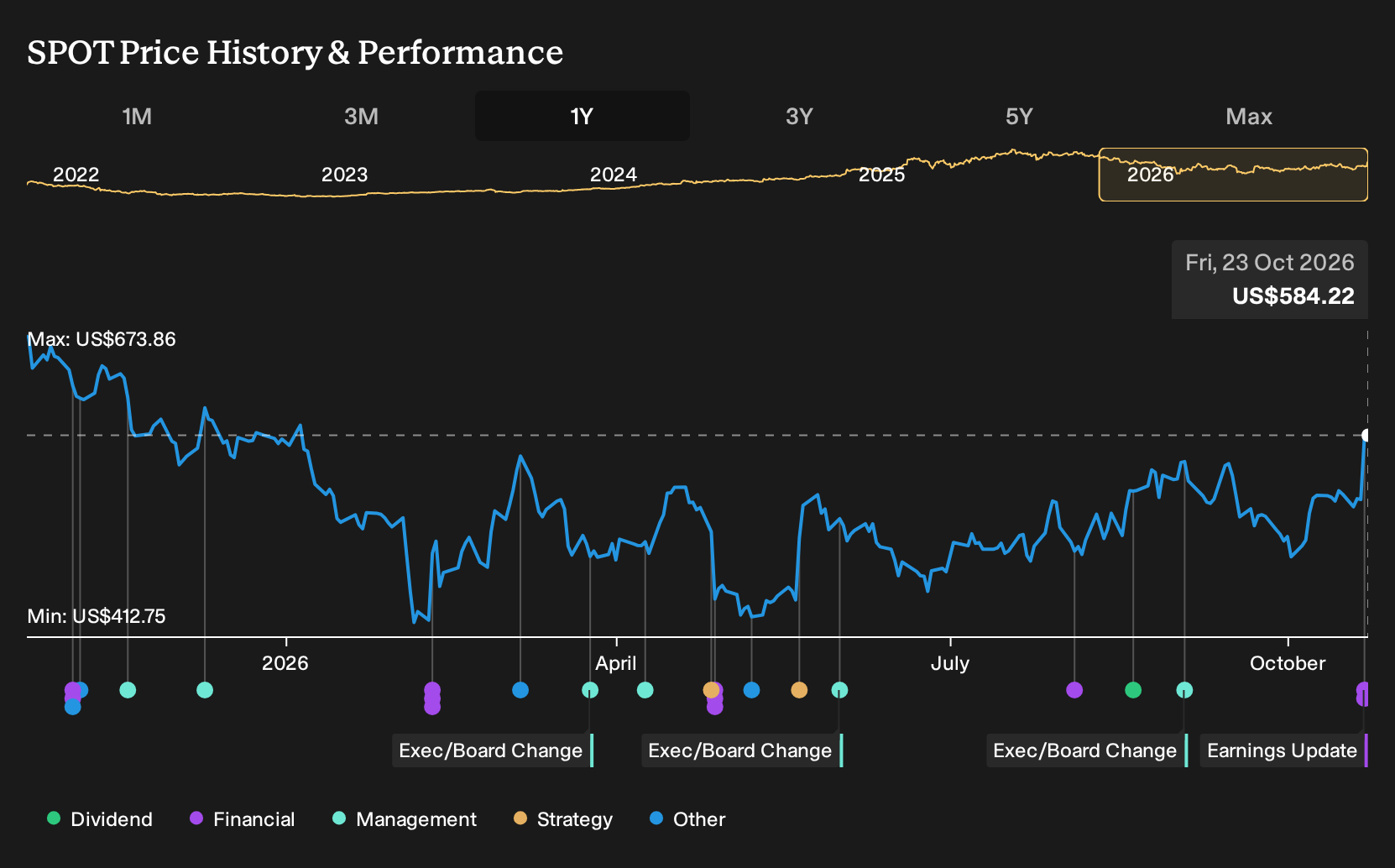
Against a current share price of $533.37, the consensus target of $596.58 implies upside of about 10.6% based on analyst models. There is still a wide spread between the most bullish target at $701.26 and the most cautious at $408.89, which underlines how differently the market can interpret the same user metrics, margin guidance and AI investment plan.
Spotify Technology's narrative projects €26.6b revenue and €4.3b earnings by 2029. This scenario assumes 13.6% yearly revenue growth and an earnings increase of about €1.0b from €3.3b today.
Uncover why Spotify Technology's fair value is essentially aligned with its current price.
Exploring Other Perspectives
One bullish twist in the Spotify Technology story is how much weight some analysts put on AI features and Audiobooks+ as future earnings drivers. Before this earnings release, the most optimistic forecasts were built around revenue reaching about €28.9b and earnings of roughly €5.0b by 2029. Those projections have not yet absorbed the latest numbers, so you may see those optimistic narratives, and the more cautious €26.6b and €4.3b consensus path, shift meaningfully as analysts revisit their AI and add on assumptions.
Explore 8 other Spotify Technology fair value estimates, including one that suggests up to 14% upside from the current price.
The Verdict Is Yours
Don't just follow the ticker. Dig into the data and build a conviction that's truly your own.
- A great starting point for your Spotify Technology research is our analysis highlighting 3 key rewards and 1 important warning sign that could impact your investment decision.
- See our latest analysis for Spotify Technology. The report includes a comprehensive fundamental analysis summarized in a single visual, the Snowflake, making it easy to evaluate Spotify Technology's overall financial health at a glance.
Looking for more investment ideas beyond Spotify Technology?
Once you have a view on Spotify Technology, it can help to cross check that thinking against other opportunities that share similar financial traits or risk profiles.
- If you care most about valuation support and balance sheet strength, scan a 28 high quality undervalued stocks that pairs healthier cash flows with pricing that some investors may see as more conservative.
- For a focus on resilience and lower volatility, check out a 30 resilient stocks with low risk scores that screens for businesses with sturdier financial profiles and fewer red flags.
- To broaden your watchlist with less crowded ideas, review a 21 high quality undiscovered gems that highlights companies where fundamentals, not headlines, do most of the talking.
Have feedback on this article? Concerned about the content? Get in touch with us directly. Alternatively, email editorial-team@simplywallst.com