


EN
Is JPMorgan Chase (JPM) Undervalued As Bond Issuance And Earnings Strength Meet A Pullback?
JPMorgan Chase (JPM) has been active in the bond market in October 2026, issuing a series of fixed and floating rate notes with maturities extending to 2056 and diversifying its funding mix.
JPMorgan Chase’s recent rush of bond issuance and solid third quarter results comes against a softer tape for the equity, with the share price down 7.2% over the past 90 days but still posting a 1.9% year to date share price gain and an 11.1% one year total shareholder return that sits alongside a very large three year total shareholder return near 16x, suggesting that recent weakness reflects cooling momentum rather than a break in the longer term story that investors have been pricing in.
Spot opportunities that echo JPMorgan Chase’s mix of bond issuance, earnings strength and recent share price consolidation by scanning our curated list of 28 high quality undervalued stocks.Bulls point to JPMorgan Chase’s earnings, bond market demand and long run shareholder returns. Bears focus on the recent pullback. Which side does the current valuation evidence lean toward next?
Most Popular Narrative: 10.5% Undervalued
The most followed valuation story on JPMorgan Chase pegs fair value at $370.39 against a last close of $331.58, which implies investors are pricing in a discount to that narrative view and leaving a valuation gap on the table.
JPMorgan is the best-run large bank in the world, a diversified "fortress balance sheet" spanning consumer, corporate, investment banking and asset management. It is my financial-sector anchor and a source of steady dividends.
Catalysts: net interest income, capital returns (dividends + buybacks), market-share gains in downturns, and scale advantages in technology. It tends to emerge from crises stronger.
See why 16 investors see JPMorgan Chase as 10% undervalued.
According to duarte_EM, this thesis leans on JPMorgan Chase as a diversified banking platform where multiple engines support earnings power rather than a single revenue stream. The view couples those business drivers with a conservative approach to valuation, which matters when markets have already rewarded the stock over several years.
The narrative anchors on roughly mid single digit to high single digit yearly earnings growth and a modest P/E range to frame what a reasonable valuation might look like for a large bank. On that basis, the fair value estimate of $370.39 suggests the recent share price consolidation has opened a gap relative to that thesis without requiring aggressive growth assumptions.
For investors weighing the latest bond issuance and recent share price pullback against this story, the key question is whether JPMorgan Chase continues to justify being treated as a high quality compounder within the banking sector rather than a more cyclical trade. The current narrative driven fair value signals some headroom to that view while still treating the stock as a mature financial institution.
Result: Fair Value of $370.39 (UNDERVALUED)
Still, a deeper credit downturn or heavier regulatory pressure on large banks could challenge JPMorgan Chase’s earnings power and narrow the valuation gap described in this narrative.
Find out about the key risks to this JPMorgan Chase narrative.
Another View: JPMorgan Chase Through The P/E Lens
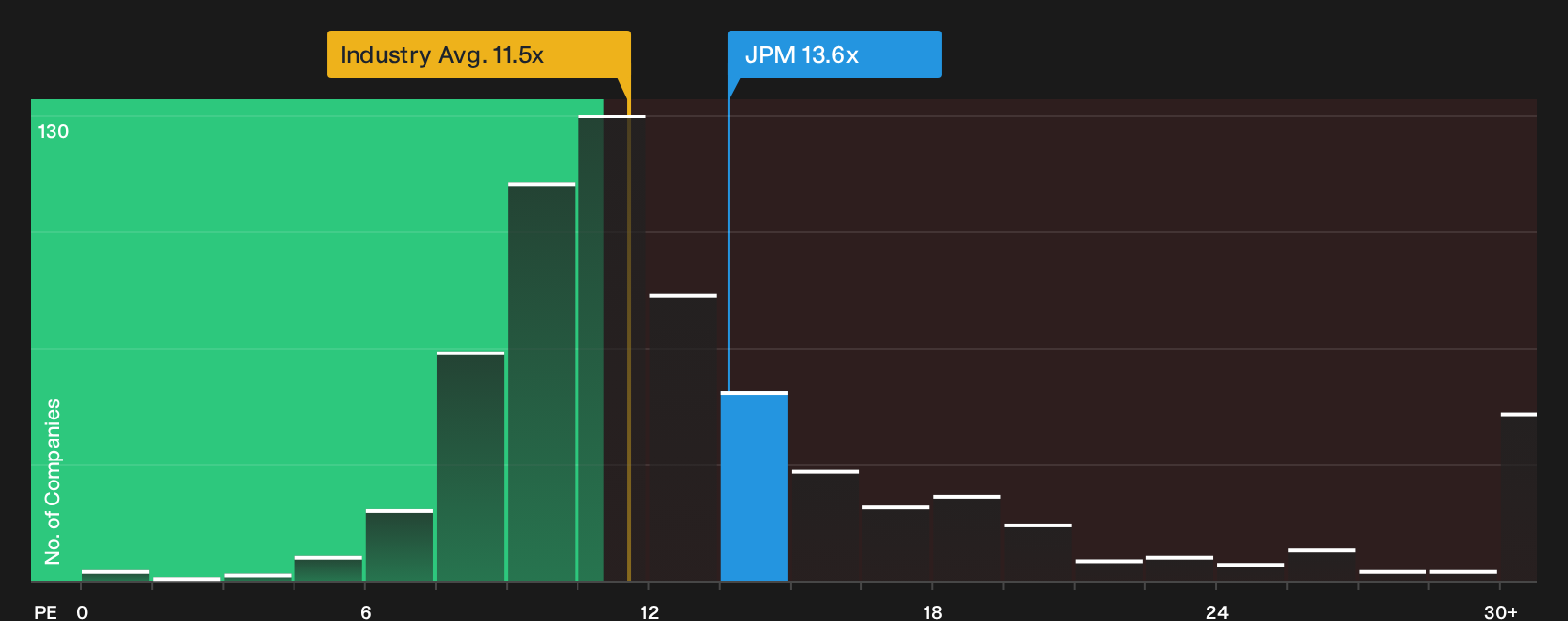
The story looks different when you switch from narrative fair value to the P/E ratio. At 13.6x earnings, JPMorgan Chase trades richer than the US banks peer group on 11.4x, yet sits close to a fair ratio of 13.9x. Is that a small premium for quality or a tight margin for error?
That is where a closer look at the valuation breakdown helps most investors separate comfort from complacency and see what the numbers imply for future upside or downside at today’s price. See what the numbers say about this price — find out in our valuation breakdown.
Next Steps
Mixed signals on JPMorgan Chase often make the loudest headlines, which is why you are better off going straight to the source data and weighing both sides for yourself. To see how that balance of concerns and bright spots stacks up in one place, review the 3 key rewards and 1 important warning sign
Looking for more investment ideas beyond JPMorgan Chase?
If you stop with JPMorgan Chase, you risk missing other opportunities that fit your style. Consider a few alternatives before the market moves.
- Target reliable income by scanning companies that show up in our 5 dividend fortresses. Review which payouts may better match your goals.
- Hunt for resilient balance sheets with the list of solid balance sheet and fundamentals (24 results). This can help you focus on businesses that may better handle tougher conditions.
- Spot potential future leaders early through the 21 high quality undiscovered gems. This can help you avoid hearing about them only after the crowd has moved in.
Have feedback on this article? Concerned about the content? Get in touch with us directly. Alternatively, email editorial-team@simplywallst.com