


EN
How Workforce Training Could Impact Campbell's Stock
- Per Scholas and The Campbell's Company have already launched an Advanced Manufacturing Technician training program in Greater Milwaukee, backed by a US$500,000 Campbell's investment to support a 15 week, 400+ hour curriculum for 25 learners.
- The partnership gives Campbell's a structured way to build a pipeline of technicians with skills tailored to its high speed production lines and modern plant requirements, at a time when the sector faces projected demand for 1.9 million additional manufacturing workers by 2033.
- We will look at how Campbell's long term investment narrative is shaped by this targeted manufacturing talent program in Milwaukee.
Scan beyond Campbell's and this Milwaukee training push to see which manufacturers on our curated list are also investing in hard to automate skills and infrastructure through the 30 resilient stocks with low risk scores.
Campbell's Investment Narrative Recap
To own Campbell's you need to believe a relatively stable packaged foods business can lift earnings through mix, pricing, and its US$500 million savings program, despite muted top line growth. The Milwaukee training news sits to the side of the near term story, which still revolves around snacks volume pressure, cost inflation, and productivity execution.
The key near term swing factor is whether cost actions and portfolio focus offset weaker snacks consumption without further margin strain. The biggest risk remains stubborn input and logistics costs or disruption from restructuring. The Per Scholas partnership looks operationally helpful over time, but not a material near term catalyst.
With no other fresh announcements around this news, the most relevant reference point is still management's expanded enterprise wide savings program through fiscal 2030. That initiative targets procurement, headcount and network optimisation across virtually every cost line, at the same time Campbell's is contending with high single digit inflation in materials and elevated logistics costs.
The Milwaukee technician pipeline supports that effort by aiming to sustain plant uptime and reduce operational friction on high speed lines. Execution risk sits in the background. Heavy dependence on restructuring, workforce changes and network adjustments increases the chance that short term disruption or extra charges erode the benefit, which you need to factor into any view on catalysts from here.
What The Campbell's Consensus Is Really Pricing In
Campbell's narrative projects US$9.6b revenue and US$594.6m earnings by 2029. This implies essentially flat top line over the next few years and an earnings increase of about US$196.6m from current earnings of US$398.0m.
Analysts are not baking in a revenue surge for Campbell's. The expectation is for sales to stay broadly steady while profit margins move from 4.1% today to 6.2% in three years as the cost program, mix decisions and pricing work through the system.
The earnings bridge matters more than the sales line. Consensus points to profit of US$594.6m by 2029 compared with US$398.0m today, which is roughly a 1.5x step up in absolute earnings even as the top line stays close to current levels.
That story rests on the idea that a relatively unchanged revenue base can carry more profit as procurement changes, workforce reductions and network decisions take hold. It also assumes the share count stays flat, so any earnings uplift feeds directly into earnings per share rather than being diluted.
On these figures, the current analyst framework has Campbell's trading on a P/E of 13x those 2029 earnings, versus 14.7x on earnings today and 17.9x for the wider US food peer group. The implied discount suggests analysts see the stock as broadly fair value on a cautious set of profit assumptions rather than on aggressive growth hopes.
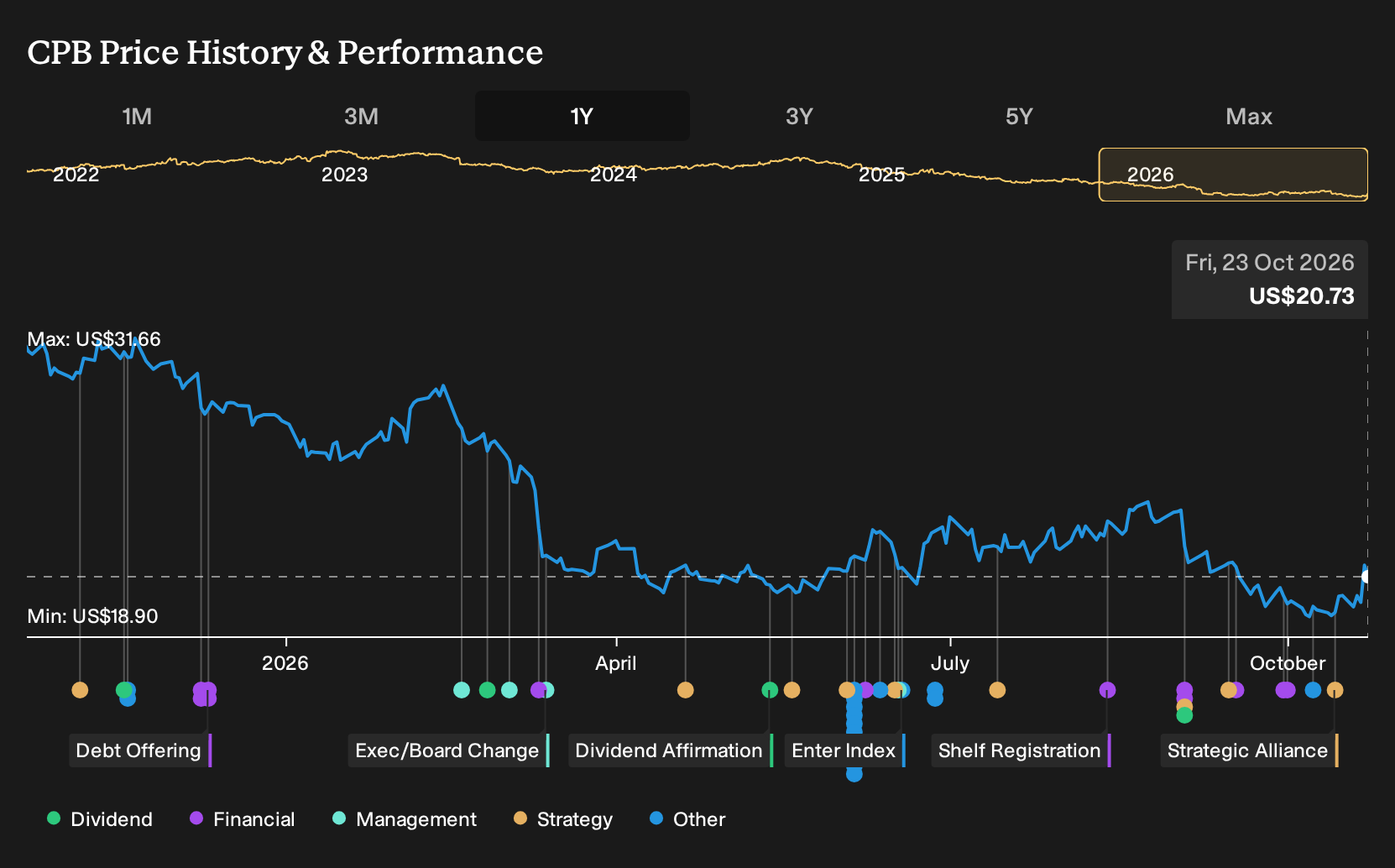
The consensus price target sits at US$20.79 versus a current share price of US$19.62, only 5.6% higher. That narrow gap indicates the median view already embeds the flat revenue profile, the margin lift and the execution risks around the US$500m savings plan.
Uncover why Campbell's fair value is essentially aligned with its current price.
Exploring Other Perspectives
Some bullish analysts think the bigger swing factor for Campbell's is not cost cuts but whether branded demand really accelerates. Before this Milwaukee training news, the most optimistic camp was pencilling in US$10.5b of revenue and US$798.5m of earnings by 2029. Those expectations are far above the cautious baseline and could shift as talent investments like this one start to be reflected in fresh research. Use that gap as a prompt to compare several viewpoints rather than anchoring on a single forecast.
Explore 4 other Campbell's fair value estimates, including one that suggests as much as 101% upside from the current price.
Reach Your Own Conclusion
Don't just follow the ticker. Dig into the data and build a conviction that's truly your own.
- A great starting point for your Campbell's research is our analysis highlighting 2 key rewards and 4 important warning signs that could impact your investment decision.
- See our latest analysis for Campbell's. The report includes a comprehensive fundamental analysis summarized in a single visual, the Snowflake, making it easy to evaluate Campbell's overall financial health at a glance.
Looking for more investment ideas beyond Campbell's?
If you want to put Campbell's in context, it helps to line it up against other businesses with different risk profiles, balance sheets, and income streams. The Simply Wall St Screener can help you quickly sort through opportunities that match the kind of portfolio you are trying to build.
- If capital preservation sits high on your list, start by scanning a curated 30 resilient stocks with low risk scores that tend to show steadier risk profiles than the broader market.
- For investors hunting for potential mispricing, filter for companies on our 28 high quality undervalued stocks where fundamentals and current prices look out of sync.
- If cash income is a priority, focus your research on the 5 dividend fortresses that currently offer yields above 5% and may suit an income focused approach.
Have feedback on this article? Concerned about the content? Get in touch with us directly. Alternatively, email editorial-team@simplywallst.com