


EN
AI financing concerns loom over US stock cloud giants' earnings reports as a key test
The Zhitong Finance App learned that concerns about artificial intelligence (AI) financing costs continue to heat up and are becoming an obstacle that US stocks must overcome before returning to new highs. Affected by this, bonds have once again become a hedging tool for technology stocks, and the semiconductor sector is close to being oversold; and as the financial reporting week for hyperscale cloud vendors approaches, AI trading is facing a critical test where technology and fundamentals intersect.
The sell-off in tech stocks doesn't mean investors have turned to safe haven. They are rotating positions at full speed, moving to more defensive sectors, and making up for some of the stocks that have fallen the worst in AI trading. At the same time, as financing costs continue to rise, they are also leaving the biggest winners in the AI field. Political uncertainty and geopolitical conflict add even more risk.
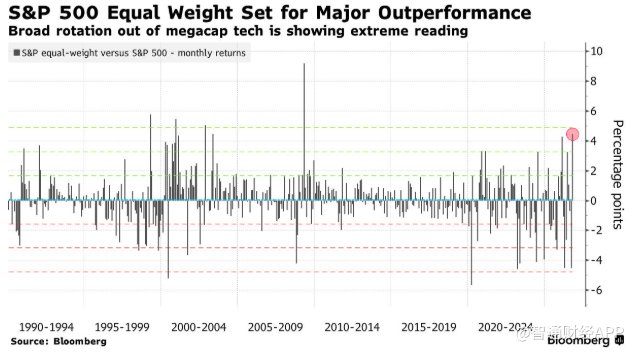
As a result, weighted indices such as the S&P 500 outperformed the market capitalization weighted version this month, and are likely to rank among the biggest monthly gaps in recorded history. This gap is the sixth largest in data dating back to 1990, and deviates from the historical mean by nearly three standard deviations.
Weighted indices such as the S&P 500 performed well
“People are worried about everything”
A team of Bank of America strategists led by Michael Hartnett said, “We will maintain our risk aversion strategy until mid-November.” They expect bond yields, stocks, and the dollar to continue to fall until the Democratic Party's victory in the midterm elections is priced by the market. Other potential turning points include intervention to curb the sell-off of French bonds, cutting AI capital spending, or peaking debt spreads through increased stock issuance.
These strategists said that if a peace agreement between Russia and Ukraine or the US and Iran pushes oil prices to fall by $10 to $20 per barrel, the market may receive a short-term boost. On the downside, they warned that if interest spreads on hyperscale cloud vendor bonds rise above 200 basis points, investors may be forced to reduce their risk exposure as concerns about shadow banking pressure increase.
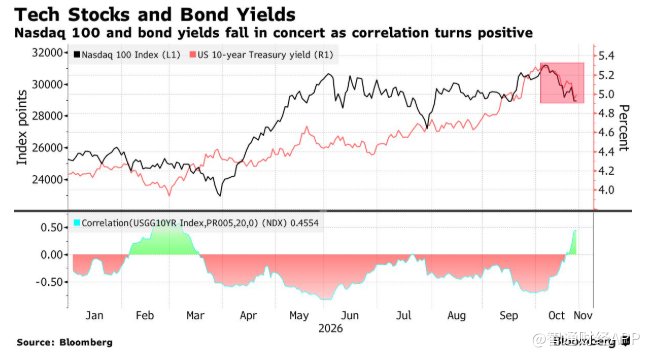
The turmoil among semiconductor and hyperscale cloud vendors is forcing investors to reassess economic growth expectations, which helps explain the decline in US bond yields. In fact, bonds have once again begun to act as a hedge against technology stocks, and the correlation between the Nasdaq 100 Index and 10-year US Treasury yields is particularly prominent. If the market previously faced the plight of high yields, then AI spending concerns are addressing this issue.
The Nasdaq 100 index and bond yields fell simultaneously, and the correlation turned positive
“AI loses, bonds win,” said Chad Privorotsky, chief manager of Goldman Sachs Group's European one-delta deal, adding that the market is artificially cutting capital expenditure, lowering growth expectations, and relieving long-term pressure. “People are worried about everything,” he said. These concerns include “the ability to realise gigawatts of computing power, excess gigawatts of computing power, insufficient capital, insufficient electricity, political influence after the midterm elections, and cybersecurity.”
Semiconductors are close to being oversold, and financial reports are a key test
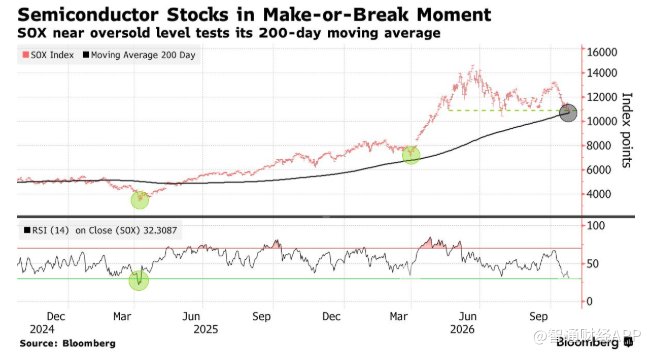
The semiconductor industry is the sector hardest hit in this round of market rotation. The Philadelphia Semiconductor Index is approaching oversold levels and the 200-day moving average. Furthermore, the semiconductor industry's forward price-earnings ratio has fallen to about 17 times, a level that has marked the bottom of this benchmark index twice in the past two years.
The Philadelphia Semiconductor Index is approaching the level of oversold
This round of trends occurred before the financial reports of major hyperscale cloud vendors were released, which indicates that AI transactions will usher in a critical week. The results of Microsoft (MSFT.US), Amazon (AMZN.US), Alphabet (GOOGL.US), and Oracle (ORCL.US) will reveal how quickly they turn backlog orders into revenue, the progress of deployment, and the scale of planned spending. This will be a critical moment where technology and fundamentals meet.
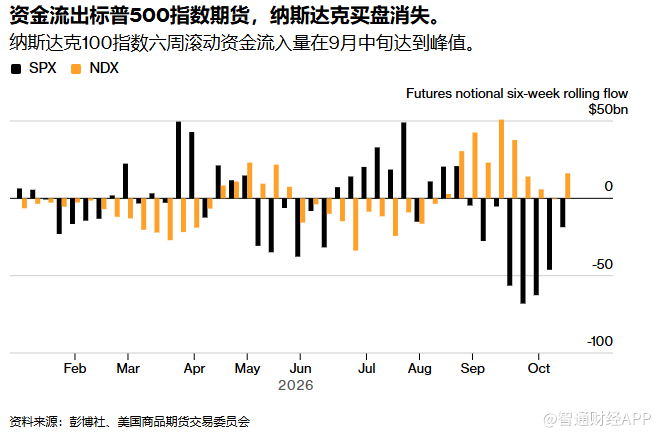
At the same time, traders' positions indicate that market sentiment is not optimistic. According to data from the US Commodity Futures Trading Commission (CFTC), the capital flow of S&P 500 futures is still biased towards selling. The six-week rolling data as of October 20 shows that although the rate of capital outflows has slowed down, they have continued. Buying on NASDAQ futures disappeared around mid-October, and although the six-week rolling data rebounded last week, it did not reflect the sharp fall of last Thursday.
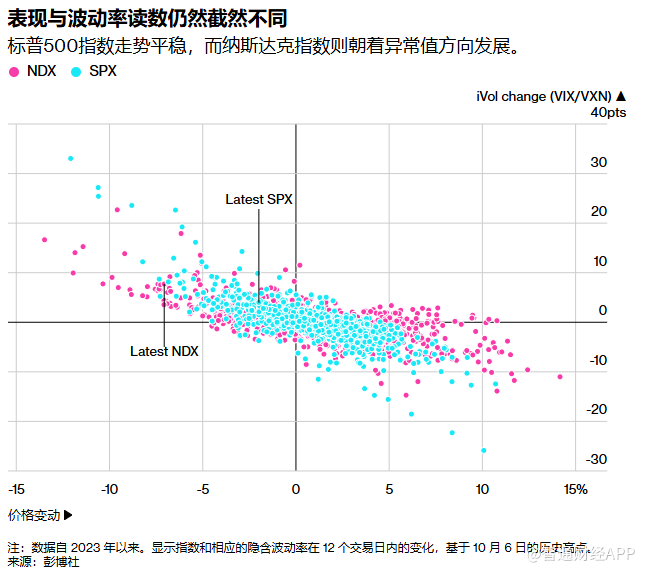
If you want to use a chart to summarize the current market, the picture below is probably the most appropriate one. Since US stocks hit new highs on October 6, the trend of the NASDAQ 100 Index and the S&P 500 Index has fully demonstrated the importance of AI. The former is still within the normal statistical range, while the latter is moving towards the outlier region. This divergence reflects market rotation, depth of retracement, and rising protection costs when investors reposition positions.
“If the monetization process disappoints, capital expenditure and valuation may fall while debt remains, which will hurt economic growth and put pressure on the stock market. This is the main risk scenario,” said a strategist at Oriental Huili Investment Research Institute, led by Monica Defin, adding that profit visibility and a sustainable financing environment will be critical. “The benchmark scenario is that debt can be absorbed rather than broken. Nominal growth remains strong, inflation expectations are stable, credit markets are orderly, and investment remains strong.”