


EN
Could New AI Tools Alter The Investment Case For FIS Stock?
- Fidelity National Information Services has rolled out two major AI products, including the AML Investigations Agent for U.S. banks and the Agentic Insights Suite for CFO teams, aimed at automating financial crime reviews and turning dispersed data into decision-ready intelligence.
- The AML Investigations Agent is built directly on FIS’s core banking and payments infrastructure with full audit trails and institution-specific controls. This ties AI automation tightly to existing compliance workflows and could materially reshape how clients handle regulatory and risk workloads.
- We will look at how Fidelity National Information Services' investment narrative is affected by these AI agents that automate AML investigations.
Scan how Fidelity National Information Services is pushing AI deeper into banking and treasury, then widen your lens to other potential beneficiaries with our hand-picked 55 AI infrastructure stocks
Fidelity National Information Services Investment Narrative Recap
To own Fidelity National Information Services, you need to believe the core banking, payments and capital markets platforms can shift further toward higher margin, recurring software and AI driven workflows, while cutting one time cash costs and improving free cash flow. The near term swing factor is execution on that simplification and debt paydown plan, against a backdrop where earnings are expected to decline over the next three years.
The biggest risk is that large banks and financial institutions reassess vendors in favor of digital native fintech competitors, which could slow new deals and renewal economics. Persistent execution issues, particularly in Capital Markets and professional services, would make it harder for Fidelity National Information Services to translate AI buzz into steadier revenue and margins.
The AML Investigations Agent is the clearest link between the current AI story and the existing Banking Solutions infrastructure. It runs in FIS’s private cloud, sits directly on the firm’s core banking platforms and keeps each institution’s risk rules isolated through the FIS Control Plane, so banks can plug it into today’s compliance processes rather than ripping out existing systems.
For catalysts, this product matters because it is already being deployed at Amalgamated Bank and is available to any U.S. bank using FIS infrastructure. This directly ties into the earlier narrative about a 500 opportunity pipeline and AI products already live at 200 customers. The operational test now is simple execution, scaling deployments while maintaining explainability, audit trails and regulator friendly controls.
Analyst Expectations Behind Fidelity National Information Services' AI Push
Fidelity National Information Services' narrative projects US$15.1b in revenue and US$2.1b in earnings by 2029. This is based on analysts assuming 7.4% yearly revenue growth and an earnings decline of US$1.3b from US$3.4b today.
Uncover how Fidelity National Information Services' fair value indicates a 29% potential upside to its current price, a discount that may not last long if AI execution continues to gain traction.
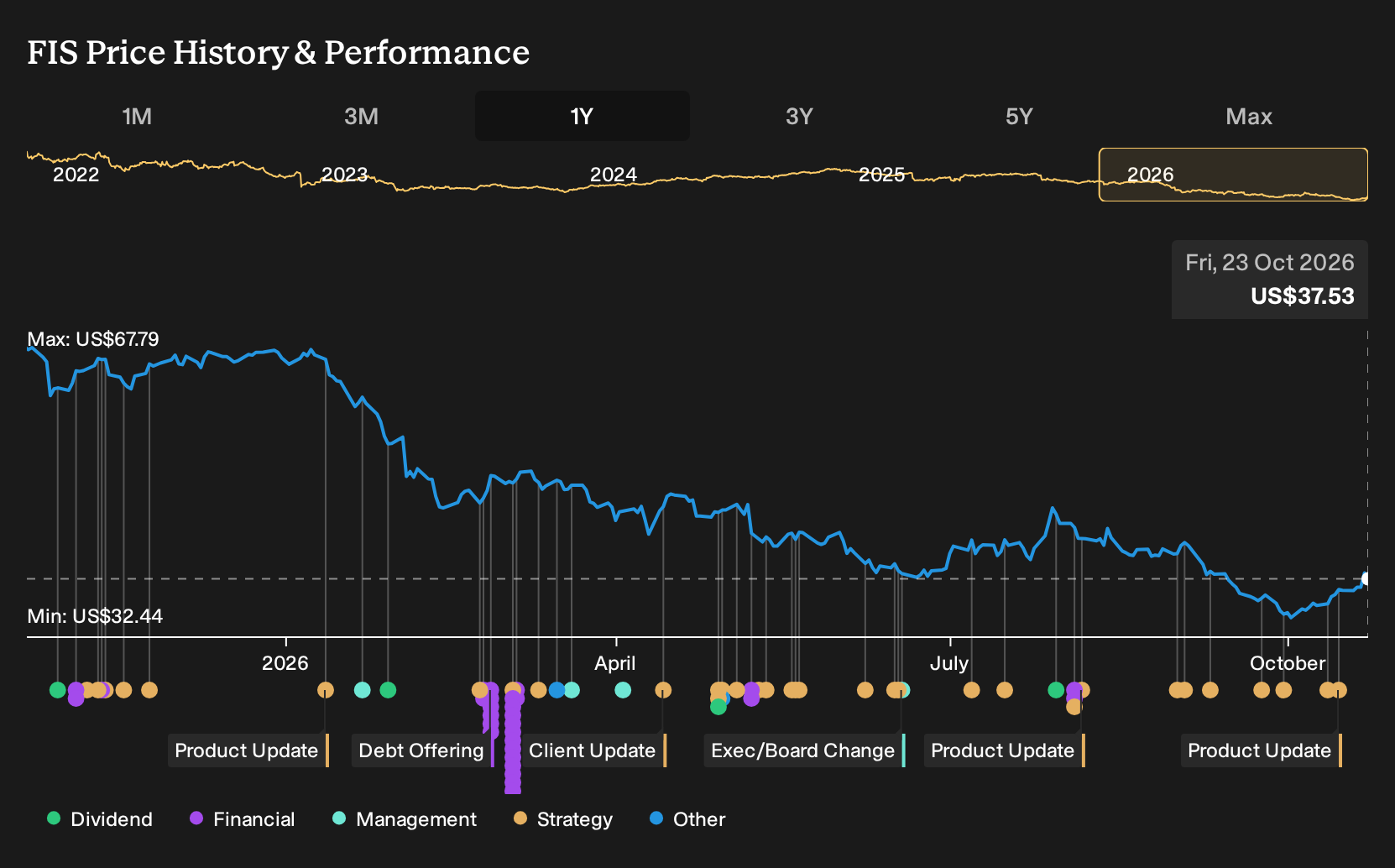
Exploring Other Perspectives
One alternate view focuses on margin pressure rather than AI upside. The most cautious analysts expected Fidelity National Information Services to generate about US$14.9b of revenue and US$1.6b of earnings by 2029, with profit margins at 10.6%. Those forecasts came before this AML agent launch, so you may see opinions shift as assumptions get revisited.
Explore 2 other Fidelity National Information Services fair value estimates, including one that suggests it could be worth just $48.25!
Decide For Yourself
Disagree with existing narratives? Extraordinary investment returns rarely come from following the herd, so consider your own analysis and judgment.
- A great starting point for your Fidelity National Information Services research is our analysis highlighting 3 key rewards and 3 important warning signs that could impact your investment decision.
- See our latest analysis for Fidelity National Information Services. The report includes a comprehensive fundamental analysis summarized in a single visual, the Snowflake, making it easy to evaluate Fidelity National Information Services' overall financial health at a glance.
Looking For More Investment Ideas Beyond Fidelity National Information Services?
If the Fidelity National Information Services story has sharpened your thinking about where AI and financial infrastructure intersect, it can help to line that up against other opportunities with different risk and income profiles. The Simply Wall St Screener lets you quickly filter for specific traits so you are not just reacting to headlines but building a watchlist that suits your own approach.
- Prefer resilience and lower volatility over fast swings, and want a shortlist that reflects that? Start with a group of 30 resilient stocks with low risk scores that tend to hold up better when conditions get choppy.
- Looking for companies where the balance sheet does more of the heavy lifting, with cash and debt profiles that support business reinvestment? Filter for a list of solid balance sheet and fundamentals (24 results) to see which candidates meet that standard.
- Interested in finding underfollowed opportunities where the story has not yet gone mainstream? Run a search across 21 high quality undiscovered gems and see which ones might deserve a place on your radar.
Have feedback on this article? Concerned about the content? Get in touch with us directly. Alternatively, email editorial-team@simplywallst.com