


EN
Should Strong Q3 Earnings Require Action From Saab (OM:SAAB B) Investors?
- Saab reported Q3 2026 sales of SEK 20,553 million and net income of SEK 1,389 million, with nine month earnings per share from continuing operations above the prior year levels.
- The combination of strong Q3 results, a sizeable order backlog and recent space, airborne and underwater system developments highlights Saab's focus on efficiently scaling complex defence programs.
- The next area of attention will be how Saab's stronger Q3 earnings profile influences the existing investment narrative built around its record backlog.
Scan beyond Saab and compare this defence-led momentum story with other contractors showing strong order books and complex program execution in our curated list of 221 resilient stocks with low risk scores.
Saab Investment Narrative Recap
For Saab, the big picture an investor needs to buy into is simple. A defence contractor with a SEK 364b backlog is trying to convert long contracts into predictable earnings while keeping margins intact. The latest Q3 report, with SEK 20,553 million in quarterly sales and SEK 1,389 million in net income, supports the idea that the core portfolio is scaling.
The key short term catalyst remains execution on that order book while easing supply chain bottlenecks and limiting drag from subscale programs like T 7. The main risk is that underabsorption, bid costs and material constraints persist longer than expected. This Q3 set does not remove that risk, but it makes it harder to argue the issues are spreading.
The GlobalEye milestone for the Swedish Air Force is the announcement that ties closest to the Q3 story. You now have a clear example of a complex, multi domain platform moving from the contract phase into physical aircraft that can be tested, verified and ultimately delivered. That is exactly where a large part of Saab’s backlog sits.
For you as a shareholder, GlobalEye matters because it connects product progress with the volume and margin debates. Scaling to more aircraft per year, while keeping execution tight on systems like GlobalEye, is where Saab can turn long dated orders into cash and earnings. Slippage here would feed directly into the same risks investors already watch around supply chains and open book, lower margin work.
What The Saab Consensus Is Really Pricing In
Analysts are effectively telling you that Saab today is a story about steep compounding over several years and not just a single strong quarter. The consensus model anchors on earnings of SEK 7.1b today stepping up to SEK 13.4b by 2029, with revenue expected to track an 18.9% yearly growth rate over the next three years. That shift in profit, if it plays out, would mean Saab roughly doubles its earnings profile while nudging margins higher from 8.0% to 9.0%.
There is a wide band of opinion inside that headline number. Some analysts plug in as much as SEK 15.8b of profit for 2029, which indicates that expectations stretch well beyond the official consensus. For you, that gap matters. The broader the range, the more sensitive the Saab share price can be to news on program execution, cash conversion or any wobble in defence spending plans from large customers.
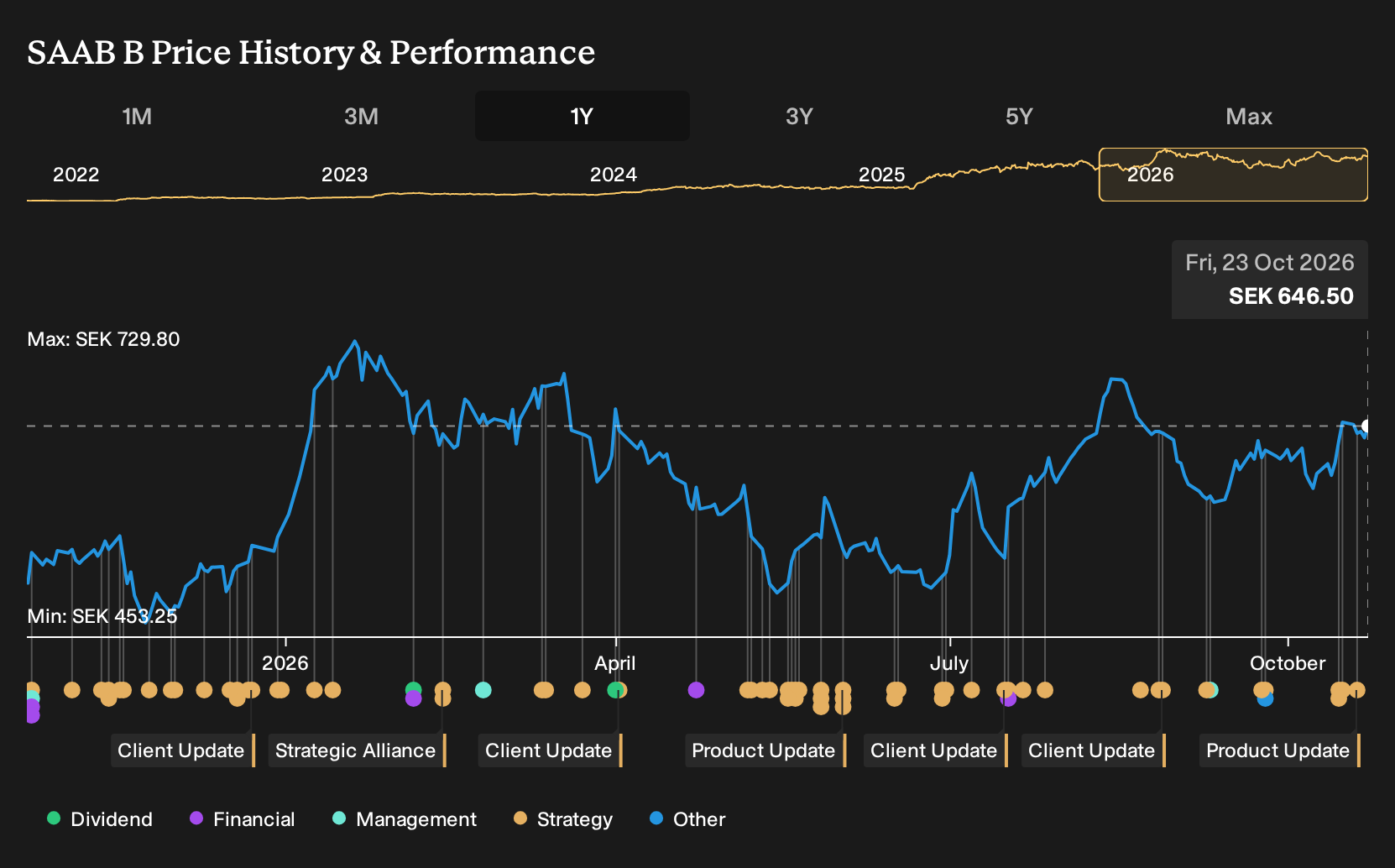
Valuation assumptions are just as demanding as the operational ones. The current models lean on Saab reaching SEK 148.2b of sales and SEK 13.4b of earnings by 2029, then trading on a P/E of 30.9x at that point, down from 47.9x today and below the quoted 46.3x for the GB Aerospace & Defense industry. The key point is that the consensus price target of SEK 637.07 sits only 0.9% above the recent SEK 631.6 share price. This suggests analysts as a group view the stock as roughly in line with their base case scenario.
Put differently, the market is not being asked to believe in explosive multiple expansion. It is being asked to accept that Saab keeps growing its top line at a high teens rate, edges margins up, and converts a large backlog into SEK 13.4b of earnings within three years of the GlobalEye output ramp described by analysts. If you are more cautious on revenue cadence, program risk or supply chains, the 30.9x exit multiple may feel tight. If you are more optimistic on mix, volume and margin, the more bullish SEK 760.0 target will look less stretched.
The capital structure assumptions are relatively modest in comparison. Forecast share count growth of 0.28% per year over the next three years implies only light dilution, so most of the expected uplift in per share earnings comes from the underlying business rather than financial engineering. The chosen 6.21% discount rate is another quiet swing factor. If your own required return is higher, you would likely arrive at a lower fair value than the SEK 637.07 consensus, even if you accept the same revenue and earnings path.
Saab's narrative projects SEK 148.2b revenue and SEK 13.4b earnings by 2029. This assumes 18.9% yearly revenue growth and an earnings increase of around SEK 6.3b from current earnings of SEK 7.1b.
Uncover why Saab's fair value indicates that Saab is roughly in line with its current price.
Exploring Other Perspectives
One bullish twist you may want to test against this Q3 from Saab is the idea that software heavy systems like Allied Mission System and GlobalEye support a richer earnings mix. The most optimistic analysts were already pencilling in SEK 161.6b of revenue and SEK 15.1b of earnings by 2029. Those stronger assumptions show how far views can stretch, and they may shift again once this latest cluster of space, underwater and airborne updates fully filters into fresh models. Exploring that spread in opinion can help you decide which version of Saab’s future you are really buying.
Explore 5 other Saab fair value estimates, including one that suggests potential upside of up to 18% from the current price.
The Verdict Is Yours
Disagree with existing narratives? Extraordinary investment returns rarely come from following the herd, so consider your own analysis carefully.
- A great starting point for your Saab research is our analysis highlighting 2 key rewards and 1 important warning sign that could impact your investment decision.
- See our latest analysis for Saab. The report includes a comprehensive fundamental analysis summarized in a single visual, the Snowflake, making it easy to evaluate Saab's overall financial health at a glance.
Looking For More Investment Ideas Beyond Saab?
If Saab has sharpened your focus on defence and quality execution, it can be useful to line it up against other stocks with different strengths. The Simply Wall St Screener lets you quickly filter for traits you care about, then compare fundamentals side by side so Saab is only one of several options on your radar.
- If resilience and balance sheet strength matter most to you, consider screening for a list of solid balance sheet and fundamentals (207 results) that can help anchor a more defensive portfolio.
- If you want potential upside with quality in mind, use our tool to surface a 611 high quality undiscovered gems that might not yet be widely followed.
- If income is a priority and you prefer companies that pay you while you wait, scan through a curated set of 230 dividend fortresses that combine higher yields with financial discipline.
Have feedback on this article? Concerned about the content? Get in touch with us directly. Alternatively, email editorial-team@simplywallst.com