


EN
Earnings Beat Could Be A Game Changer For RingCentral Stock (RNG)
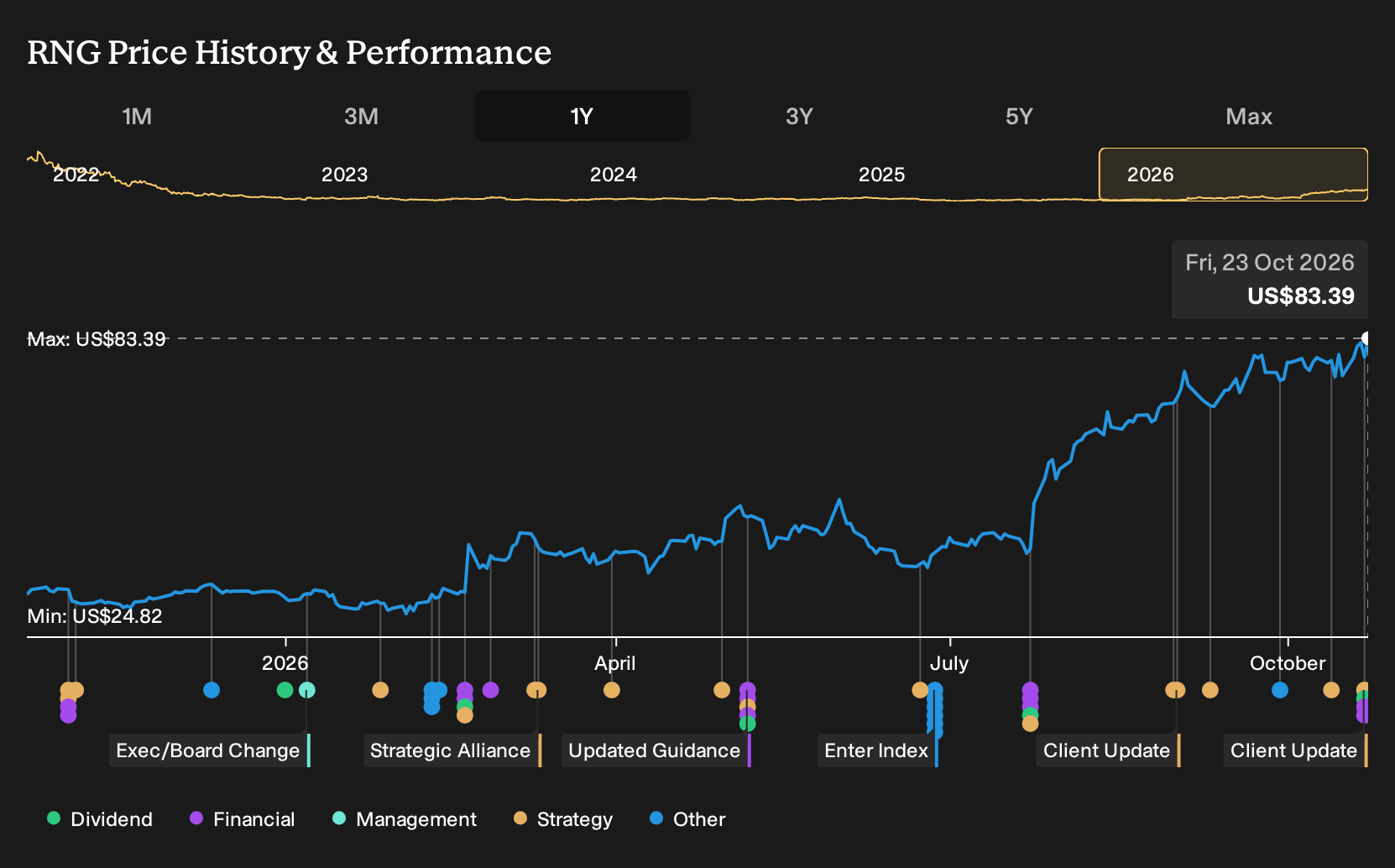
- RingCentral reported third quarter 2026 revenue of US$676.04 million and net income of US$569.7 million, alongside higher full year guidance and a new quarterly dividend of US$0.125 per share approved for payment in November 2026.
- The earnings update highlighted meaningful profitability, growing AI powered products as a material slice of recurring revenue, and fresh AI partnerships that tie RingCentral more deeply into customer workflows and partner distribution.
- Next, the focus turns to how RingCentral's investment narrative might shift, as stronger margins intersect with rising AI driven recurring revenue.
Scan how RingCentral's AI and dividend story compares to other communication and automation plays by zeroing in on our hand picked 55 AI infrastructure stocks.
RingCentral Investment Narrative Recap
To own RingCentral, you need to believe its AI centric platform can stay relevant as more enterprises lean into bundled suites from larger vendors. The near term story rests on whether AI products, now a material slice of recurring revenue, can keep supporting the improved margins shown in the latest results without letting R&D spending run too hot.
The key short term catalyst is execution on AI deployments with large reference customers and channel partners, which could reinforce confidence in guidance. The biggest risk is that competition and bundled offers pressure win rates or pricing, which would matter more now that the business is leaning harder on profitability targets.
The expanded Golden State Warriors agreement ties RingCentral’s agentic voice AI directly to a high visibility fan engagement use case, from ticketing to game day questions. That kind of at scale deployment puts practical stress on reliability, latency, and automation quality, all areas investors are watching as AI moves deeper into customer facing workloads.
For catalysts, this partnership functions as a live showcase for RingCentral’s AI reception, assistant, and contact center stack. If execution remains solid, it can support the narrative that AI offerings create stickier relationships and new use cases. The flip side is that any missteps would be public and could feed concerns about competition or product maturity.
What The RingCentral Consensus Is Really Pricing In
RingCentral's narrative projects US$3.1b in revenue and US$240.2 million in earnings by 2029, based on analysts' assumption of 5.5% yearly revenue growth and an earnings decline of US$422.2 million from US$662.4 million today.
Analysts are effectively outlining a scenario in which RingCentral grows its top line at 5.5% a year while profit compresses sharply over the next few years. Earnings today sit at US$662.4 million and the consensus view calls for that to step down to US$240.2 million by 2029, even as the business focuses on AI-centric products and recurring software revenue.
That forecast implies a very different earnings mix, with lower margins on a larger revenue base and a heavier reliance on AI automation and partner channels to sustain cash generation. For you as an investor, the key question is whether a lower earnings run rate on US$3.1b of projected sales in 2029 aligns with how you expect RingCentral's AI investments, dividend commitments, and competitive position to develop from here.
Discover how RingCentral's fair value indicates a 12% potential upside to its current price that may not last much longer.
Exploring Other Perspectives
Some of the most optimistic analysts lean hard into RingCentral’s AI catalyst. Before this earnings and Warriors partnership news, they were modeling revenue at roughly US$3.1b and earnings near US$586.1 million by 2029, far above the US$240.2 million consensus view. That gap shows how widely opinions can differ and why exploring multiple scenarios matters for you.
Explore 3 other RingCentral fair value estimates, including one that suggests up to 165% upside from the current price!
Decide For Yourself
Don't just follow the ticker. Dig into the data and build a conviction that's truly your own.
- A great starting point for your RingCentral research is our analysis highlighting 3 key rewards and 2 important warning signs that could impact your investment decision.
- See our latest analysis for RingCentral. The report includes a comprehensive fundamental analysis summarized in a single visual, the Snowflake, making it easy to evaluate RingCentral's overall financial health at a glance.
Looking For More Investment Ideas Beyond RingCentral?
If the RingCentral story has sharpened your thinking about AI, cash generation, and income, it can help to compare it with other opportunities that match different objectives on your watchlist.
- If capital preservation matters most to you, start with a group of 30 resilient stocks with low risk scores that score well on resilience and risk controls.
- For investors who care about value and quality together, focus on a curated 29 high quality undervalued stocks that pair stronger fundamentals with pricing that may look conservative.
- If you prefer solid finances as your base case, concentrate on a list of solid balance sheet and fundamentals (24 results) so you can filter for sturdier balance sheets and healthier fundamentals in one pass.
Have feedback on this article? Concerned about the content? Get in touch with us directly. Alternatively, email editorial-team@simplywallst.com