


EN
Does Lower Third Quarter Earnings Change The Bull Case For Hancock Whitney Stock?
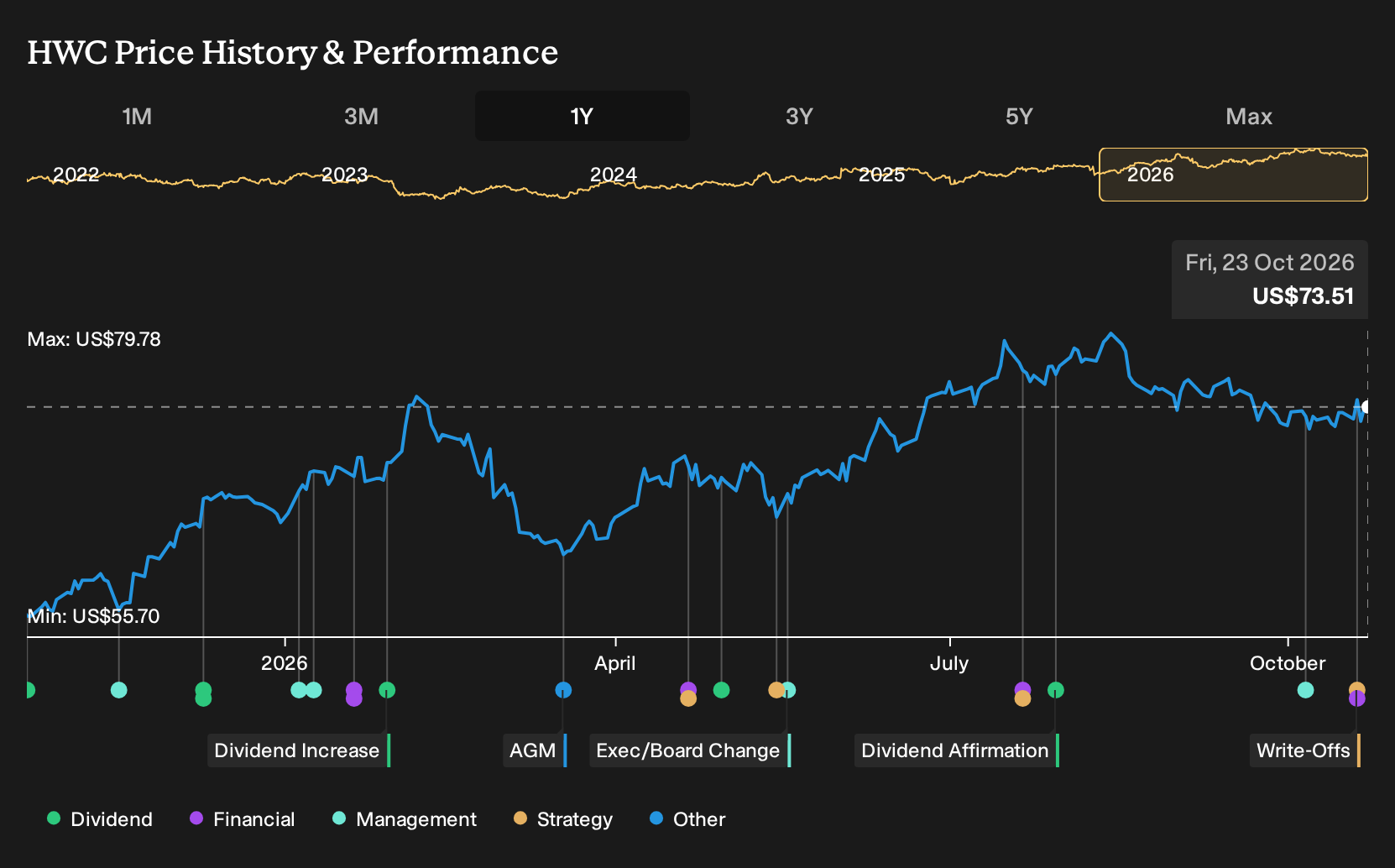
- Hancock Whitney reported third quarter 2026 net income of US$110.06 million and basic EPS of US$1.37, both below the prior year, alongside total net charge offs of US$10.20 million and continued execution of its share repurchase program.
- The bank retired 3,112,966 shares for US$220.84 million under its December 2025 buyback. This share retirement partly offsets the earnings softness by spreading profits across a smaller share base.
- The focus now turns to how Hancock Whitney's lower quarterly earnings influence the existing investment narrative built around growth hires and capital returns.
Hancock Whitney Investment Narrative Recap
To own Hancock Whitney, you need to be comfortable with a story that mixes earnings pressure with a push for better productivity, richer fee income and disciplined credit costs. The third quarter step down in net income and EPS keeps the spotlight on execution. The near term swing factor is how quickly the new bankers, the One Florida Bank integration and the wealth businesses translate into steadier revenue.
The biggest risk right now is that weaker recent profitability and past efficiency concerns linger longer than management expects, especially if loan growth from new hires does not scale as intended. The latest quarter does not radically change that risk reward balance, but it underlines that the margin for error on operating efficiency is thin.
The share repurchase update is the announcement that ties closest to this earnings print. Retiring 3,112,966 shares for US$220.84 million, including 1,000,000 shares in the third quarter, supports per share metrics even as net income and EPS trend lower year on year. For you as a shareholder, the story becomes less about headline profit and more about how much of it is spread over each share.
Capital returns can act as a bridge while catalysts like banker hiring, balance sheet repricing and the One Florida Bank acquisition play through the system. At the same time, buybacks shrink flexibility if credit costs or efficiency slip. For Hancock Whitney, the combination of softer earnings and active repurchases raises the bar on delivering the operational improvements that analysts already expect.
What The Hancock Whitney Consensus Is Pricing In
Hancock Whitney's narrative projects US$2.0b revenue and US$659.6m earnings by 2029. This is based on 12.6% yearly revenue growth and an earnings increase of about US$233.7m from US$425.9m today.
Uncover why Hancock Whitney's fair value indicates a 15% potential upside to its current price, which could narrow quickly.
Exploring Other Perspectives
Two fair value estimates from the Simply Wall St Community span roughly US$84.53 to US$141.65, so you are looking at a wide band of opinions on Hancock Whitney. That spread coincides with recent earnings softness, efficiency concerns and reliance on banker hiring, so you may want to test your view against several contrasting community perspectives.
Explore another Hancock Whitney fair value estimate, including one that suggests potential upside of up to 93% from the current price.
Decide For Yourself
Don't just follow the ticker. Dig into the data and build a conviction that's truly your own.
- A great starting point for your Hancock Whitney research is our analysis highlighting 3 key rewards and 1 important warning sign that could impact your investment decision.
- See our latest analysis for Hancock Whitney. The report includes a comprehensive fundamental analysis summarized in a single visual, the Snowflake, making it easy to evaluate Hancock Whitney's overall financial health at a glance.
Looking For More Investment Ideas Beyond Hancock Whitney?
If the Hancock Whitney story has you thinking about balance sheets, earnings quality and how capital is handed back to shareholders, it can help to widen the lens and compare it with other businesses that share similar traits.
- If you want potential upside with a focus on financial resilience, scan a curated 21 high quality undiscovered gems that pair solid fundamentals with less crowded ownership.
- If capital preservation matters just as much as return potential, filter for 30 resilient stocks with low risk scores that score well on resilience and downside protection.
- If you care most about companies that can support their obligations and reinvest without stretching their finances, start with a list of solid balance sheet and fundamentals (24 results) that meet strict balance sheet and fundamentals checks.
Have feedback on this article? Concerned about the content? Get in touch with us directly. Alternatively, email editorial-team@simplywallst.com