


EN
Is Board Appointments Altering The Investment Case For Applied Industrial Technologies Stock?
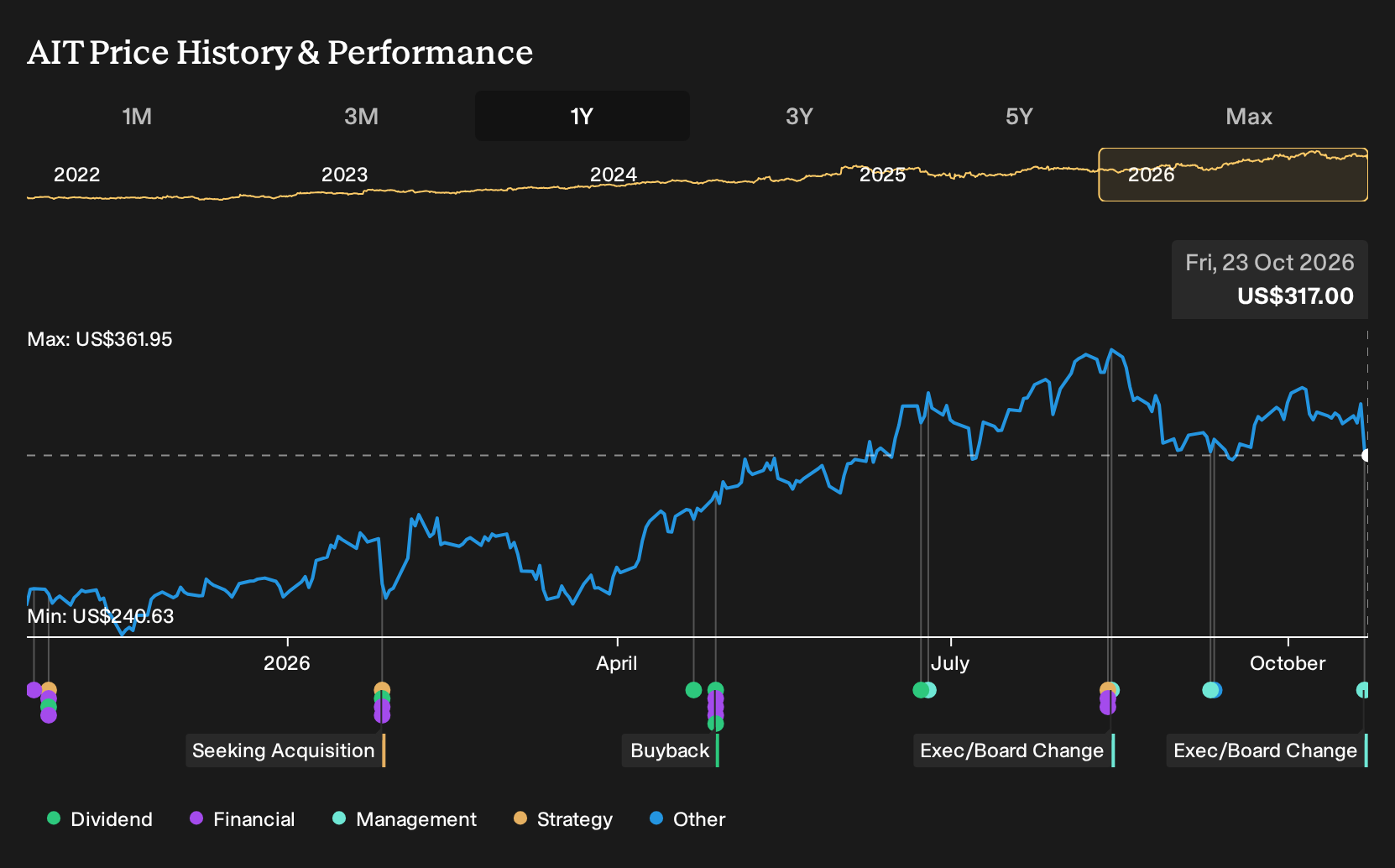
- Applied Industrial Technologies appointed Pamela J. Tomczik and Michael L. Olosky to its Board in 2026, placing them on key audit, governance, sustainability, and compensation committees that oversee controls, risk, and long term direction.
- The board refresh brings direct experience in industrial operations, acquisitions, and complex technology markets, which ties closely to Applied Industrial Technologies' push into higher value automation, robotics, and engineered solutions projects.
- This development may influence how investors view Applied Industrial Technologies' strategy, particularly as these new directors support its automation focused initiatives.
Applied Industrial Technologies Investment Narrative Recap
To own Applied Industrial Technologies, investors need to be comfortable with a story that leans on automation, robotics, and higher value engineered projects while core industrial end markets remain mixed. A key near term swing factor is how quickly that automation and Engineered Solutions backlog converts into revenue, given management guidance for only mid single digit sales growth and slightly softer EBITDA margins in FY27.
The biggest operational risk currently lies in more cyclical sectors such as machinery, metals, and energy, where demand could stay muted and potentially limit earnings progress. The fresh board appointments appear directionally helpful for governance and oversight but do not materially change that near term demand risk.
The election of Michael L. Olosky to the Applied Industrial Technologies board is the clearest operationally relevant update tied to this story. His background running Simpson Manufacturing and leading industrial and electronics divisions at Henkel aligns directly with AIT's focus on complex automation and fluid power projects and its exposure to semiconductor and data center work.
For catalysts, investors are monitoring whether management can continue converting double digit Engineered Solutions order growth and more than 20% automation organic sales growth in Q4 FY26 into margins closer to the long term 14% EBITDA target. Olosky's role on the Corporate Governance & Sustainability and Executive Organization & Compensation Committees ties him into oversight of execution, capital deployment, and incentive design, all of which are important to whether those projects translate into durable cash generation.
Applied Industrial Technologies Forecasts And Valuation Check
Analyst expectations around Applied Industrial Technologies are tight and number driven, which gives you a clearer yardstick for what needs to go right in the automation and Engineered Solutions push. Consensus assumes revenue grows at 5.2% a year over the next three years, profit margins edge higher from 8.3% today to 8.8%, and earnings reach US$511.0 million by 2029 compared with US$414.5 million today. That shift equates to roughly US$96.5 million more profit that needs to show up on the income statement, backed by ongoing mix shift toward higher value projects and steady buybacks that analysts estimate will trim the share count by 2.7% a year.
Applied Industrial Technologies' narrative projects US$5.8b revenue and US$511.0 million earnings by 2029. This requires 5.2% yearly revenue growth and an earnings increase of about US$96.5 million from US$414.5 million today.
On valuation, the stock story hinges on whether you think those 2029 targets are realistic for a distributor leaning harder into automation and engineered work. The consensus price target sits at US$400.00 per share against a current price of US$320.39. This is based on the idea that the business will earn US$511.0 million on US$5.8b of sales and trade at a P/E of 33.5x by 2029, compared with 28.4x today and 24.4x for the wider US trade distributors group. That is a richer multiple than the sector, so any wobble in automation demand, integration outcomes, or margin mix could matter quickly for how Applied Industrial Technologies is priced.
Uncover how Applied Industrial Technologies' fair value indicates a 26% potential upside to its current price that may not last much longer.
Exploring Other Perspectives
Two fair value estimates from the Simply Wall St Community bracket Applied Industrial Technologies between about US$296 and US$400 per share, which is a wide span for a small sample of private investors. When you combine that range with automation demand, new board oversight, and sector softness risk, you can see why there are sharply different views. Explore the full spread before deciding where you land.
Explore another Applied Industrial Technologies fair value estimate, including one that suggests as much as 7% downside from the current price.
Decide For Yourself
Disagree with existing narratives? Extraordinary investment returns rarely come from following the herd, so go with your instincts.
- A great starting point for your Applied Industrial Technologies research is our analysis highlighting 3 key rewards and 1 important warning sign that could impact your investment decision.
- See our latest analysis for Applied Industrial Technologies. The report includes a comprehensive fundamental analysis summarized in a single visual, the Snowflake, making it easy to evaluate Applied Industrial Technologies' overall financial health at a glance.
Looking For More Investment Ideas Beyond Applied Industrial Technologies?
If the Applied Industrial Technologies story has sharpened your thinking around automation, cash generation, and risk, you can use that same checklist to widen your opportunity set with the Simply Wall St Screener.
- For investors who want quality and value in the same place, start with a curated group of 29 high quality undervalued stocks that combine solid fundamentals with lower implied expectations.
- If capital preservation and a smoother ride matter most to you, narrow the field to 30 resilient stocks with low risk scores that screen well on balance sheet strength and risk metrics.
- When you want to get ahead of the crowd, hunt through 21 high quality undiscovered gems that pair strong financial profiles with relatively low market attention.
Have feedback on this article? Concerned about the content? Get in touch with us directly. Alternatively, email editorial-team@simplywallst.com