


EN
Missed FedEx's Run? What Holders Had To Believe
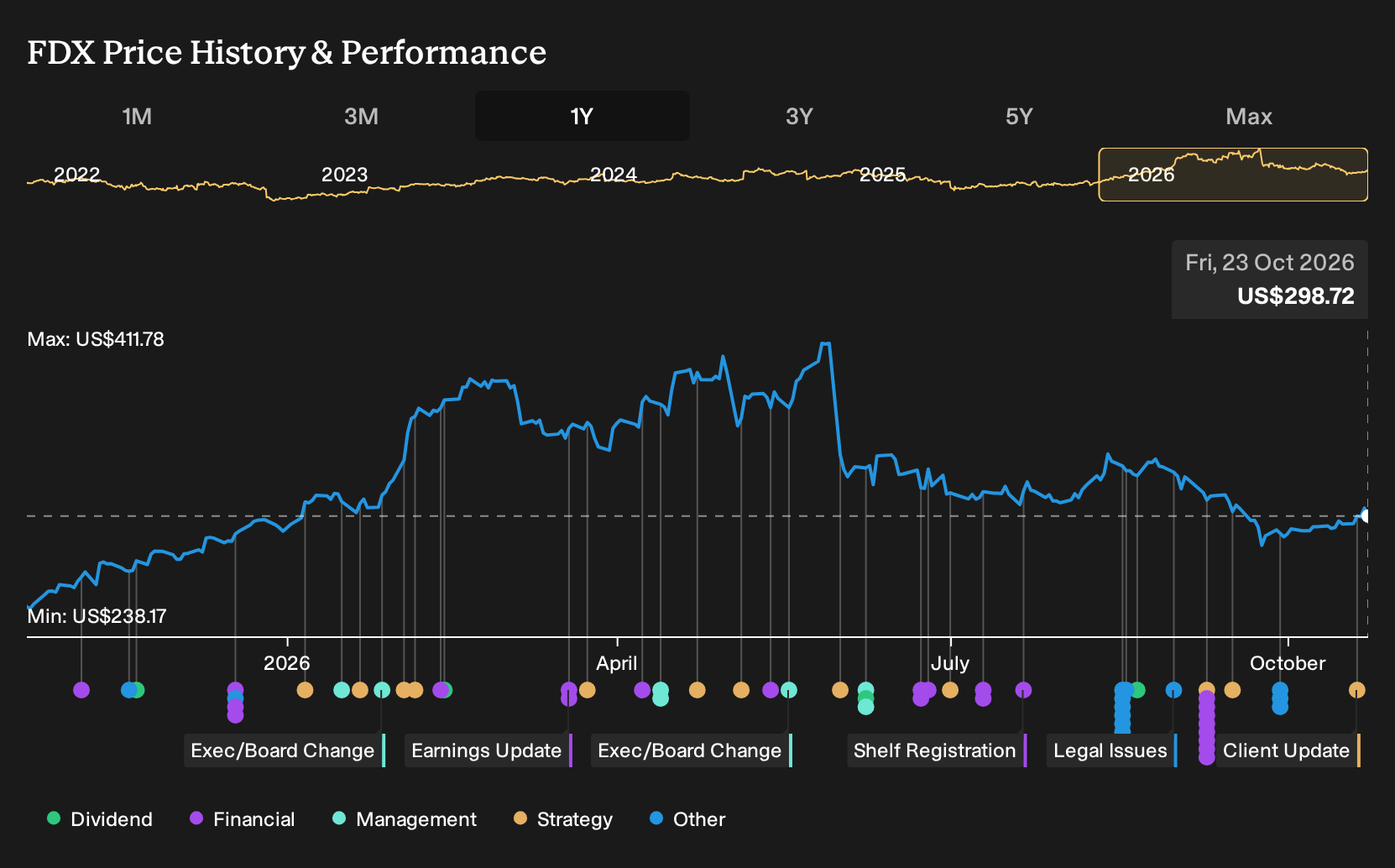
If you only read recent headlines on FedEx, you saw mixed Q4 2026 figures where revenue reached US$25.0b while net income slipped and margins compressed after the Freight spin off. Holding FedEx over the past year would have returned 56.4%, including dividends. If you had been deciding back in October 2025, with analysts split between optimism and structural worries, what did that gap between business progress and shareholder reward really ask you to judge?
A Narrative on Simply Wall St is one investor's written case for a company, with its growth, margin and multiple assumptions spelled out. Those assumptions imply an estimated Fair Value.
The easy part of this move is behind FedEx. Zero in on 29 high quality undervalued stocks for companies trading below our estimates.
The Argument FedEx Investors Were Really Having
The shares cost US$238 at the start of the period. Any call on FedEx in late 2025 came down to which future you thought was more reasonable.
The bullish Narrative put Fair Value at US$263, about 10% above the start price. It hinged on revenue growth of 2.8% a year and profit margins reaching 5.4% with help from DRIVE and Network 2.0.
The bearish script pointed to Fair Value of US$200, about 16% below the start price. It stressed structural parcel volume pressure and higher labor and environmental costs as long term threats.
What The FedEx Results Actually Tested
FedEx’s Q4 2026 report, the first after the Freight spin off, showed revenue of US$25.0b compared with US$22.2b in Q4 2025, which supported the view that the network could carry more volume and pricing. Profit told a tougher story. Net income slipped from US$1,646m to US$1,595m and net margin eased from 7.4% to 6.4%. The evidence cut both ways.
The key issue was whether cost programs could protect profitability as FedEx reshaped its footprint. For a different stock, focus on whether higher sales actually turn into a higher net margin, and test that claim against several reporting periods, not just the top line.
What FedEx's Run Up 56% Now Asks You To Believe
FedEx trades at US$299 today after returning 56.4% over the past year. The selected Narrative places its Fair Value below that price and argues that fuel costs, capital spending and execution on cost programs now matter more than broad parcel volume debates.
The core question is what has to keep going right for this level to hold. Anyone paying US$299 would be leaning on FedEx turning AI, Dataworks and Network 2.0 savings into pricing resilience and free cash flow even as fuel, labor and decarbonization spending continue to bite.
"Bearish analysts expect FedEx to face continued pressure on operating margins as higher crude and diesel costs intersect with rising labor and environmental requirements. The main factor that needs to go right is that FedEx converts its AI, Dataworks and Network 2.0 efficiency programs, along with lower capital intensity, into durable surcharge capture, a healthier mix toward premium B2B and health care, and sustained free cash flow at approximately 4% capex to revenue."
One Narrative has put a figure on that disagreement. → See the Narrative with its lower Fair Value, assumptions and all
Before The Next Story Makes Headlines
You may be late to this rally, but that does not have to mean arriving late to every opportunity. Start with companies whose prices leave room for a different view of their future. Here are three trading below our estimates.
- Company 1 - 33% below our estimate - targets data centre buildouts where AI integration demands higher power density and cooling.
- Company 2 - 24% below our estimate - embeds AI tools into cloud, productivity, developer and security workflows for long-term enterprise adoption.
- Company 3 - 37% below our estimate - captures complex consulting work as regulators and litigators address emergent AI technical risks.
Three companies from the same screener. Open all 24 companies with the balance sheet to back it up →
Have feedback on this article? Concerned about the content? Get in touch with us directly. Alternatively, email editorial-team@simplywallst.com