


EN
How to Play the Brutal Selloff in CoreWeave Stock
Artificial intelligence (AI) has unleashed one of the biggest infrastructure spending booms in history, transforming demand for computing power, advanced semiconductors, data centers, and electricity. Billions of dollars in borrowing have helped fund the infrastructure underpinning the AI boom. Now, persistent inflation and rising interest rates threaten to make that expansion more expensive, a shift that has been particularly harsh for neocloud providers.
CoreWeave (CRWV) finds itself at the center of that reassessment. Shares of CoreWeave have plunged 38% over the past month as debt concerns have intensified and the company’s bonds weakened. Yields on some unsecured notes climbed to around 15%, and the cost of insuring its debt against default surged beyond 1,000 basis points. According to Reuters, these credit-market signals imply a roughly 63% probability of default within five years.
The underlying financial commitments explain much of that unease. Reuters also reported that CoreWeave carries approximately $50 billion in debt while having also accumulated more than $104 billion in contracted revenue backlog, leaving the company with a substantial pipeline of future business to deliver.
The backlog is undeniably large, but contracted revenue is not cash in the bank. CoreWeave must still build the necessary infrastructure, supply the promised computing capacity, and generate enough cash to meet its financial obligations.
Against this backdrop, CEO Mike Intrator — who co-founded CoreWeave in 2017 as a cryptocurrency mining venture — recently emphasized that the company retains access to a range of funding options, offering some reassurance. But with CRWV stock already battered and down 12% over the past five sessions, let's look at whether the selloff has created an attractive entry point or exposed risks that the market had previously overlooked.
About CoreWeave Stock
Based in Livingston, New Jersey, CoreWeave specializes in cloud infrastructure for AI and high-performance computing (HPC). Its CoreWeave Cloud platform offers GPU and CPU computing, storage, networking, servers, and AI development tools, supporting everything from machine-learning applications to visual-effects rendering and large-scale AI workloads.
Despite a market capitalization of approximately $25 billion, CRWV stock has declined 56% over the past 52 weeks and 24% year-to-date (YTD). The fall has been driven by growing scrutiny surrounding its debt-heavy expansion, even as demand for the computing infrastructure it provides remains substantial.
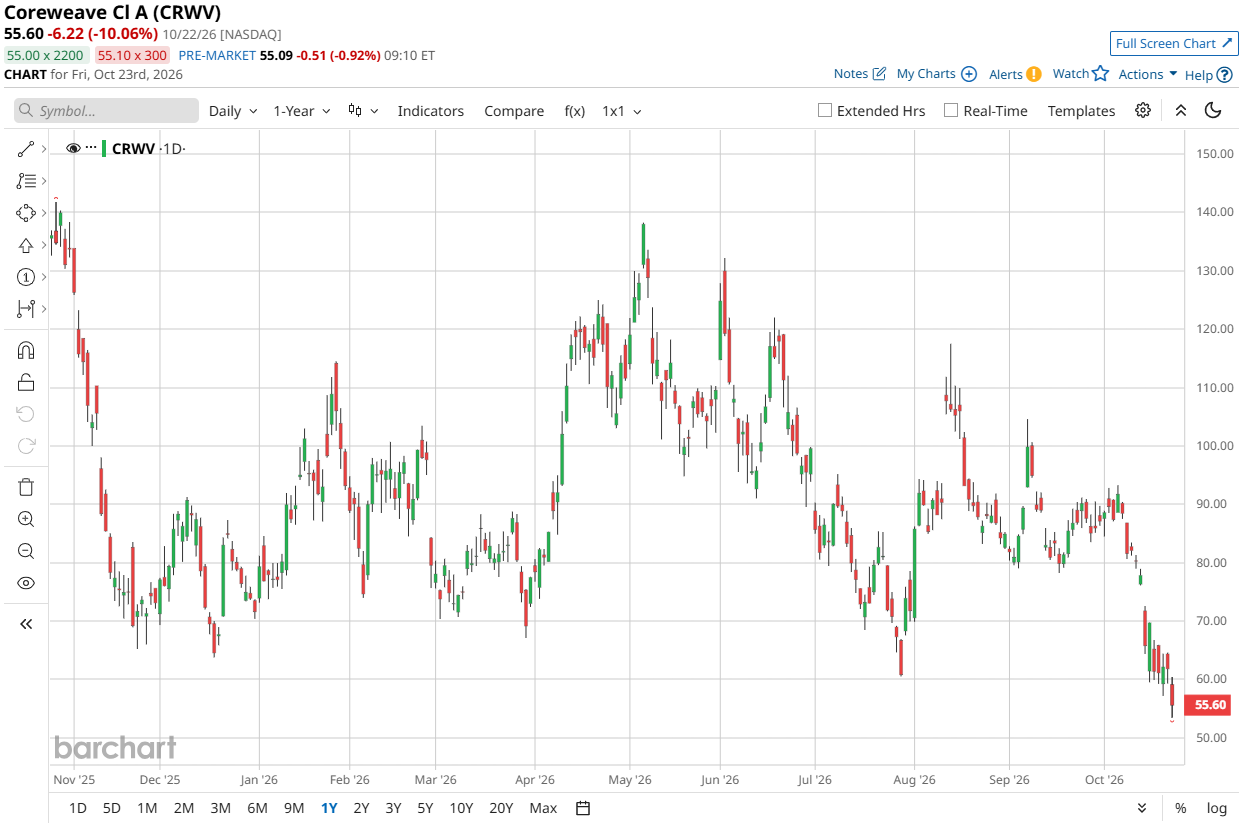
In terms of valuation, CRWV stock currently trades at 4.9 times sales.
A Closer Look at CoreWeave’s Q2 Earnings
CoreWeave reported its second-quarter fiscal 2026 results on Aug. 11, prompting a 2.4% gain that day followed by a 19% jump in the next trading session. Revenue surged 112% year-over-year (YOY) to $2.58 billion, exceeding Wall Street expectations of $2.54 billion.
Expanded computing capacity, increasing enterprise adoption, and strong demand from AI-focused customers helped drive the improvement. The company's revenue backlog climbed to approximately $104 billion, while CoreWeave secured more than $25 billion in additional customer commitments early in Q3.
Adjusted EBITDA surged almost 101% YOY to $1.51 billion, reflecting the scale of the business being built around accelerating demand for AI computing. However, CoreWeave's adjusted EBITDA margin slipped to 59% from 62% in the prior-year period, while adjusted operating income fell 36% YOY to $128 million.
The contrast between rapid revenue growth and weaker operating profitability points to the cost of expanding infrastructure, investing in technology, and adding capacity to serve future customer demand. Those pressures become clearer when financing and investment costs come into play.
Net interest expense soared 140% YOY to $640 million in Q2, while capital expenditures reached $9.4 billion. As a result, CoreWeave's adjusted net loss widened to $567 million from $130 million. Net loss per share also widened 90% YOY to $1.14.
The balance sheet remains the more pressing concern. CoreWeave has more than $50 billion in debt and lease liabilities against only $5.5 billion in cash. Those obligations also exceed the company's entire market cap, underscoring the scale of its financial commitments relative to its current equity value.
Management has nevertheless strengthened its 2026 outlook, raising its revenue forecast to a range of $12.4 billion to $13.2 billion and adjusted operating income guidance to $960 million to $1.15 billion. The company expects full-year capex to reach $35 billion to $39 billion, a substantial commitment that reflects the resources required to meet contracted demand.
Analysts remain cautious about the near-term earnings trajectory. Loss per share is forecast to widen 368% YOY to $1.45 in Q3, while loss per share for full-year fiscal 2026 is expected to widen 84% YOY to $4.96. However, some relief is expected in fiscal 2027, as analysts predict loss per share to narrow to $3.16, a 36% YOY improvement.
What Do Analysts Expect for CoreWeave Stock?
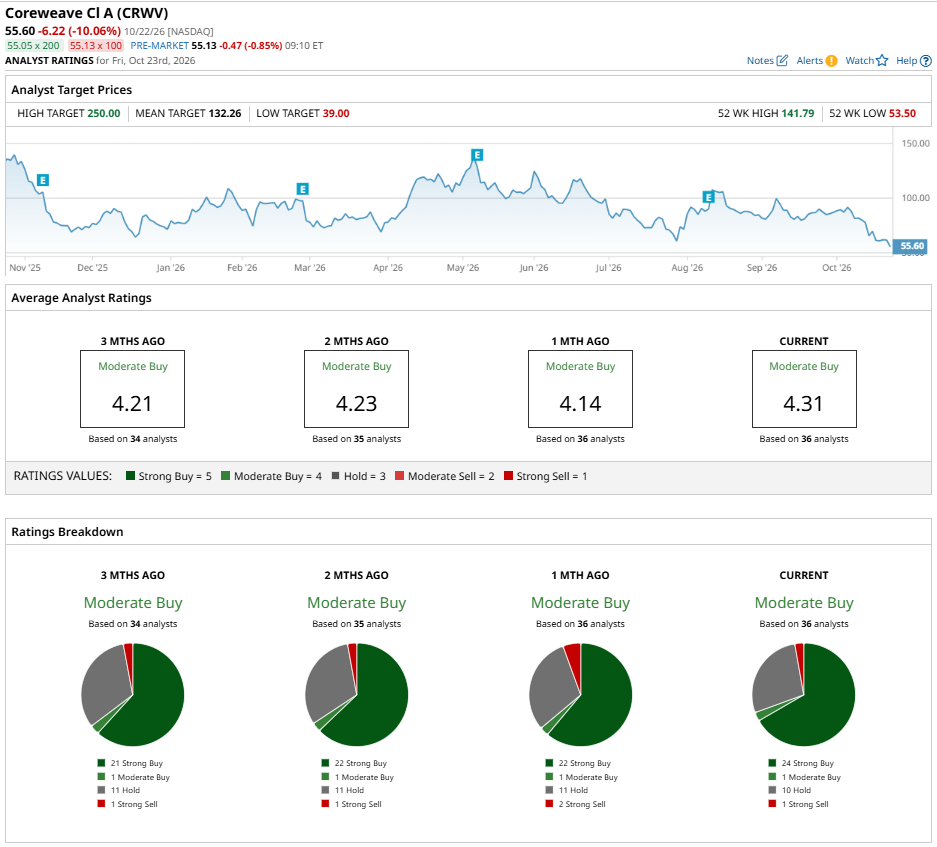
Despite the sharp decline and mounting balance-sheet concerns, Wall Street has not abandoned CoreWeave. CRWV stock has a consensus “Moderate Buy” rating overall, indicating that analysts generally see recovery potential even as financial risks remain in focus.
Of the 36 analysts covering CRWV stock, 24 analysts have a “Strong Buy” rating, one recommends a “Moderate Buy,” 10 have a “Hold” rating, and one analyst has a “Strong Sell.” The average price target of $131.83 implies potential upside of 143% from current levels, while the high target of $250 points to a possible gain of 361% from here.
On the date of publication, Aanchal Sugandh did not have (either directly or indirectly) positions in any of the securities mentioned in this article. All information and data in this article is solely for informational purposes. For more information please view the Barchart Disclosure Policy here.