


EN
Does ChatGPT Pet Insurance Change The Bull Case For MetLife (MET)?
- MetLife Pet Insurance has already integrated its portal with a ChatGPT plugin, letting pet owners pull personalized quotes, complete applications and move directly to the MetLife Pet site to purchase coverage.
- This move makes MetLife the first major pet insurer to support conversational pet insurance applications through ChatGPT. It highlights how management is using AI tools to lower friction in customer acquisition and policy onboarding.
- We will now look at how this AI powered pet insurance plugin could influence MetLife's broader investment narrative and execution.
Scan beyond MetLife to find other insurers and platforms quietly leaning into AI driven distribution with a curated set of 39 profitable AI stocks that aren't just burning cash.
MetLife Investment Narrative Recap
For an investor to stay with MetLife, there needs to be confidence that the New Frontier cost program, technology spend and international operations can keep supporting earnings quality, even while reported revenue and book value occasionally miss expectations. The ChatGPT driven pet insurance integration looks additive rather than transformational and does not obviously change the key near term earnings catalyst. That remains execution on the broader plan.
The biggest immediate risk still sits in fee and spread based income. MetLife Investment Management guiding to the low end of its 2026 earnings range and weaker spreads in Retirement and Income Solutions both matter more to the story than a single product integration. The plugin is interesting proof of concept on AI, but its financial impact today appears modest.
The most directly related earlier development is management’s wider push into technology and AI, backed by more than US$3.2b of spend over five years. The MetLife Pet Insurance plugin sits inside that effort as one more example of using automation to simplify underwriting, claims and customer onboarding, which in theory can support unit costs if adopted at scale.
For you as a shareholder, the link between these tech moves and the main earnings levers is critical. Efficiency gains are one side of the equation. The other is the sensitivity of spread income and fee revenue to investment performance, especially after weaker private equity returns and lower investment spreads. That combination keeps execution risk in focus, even as MetLife experiments with more AI driven distribution.
What The MetLife AI Push Means Next
MetLife's AI activity only really matters for you if it lines up with what analysts already expect on revenue, earnings and valuation. The current consensus backdrop is that top line will expand by 4.2% a year over the next 3 years, profit margins are projected to move from 4.3% today to 7.9% by 2029, and earnings are estimated to reach US$7.1b by that same year compared with US$3.4b now. That is a sizeable shift in profitability, and any contribution from AI driven pet insurance distribution sits inside those numbers rather than on top of them.
The earnings bridge implied here is straightforward. Consensus points to MetLife roughly doubling profit in dollar terms over this period, rising from US$3.4b of earnings today to US$7.1b by 2029. On a simple multiple basis that is just over a 2x increase in the earnings pool that would need to be supported by a mix of higher revenue, better margins and ongoing capital management, including share count falling an expected 3.55% per year for the next 3 years.
On revenue, analysts are pencilling in US$89.7b for 2029. That figure is paired with the projected US$7.1b of earnings in the same year, which implies a meaningfully higher margin structure than at present. For AI projects like the MetLife Pet Insurance plugin to matter in that context, they need to scale across distribution, underwriting and service in ways that help support both the 4.2% annual growth assumption and the margin lift built into those long dated estimates.
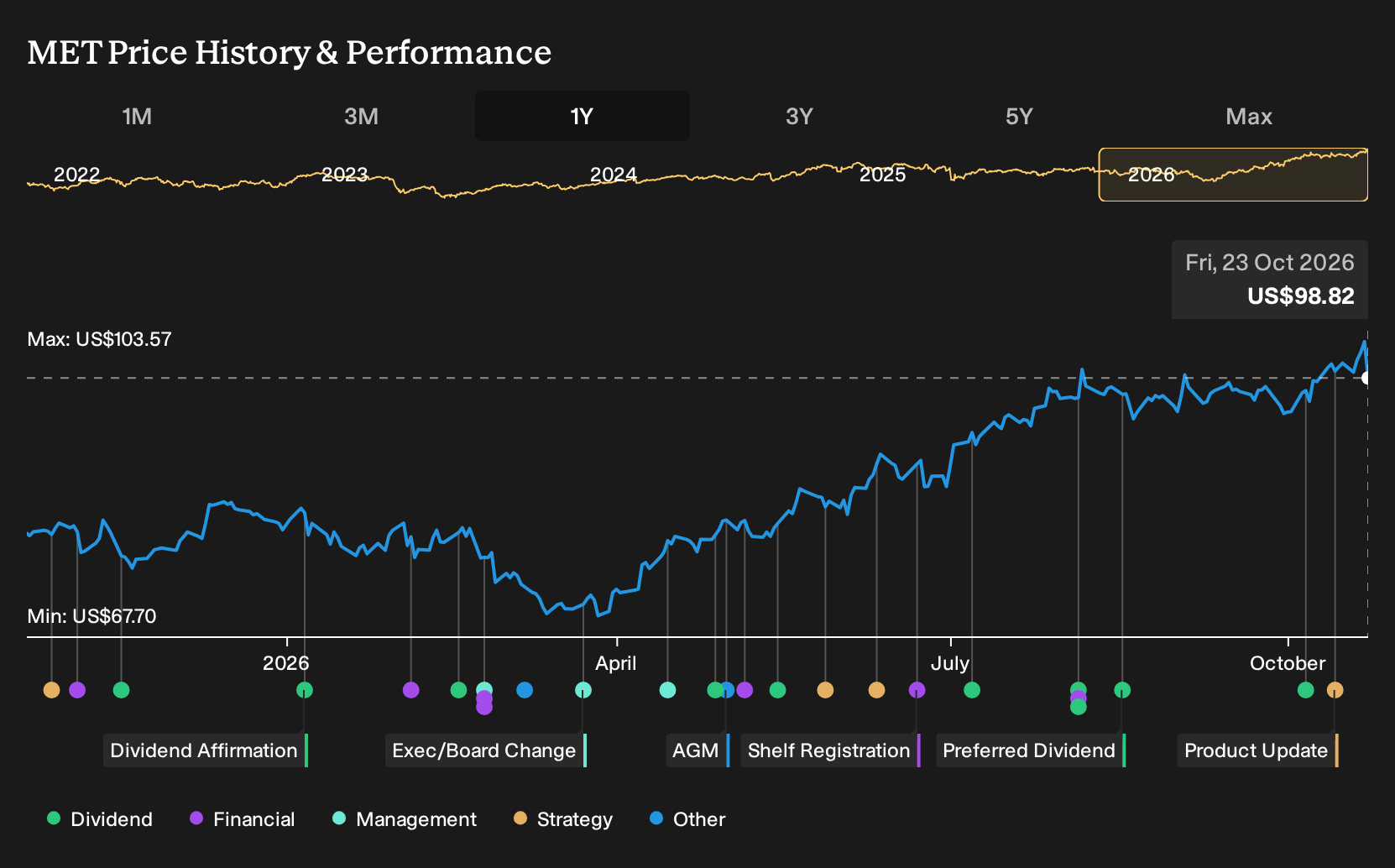
Valuation expectations tighten the lens further. The current consensus price target of US$107.38 on MetLife is grounded in the idea that by 2029 the stock trades on a P/E of 10.8x those US$7.1b of earnings, which lines up with the present industry multiple. With shares at US$97.16, that target implies 9.5% upside against today, so any disappointment on revenue, margin or fee and spread income would matter more than whether one AI plugin is a short term success.
MetLife's narrative projects US$89.7b revenue and US$7.1b earnings by 2029. This ties to 4.2% yearly revenue growth and an earnings increase of about US$3.7b from US$3.4b today.
Uncover why MetLife's fair value indicates a 9% potential upside to its current price, which could narrow quickly.
Exploring Other Perspectives
Two fair value estimates from the Simply Wall St Community cluster between US$107.38 and about US$173.37, so some private investors see MetLife as only modestly mispriced while others pencil in far richer potential. You face that spread against risks around fee income and spreads, as well as catalysts in international expansion and AI execution.
Explore another MetLife fair value estimate, including one that suggests the potential for as much as 75% upside from the current price.
The Verdict Is Yours
Don't just follow the ticker; dig into the data and build a conviction that's truly your own.
- A great starting point for your MetLife research is our analysis highlighting 3 key rewards and 1 important warning sign that could impact your investment decision.
- See our latest analysis for MetLife. The report includes a comprehensive fundamental analysis summarized in a single visual, the Snowflake, making it easy to evaluate MetLife's overall financial health at a glance.
Looking For More Investment Ideas Beyond MetLife?
If MetLife has sharpened your focus on where earnings quality and balance sheet strength intersect, it can be useful to line it up against other businesses with similar traits. The Simply Wall St Screener lets you filter for the mix of resilience, income and value that fits your own plan rather than relying on a single ticker.
- If capital preservation ranks high for you, start with a group of companies that score well on stability through our 30 resilient stocks with low risk scores.
- For readers who want income on top of potential price moves, compare MetLife with a curated set of high-yield payers by scanning the 5 dividend fortresses.
- If you are hunting for opportunities where quality fundamentals and price seem misaligned, focus your research on the 29 high quality undervalued stocks.
Have feedback on this article? Concerned about the content? Get in touch with us directly. Alternatively, email editorial-team@simplywallst.com