


EN
BYD Stock Outlook Gets Support From Brazil Expansion
- BYD is rolling out refreshed Qin Plus and Seal 07 sedans, expanding Fang Cheng Bao launches, and tightening its Brazilian supply chain through Nexteer to support overseas-focused production and sales.
- The Nexteer steering assembly plant in Camaçari signals a deeper shift toward localised parts sourcing, which can influence BYD’s cost base and production reliability in Latin America.
- This development illustrates how BYD’s investment narrative could be affected by overseas demand supported by new Brazilian supply chain capacity.
BYD Investment Narrative Recap
To own BYD, you need to believe the business can shift more of its volume and profit mix toward overseas markets while keeping its model pipeline fresh enough to compete in China. The Qin Plus and Seal 07 refreshes speak to that product work, although the recent ban on certain BYD vehicles at a US military base underlines ongoing geopolitical friction. For now, the most important short term catalyst still looks like execution on export growth and localisation.
The biggest operational risk remains pressure on earnings if domestic demand in China stays soft and competition keeps pricing tight. That concern already shows up in first half 2026 revenue of about US$52b compared with US$56b a year earlier, and in earnings per share that declined 21% to US$1.35. The latest headlines are more incremental than transformative for those core issues.
The Nexteer steering assembly plant in Camaçari is the announcement that ties most directly into the current news flow. BYD is leaning into Brazil as a manufacturing and export hub, with a US$1b commitment to the broader Camaçari site and a target of more than 50% local parts usage by January 2027. That local sourcing push is central to any thesis built on export scale and cost control.
For you as a prospective BYD shareholder, the Brazil build out and Nexteer partnership sit right alongside product launches like the new Qin Plus and Seal 07 as key execution tests. Supply chain localisation, overseas charging build out and model refreshes all need to work together to offset weaker Chinese demand and policy barriers in markets such as the United States. If those steps fail to stabilise margins after the recent 21% EPS decline, the expansion story becomes harder to underwrite.
What The BYD Forecasts Are Asking You To Believe
Analysts are effectively asking you to underwrite a very different BYD by the late 2020s. The consensus view ties the Brazil build out, Nexteer partnership and overseas model cycle into a single financial story that leans heavily on rising revenue and fatter margins.
Forecasts point to revenue rising by 13.4% a year over the next three years, with profit margins expected to move from 3.8% today to 5.5%. On that roadmap, earnings are projected to reach CN¥62.2b by 2029 compared with CN¥29.3b today, which implies roughly a doubling of profit on current estimates. At the same time, analysts are baking in a gradual reduction in the share count of about 3.61% a year and a future P/E of 19.0x that sits well above the 9.8x currently applied to the wider Hong Kong auto group.
BYD's narrative projects CN¥1,133.3b revenue and CN¥62.2b earnings by 2029. This assumes 13.4% yearly revenue growth and an earnings increase of roughly CN¥32.9b from CN¥29.3b today.
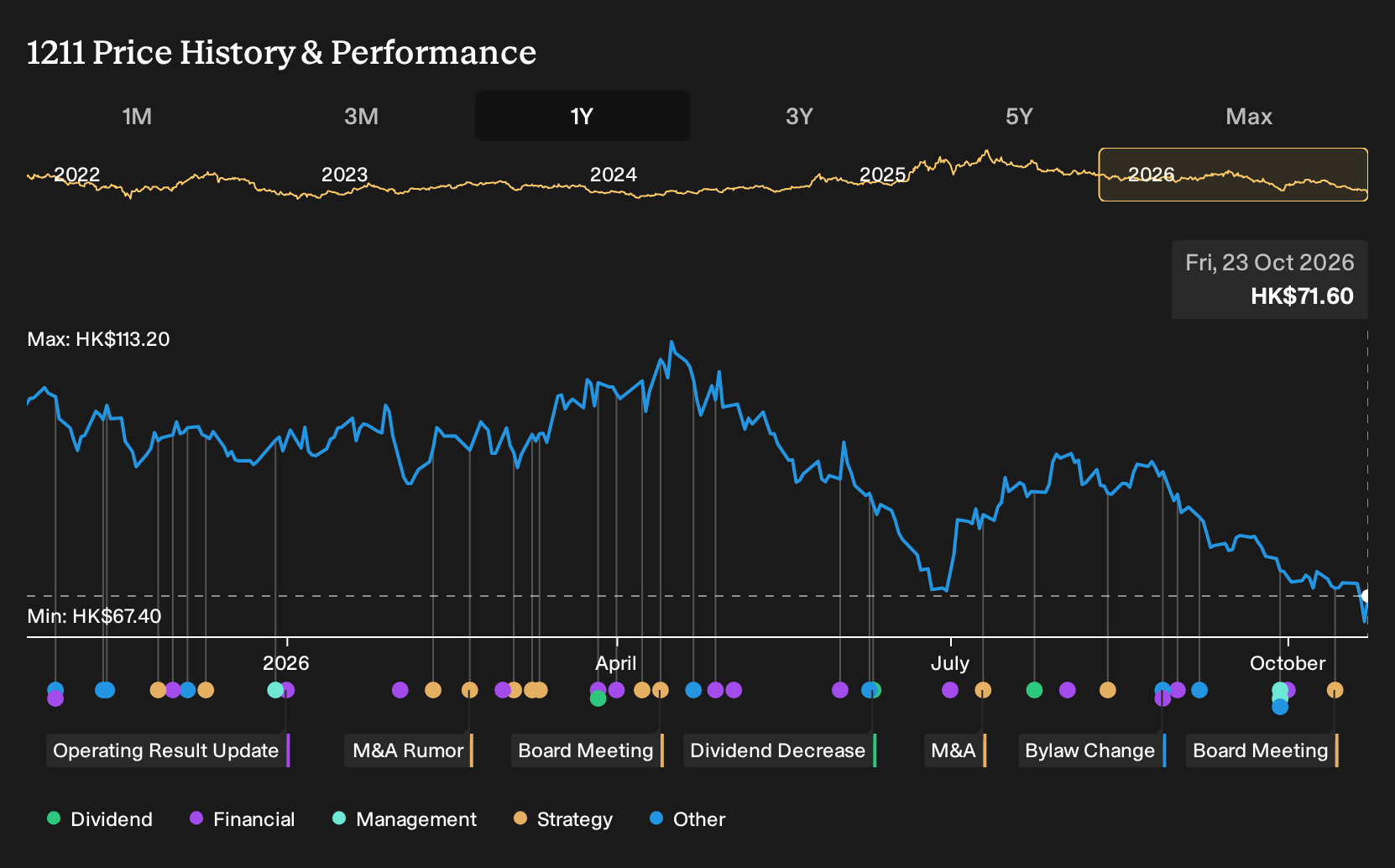
To square these numbers with the current share price of HK$71.6, the analyst set of models clusters around a consensus target of HK$122.68. That implies meaningful upside in price terms, although there is a wide spread between the most optimistic HK$151.2 target and the HK$88.5 mark at the lower end. The gap reflects genuine disagreement about how much of the overseas expansion, cost localisation and new model pipeline will translate into lasting profitability.
For a BYD investor weighing those projections against the Brazilian supply chain news, the question is simple. Do the Camaçari commitments, local sourcing push and export ambitions make earnings closer to CN¥62.2b by 2029 feel realistic, or do the current pressures in China and policy barriers in markets like the United States make that path too tight? The answer shapes whether this expansion story sits comfortably alongside other global automakers with relatively solid balance sheets or looks more like a high execution challenge tied to a single emerging market champion.
Uncover why BYD's fair value indicates a 71% potential upside to its current price before that valuation gap closes.
Exploring Other Perspectives
You can also flip the lens and treat BYD’s overseas ecosystem push as the main catalyst. The most optimistic analysts were already pencilling in revenue of about CN¥1,410.2b and earnings of CN¥88.1b by 2029 before this Brazil and new models news, so fresh information like the Qin Plus refresh or the Nexteer plant could easily shift those narratives, in either direction.
Explore 6 other BYD fair value estimates, including one that suggests potential upside of as much as 844% from the current price!
The Verdict Is Yours
Disagree with existing narratives? Extraordinary investment returns rarely come from following the herd, so trust your own analysis and judgment.
- A great starting point for your BYD research is our analysis highlighting 3 key rewards and 1 important warning sign that could impact your investment decision.
- See our latest analysis for BYD. The report includes a comprehensive fundamental analysis summarized in a single visual, the Snowflake, making it easy to evaluate BYD's overall financial health at a glance.
Looking For More Ideas Beyond BYD?
If the BYD story has sharpened your sense of what you want in an investment, it can help to line it up against a wider field of stocks that fit different risk and return profiles. The Simply Wall St Screener lets you do exactly that by filtering the market down to focused shortlists built around balance sheet strength, valuation and income potential.
- For investors who care most about resilience first and upside second, start with a 221 resilient stocks with low risk scores that score well on financial robustness and business stability.
- If you want to balance quality with the possibility of mispricing, compare BYD with a 194 high quality undervalued stocks that combine solid fundamentals with attractive valuations.
- For readers building an income-focused portfolio, round out your research with a 226 dividend fortresses that offer yields above 5% while still aiming to keep payouts supported by fundamentals.
Have feedback on this article? Concerned about the content? Get in touch with us directly. Alternatively, email editorial-team@simplywallst.com