


EN
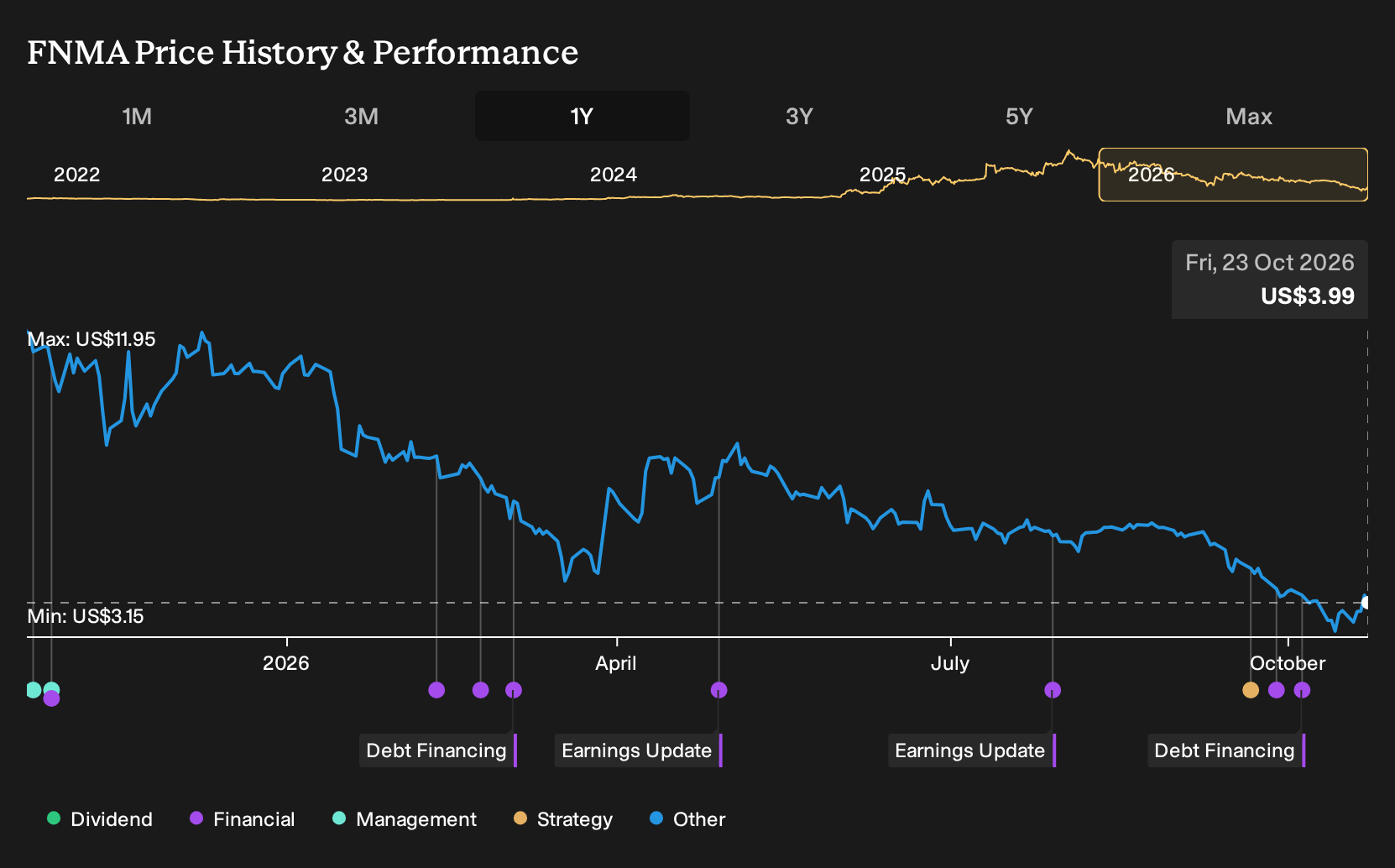
Why Fannie Mae Stock Is Back In Focus As Conservatorship Exit Talk Returns
- Federal National Mortgage Association, or Fannie Mae, is back in focus after Bill Ackman and Treasury Secretary Scott Bessent publicly discussed the timing of its exit from government conservatorship and potential changes to its ownership structure.
- The debate highlights how political control over Fannie Mae’s cash generation intersects with its large guaranty book, capital build and role in supporting U.S. housing finance.
- We will now assess how Fannie Mae’s investment narrative could be affected by the renewed debate over the timing of its conservatorship exit.
Federal National Mortgage Association Investment Narrative Recap
To own Federal National Mortgage Association, you need to be comfortable with a housing finance story that leans on a large $4.1b guaranty book, steady guaranty fee streams, and a leaner cost base supported by automation and AI. The immediate swing factor is still how credit costs evolve in single family and multifamily as mortgage volumes react to rate moves and buyer sentiment.
The biggest operational risk right now sits in multifamily stress, where weaker property valuations and higher serious delinquencies could push provisions and squeeze margins. The renewed conservatorship debate is important for equity value, but it does not materially change near-term credit, funding, or expense pressures.
The most relevant development for this debate is Scott Bessent signaling that Treasury may address Fannie Mae’s ownership structure in the 2027 to 2028 window, in contrast to Bill Ackman’s push for a faster exit. That timeline shapes how long current capital build, credit risk transfer usage, and retained portfolio strategy remain constrained by conservatorship terms.
For investors, that means the operational catalysts analysts already highlight, such as repricing the guaranty book to higher average fees and shifting the balance sheet toward higher-yielding assets, still sit alongside elevated regulatory and political risk. Any change in structure or capital framework would flow directly into how Fannie Mae funds its US$27.8b revenue engine and manages interest rate and credit exposure.
What The Current Forecasts Assume For Fannie Mae
Federal National Mortgage Association's narrative projects US$32.1b revenue and US$169.4 thousand earnings by 2029. This rests on 5.7% yearly revenue growth and an earnings decline of about US$67.8m from US$68.0m today.
Uncover why Federal National Mortgage Association's fair value highlights a 163% potential upside to its current price, indicating a valuation gap that could narrow in a relatively short period.
Exploring Other Perspectives
You can also consider a different angle. The most cautious analysts treat conservatorship timing as a key risk for Fannie Mae and already factor in about US$32.0b revenue and US$29.4b earnings for 2029 before this news. That reflects a far more optimistic profit path, and these views could change as the exit debate evolves.
Explore 5 other Federal National Mortgage Association fair value estimates, including one that suggests it could be worth just $7.40!
Reach Your Own Conclusion
Disagree with existing narratives? Extraordinary investment returns rarely come from following the herd, so rely on your own analysis and judgment.
- A great starting point for your Federal National Mortgage Association research is our analysis highlighting 2 key rewards and 3 important warning signs that could impact your investment decision.
- See our latest analysis for Federal National Mortgage Association. The report includes a comprehensive fundamental analysis summarized in a single visual, the Snowflake, making it easy to evaluate Federal National Mortgage Association's overall financial health at a glance.
Looking for more investment ideas beyond Federal National Mortgage Association?
If the Fannie Mae story has you rethinking where housing finance fits in your portfolio, it can help to widen the lens and compare it with other businesses that offer different combinations of quality, balance sheet strength, and income potential.
- For investors who want quality and value in one place, scan a curated mix of robust businesses trading at restrained valuations through 29 high quality undervalued stocks.
- If capital preservation and stability are higher on your checklist, focus on companies that score well on financial resilience metrics by reviewing the 30 resilient stocks with low risk scores.
- For those building around cash flow durability and strong fundamentals, compare Federal National Mortgage Association with other financially sound operators using the list of solid balance sheet and fundamentals (24 results).
Have feedback on this article? Concerned about the content? Get in touch with us directly. Alternatively, email editorial-team@simplywallst.com