


EN
North Atlantic Energies (ENXTPA:NAE) Draws Fresh Value Interest As Its Low P/S Raises Questions
Recent attention on North Atlantic Energies (ENXTPA:NAE) stems from its very low P/S ratio versus sector and broader peer averages. This has prompted investors to recheck the €74 share price against the refining business fundamentals.
Recent moves have been choppy. The share price jumped 5.71% in the last session but is still down 25.93% over 30 days and 6.33% over the past week. At the same time, a 64.15% year to date share price return and very large five year total shareholder return signal that long term momentum in North Atlantic Energies has been strong, even as shorter term sentiment cools around its low P/S valuation story.
Scan 194 high quality undervalued stocks that share North Atlantic Energies' low P/S profile so you can compare this refining story against other potential deep value setups in one place.At a €74 share price and an intrinsic value estimate that screens at a 92.30% discount, North Atlantic Energies looks harshly priced after a sharp pullback. Are investors correctly treating this as a value trap, or mispricing it based on fundamentals?
Preferred Multiple of 0.1x P/S: Is it justified?
On the surface, the picture is blunt. North Atlantic Energies trades on a P/S of 0.1x, while peers in the European Oil and Gas group sit closer to 1.8x and the broader comparable set is around 3.9x. That is a steep gap for a €74 share price that already screens at a 92.30% discount to an intrinsic value estimate.
P/S compares the market value of the equity to the revenues the business generates. For a refiner like North Atlantic Energies, which reported €11,407.4m of sales but a net loss of €38.4m, the ratio focuses on the top line rather than current profitability. Investors often lean on this measure for companies where earnings are either cyclically depressed or still volatile.
NAE screens as good value against both its peer average and the wider European Oil and Gas industry on this single metric. The P/S of 0.1x is described as attractive versus the 1.8x sector level and 3.9x broader peer figure. This suggests the market is pricing the refining and distribution business at a heavy discount to the revenue it produces.
The catch is that other metrics paint a tougher backdrop. Earnings have declined 47.9% per year over the past 5 years, the group is currently loss making, return on equity is negative at 5.3%, and the dividend payout ratio of 81.36% is not well covered by earnings or free cash flows. Debt is also not well supported by operating cash flow and all reported liabilities are from higher risk funding sources rather than deposits. In that setting, a very low P/S can reflect investor caution around the quality and durability of those sales rather than a straightforward bargain.
Board and governance signals pull in the same direction. The firm has brought in 6 new directors over 3 years, the average board tenure is 1.3 years, and only 22% of directors are considered independent. At the same time, CEO Charles's compensation is both below typical French market peers and flagged as consistent with recent performance. This may reassure some shareholders who worry about pay disconnecting from results.
Market performance offers another cross-check. Total shareholder return over 1 year is 93.14%, yet that still trails the French Oil and Gas industry, which returned 44.4%. The stock also underperformed the wider French market that declined 9.2% over the same period. Volatility over the last 3 months has been higher than the domestic market, which fits with the combination of a low valuation multiple and unprofitable status.
One element that complicates the picture is the strong outcome from the SWS DCF model. That discounted cash flow framework puts future cash flow value at €961.08 per share, versus the current €74 trading price, and flags North Atlantic Energies as trading "at 92.3% below our estimate of its fair value." This is a very different message to the risks implied by the earnings record and funding mix, so investors weighing the P/S signal may want to keep that DCF anchor in mind as a cross-check.
Result: Preferred multiple of 0.1x price-to-sales ratio (UNDERVALUED)
Look into how the SWS DCF model arrives at its fair value.
Still, North Atlantic Energies faces clear pressure from its current loss-making position and from debt that is not well supported by operating cash flow.
Find out about the key risks to this North Atlantic Energies narrative.
Another view on North Atlantic Energies' value
The SWS DCF model tells a very different story for North Atlantic Energies. On that framework, the share price of €74 screens as heavily undervalued against an estimated future cash flow value of €961.08 per share. That gap is huge, so which signal should you trust more: the low P/S tag or the DCF output?
Look into how the SWS DCF model arrives at its fair value.
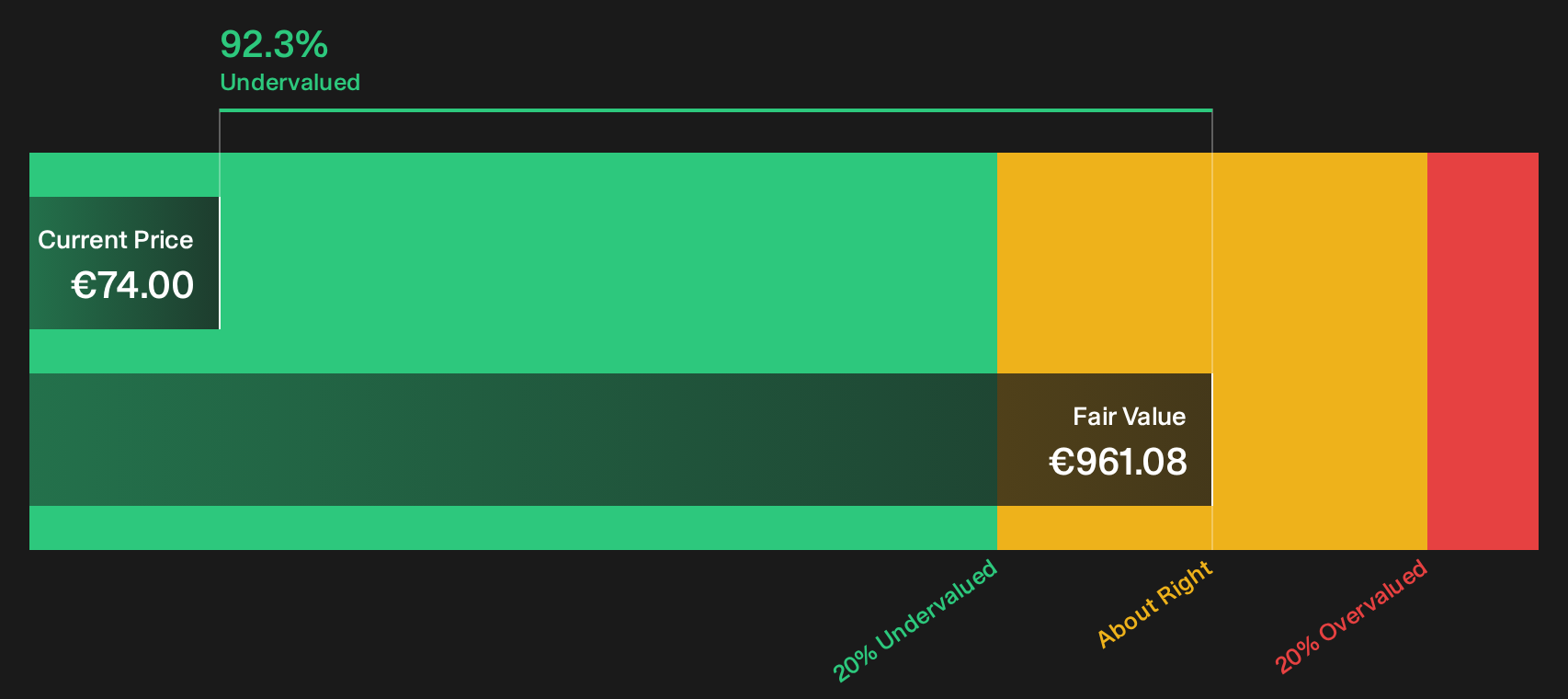
Simply Wall St performs a discounted cash flow (DCF) on every stock in the world every day (check out North Atlantic Energies for example). We show the entire calculation in full. You can track the result in your watchlist or portfolio and be alerted when this changes, or use our stock screener to discover 194 high quality undervalued stocks. If you save a screener we even alert you when new companies match - so you never miss a potential opportunity.
Next Steps
Sitting between a harsh P/S tag and a generous DCF output, sentiment around North Atlantic Energies is clearly split and time sensitive. Act quickly, review the underlying data, and use the 1 key reward and 4 important warning signs to weigh both sides before deciding where you stand.
Looking for more investment ideas beyond North Atlantic Energies?
Do not stop with North Atlantic Energies. Use the Simply Wall Street Screener to uncover fresh opportunities that fit your risk tolerance and return goals.
- Target potential mispriced opportunities by reviewing the 194 high quality undervalued stocks and compare how their valuations stack up against what you see in North Atlantic Energies.
- Strengthen your capital base by focusing on financially robust candidates in the list of solid balance sheet and fundamentals (205 results) that may handle tough conditions more effectively.
- Spot lesser known prospects by scanning the 613 high quality undiscovered gems before other investors start paying closer attention.
Have feedback on this article? Concerned about the content? Get in touch with us directly. Alternatively, email editorial-team@simplywallst.com