


EN
Taisei (TSE:1801) Could Be 35% Below Fair Value Following Autoflow Road Trial
Taisei (TSE:1801) has been pulled into focus after Japan's Ministry of Land, Infrastructure, Transport and Tourism selected it for an Autoflow Road logistics trial using unmanned cargo vehicles in dedicated lanes.
The Autoflow Road trial lands at a time when Taisei’s 1-day share price return of 0.58% sits against a year-to-date share price decline of 26.62%. Longer term total shareholder returns of 4.28% over 1 year and very strong gains over 3 and 5 years suggest momentum has cooled recently, but the multi-year story remains constructive.
Spot 95 robotics and automation stocks that, like Taisei, are tied into real-world automation projects where logistics, infrastructure and autonomous systems are already being tested on the ground.Taisei looks like a solid infrastructure and construction platform with real autonomous logistics exposure. After a share price that has cooled sharply this year, is that strength actually available at a reasonable valuation today?
Taisei valuation check: what the DCF says at today’s price
On Simply Wall St’s DCF model, Taisei is pegged with an estimated future cash flow value of ¥17,205.52 per share, against a last close of ¥11,235. That gap lines up with the platform’s summary that the stock is trading about 34.7% below its estimate of fair value.
The SWS DCF model projects Taisei’s future cash flows based on current earnings and analyst forecasts, then discounts those back to today using a required rate of return. It turns a long stream of expected cash into a single present value number so you can compare it directly with the current share price in ¥.
For a long-established construction and civil engineering group earning ¥171,412.0m on revenue of ¥2,169,967.0m, this kind of cash flow based approach can be useful. Annual revenue growth of 4.9% and net income growth of 2.6% in the supplied data keeps expectations anchored, while still supporting a DCF outcome that sits above where Taisei trades after this year’s share price pullback.
Look into how the SWS DCF model arrives at its fair value.
Result: DCF Fair value of ¥17,205.52 (UNDERVALUED)
Still, the Taisei story can be knocked off course if construction demand weakens or if large infrastructure and logistics projects face delays or cancellations.
Find out about the key risks to this Taisei narrative.
Another view on Taisei’s valuation
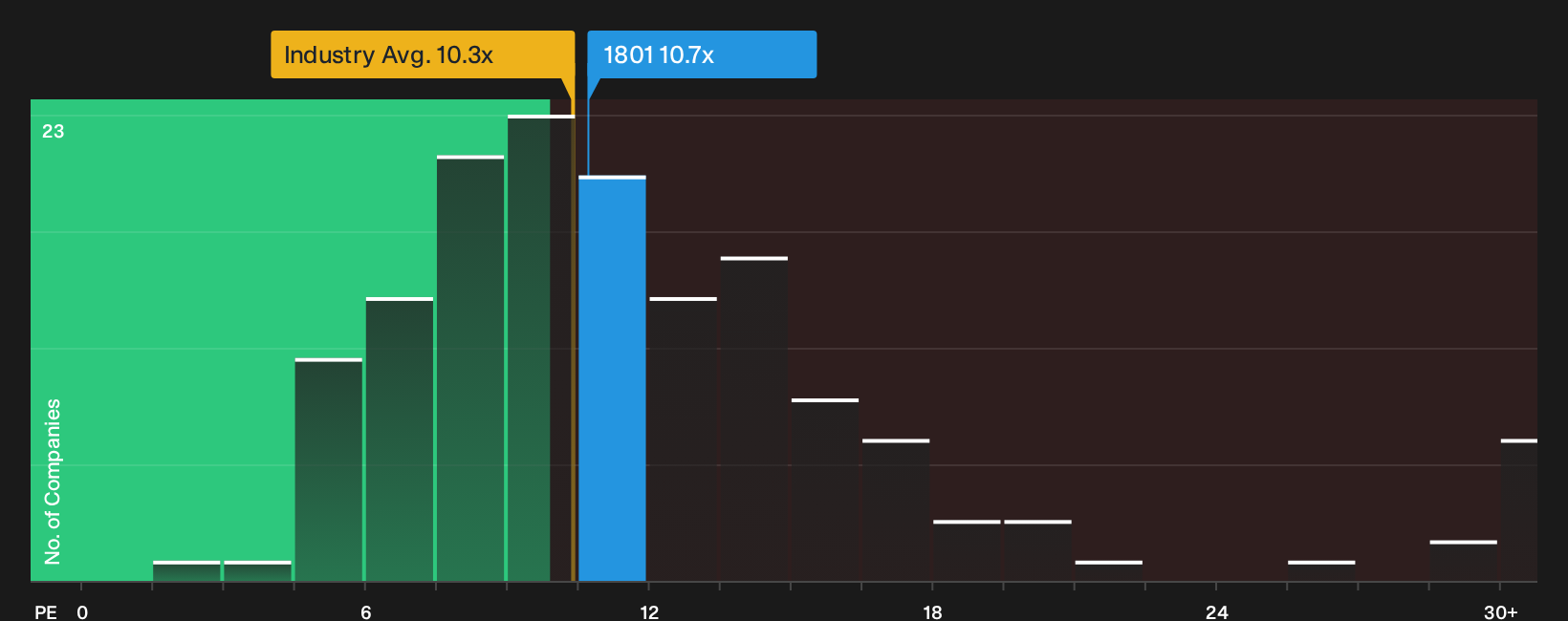
On simple earnings multiples, Taisei looks less clear cut. The stock trades at a P/E of 10.7x, which is slightly richer than the JP Construction sector at 10.3x, yet below peers at 11.5x and below a fair ratio of 18x. That mix of modest premium locally and lower level versus the fair ratio leaves you weighing whether the recent share price slide reflects caution that may fade, or a message investors should listen to.
See what the numbers say about this price — find out in our valuation breakdown.
Simply Wall St performs a discounted cash flow (DCF) on every stock in the world every day (check out Taisei for example). We show the entire calculation in full. You can track the result in your watchlist or portfolio and be alerted when this changes, or use our stock screener to discover 14 high quality undervalued stocks. If you save a screener we even alert you when new companies match - so you never miss a potential opportunity.
Next Steps
Mixed signals on Taisei’s valuation and project pipeline can pull you in both directions, so move quickly, test the numbers yourself, and then check the 4 key rewards and 1 important warning sign
Looking for more investment ideas beyond Taisei?
Do not stop with a single construction stock when the wider market offers a huge range of different risk and return profiles to compare.
Spot new potential compounders by using a focused screener that highlights 14 high quality undervalued stocks.
Balance your portfolio with dependable income by scanning for 29 dividend fortresses.
Dial down portfolio volatility by zeroing in on companies flagged in the 22 resilient stocks with low risk scores.
Have feedback on this article? Concerned about the content? Get in touch with us directly. Alternatively, email editorial-team@simplywallst.com