


EN
Did Oral IL 23 Deal Just Shift Gilead Stock Investment Narrative?
- Gilead Sciences agreed to acquire PepStar Therapeutics’ oral IL-23 receptor inhibitor program in a deal valued at up to US$1.275b, and it is also preparing extensive data presentations across liver disease and HIV at major 2026 medical meetings.
- The PepStar transaction and expanded data disclosures indicate that Gilead Sciences is committing more capital and research focus to inflammation and liver disease alongside its HIV platform.
- We will look at how Gilead Sciences’ investment narrative is influenced by the PepStar inflammation deal as it broadens beyond HIV.
Gilead Sciences Investment Narrative Recap
To own Gilead Sciences, you need to believe the HIV engine, both treatment and prevention, can stay resilient while newer areas like oncology, liver disease and inflammation become a larger part of the mix. The short term focus is on improving profitability from today’s loss making position and keeping HIV volumes and pricing steady despite policy and competitive pressure.
The Texas Medicaid settlement looks manageable against a near US$193b market cap and does not change the main earnings swing factors. The bigger risk remains execution. If new products in HIV prevention, oncology and inflammation underperform or pricing pressure intensifies, the path back to strong margins and dividend coverage becomes harder.
The recent US$45m Texas settlement is the most directly relevant event because it speaks to legal, pricing and reputational risk in an area where Gilead Sciences earns much of its revenue. Management has now put this specific overhang behind the business. Investors can better focus attention on whether future compliance costs or contract terms tighten around government reimbursement.
In that context, the pipeline and data flow, including upcoming HIV and liver presentations, sit as the key operational catalysts. If clinicians see consistent safety and efficacy in real world and late stage studies, it supports the narrative that Gilead Sciences can offset policy headwinds and gradually reduce its dependence on a single therapeutic category.
What The Current Forecasts Assume For Gilead Sciences
Analysts are effectively sketching out a Gilead Sciences where the existing portfolio funds a shift into higher margin areas. Consensus calls for revenue to rise by 5.3% a year for the next three years, with profit margins moving from a reported loss position of 10.6% today to 32.4% by 2029. On those numbers, earnings are projected to move from a loss of US$3.2b today to US$11.5b by 2029, which implies roughly a 4.6x swing in profit if the business achieves that margin reset. The same forecasts assume only a very small reduction in share count, about 0.06% a year, so most of the heavy lifting in earnings per share would need to come from higher profitability rather than financial engineering.
Gilead Sciences' narrative projects US$35.5b revenue and US$11.5b earnings by 2029. This requires 5.3% yearly revenue growth and roughly a 4.6x earnings increase from a loss of US$3.2b today.
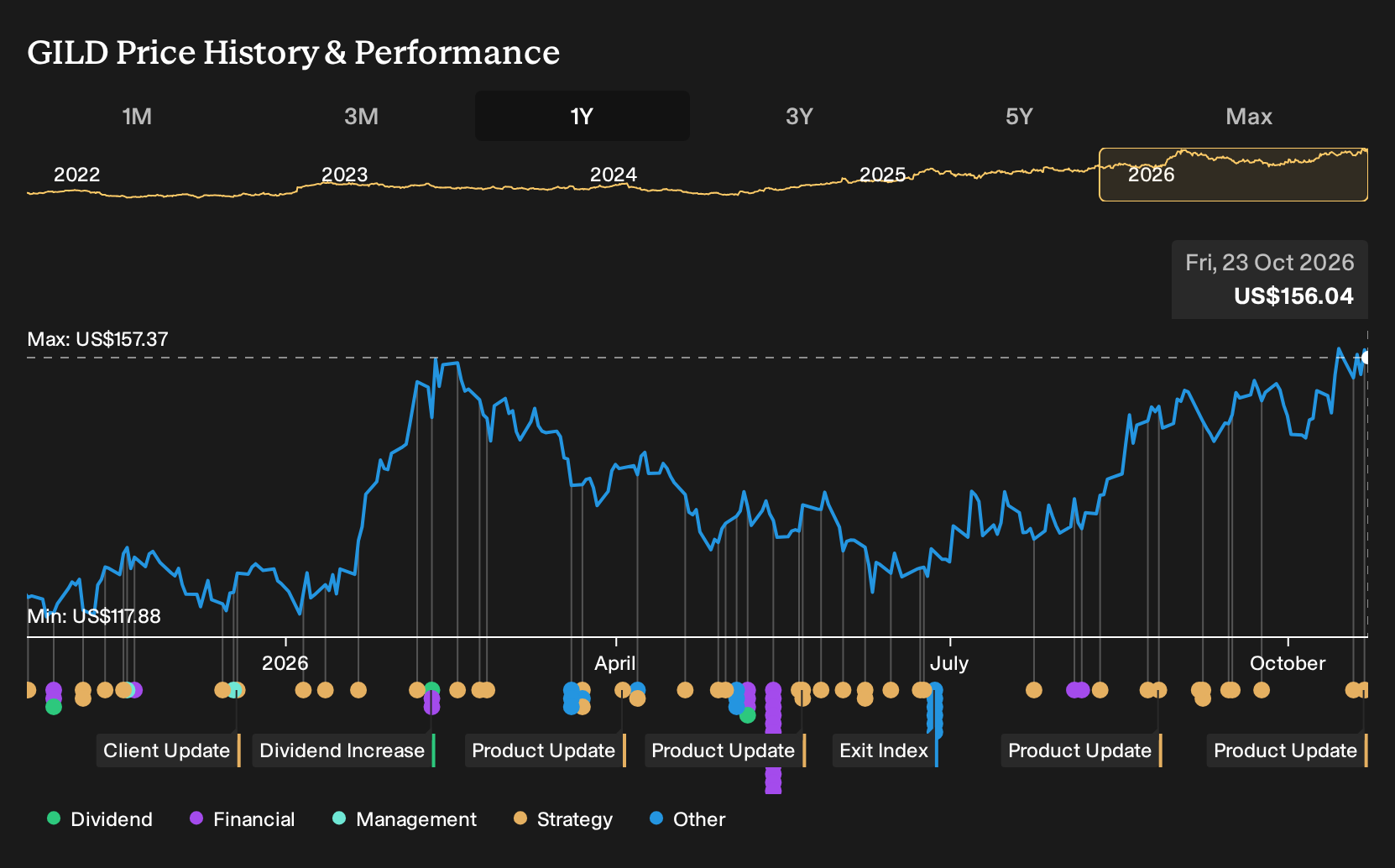
On valuation, the analyst framework ties these earnings and margin targets to a P/E of 21.3x in 2029, which is above the cited 17.1x level for the broader US biotech peer group. The consensus price target of US$158.65 sits only 4.6% above the current share price of US$151.28. This points to a view that the stock already prices in much of this recovery in profitability and capital allocation. A bullish case stretches that target to US$180, while the most cautious estimate is US$123. The spread in opinions is wide enough that readers need to decide whether a 5.3% top line growth rate and a swing to 32.4% margins feels realistic in the context of HIV concentration, PepStar related spend on inflammation and the ongoing push in oncology.
Uncover why Gilead Sciences' fair value indicates that Gilead Sciences is roughly in line with its current price.
Exploring Other Perspectives
One alternate view focuses on long acting HIV and liver disease as the real swing factors for Gilead Sciences, not just margin repair. Before this week’s PepStar deal and the Texas settlement, the most optimistic analysts were outlining revenue of about US$39.1b and earnings of US$16.4b by 2029. Those targets reflect a more positive view of HIV PrEP and oncology uptake. Your job is to weigh that against fresh legal and data headlines and decide which story feels closer to reality.
Explore 4 other Gilead Sciences fair value estimates, including one that suggests as much as 102% upside from the current price.
Form Your Own Verdict
Disagree with existing narratives? Extraordinary investment returns rarely come from following the herd, so trust your own analysis and instincts.
- A great starting point for your Gilead Sciences research is our analysis highlighting 3 key rewards and 2 important warning signs that could impact your investment decision.
- See our latest analysis for Gilead Sciences. The report includes a comprehensive fundamental analysis summarized in a single visual, the Snowflake, making it easy to evaluate Gilead Sciences' overall financial health at a glance.
Looking For More Investment Ideas Beyond Gilead Sciences?
Once you have a view on Gilead Sciences, it can help to compare that thesis against a wider watchlist of potential opportunities using the Simply Wall St screener.
- For investors who want income resilience, start with a curated set of companies that have paid-up yields and sturdy payout profiles through the 5 dividend fortresses.
- If capital preservation ranks high on your list, focus on businesses with healthier balance sheets and cleaner fundamentals by using the list of solid balance sheet and fundamentals (24 results).
- For those hunting for under-the-radar potential, scan a curated pool of quality businesses that receive less attention but have stronger fundamentals with the 21 high quality undiscovered gems.
Have feedback on this article? Concerned about the content? Get in touch with us directly. Alternatively, email editorial-team@simplywallst.com