


EN
Hershey (HSY) Faces A 114% Premium As Earnings Hopes Lift Snack Growth Interest
Hershey (HSY) is back on investor watch after fresh commentary pointed to higher earnings expectations for the upcoming September 2026 quarter and growing attention on its salty snacks push, especially Dot's Homestyle Pretzels.
Recent enthusiasm around Hershey’s salty snacks and earnings outlook comes after a choppier period for the stock, with the share price down about 7% year to date and the 1-year total shareholder return slipping 2.6%, even as shorter term moves have been mixed.
Scan other consumer stocks that mix strong brands with expansion angles similar to Hershey’s salty snacks push by checking our curated 21 high quality undiscovered gems list.
Hershey now trades at a clear discount to both analyst targets and some fair value estimates, even after the recent share pullback. Is that a genuine margin of safety, or is the market pricing real risk into this story?
Most Popular Narrative: 114% Overvalued
Hershey last closed at $169.64, while the most followed narrative on the stock, according to Esteban, pegs fair value closer to $79.25 per share. That gap puts the spotlight on how much investors are paying today for what is described as a slow but very reliable cash generator.
A fortress brand and scale position in U.S. confectionery (Reese’s, Hershey’s, Kisses) generates ~23% through-cycle ROIC and exceptionally durable free cash flow that fell only ~13% even in the worst input-cost year on record. The 2025 cocoa shock, a ~60% GAAP EPS collapse driven largely by non-cash hedge mark-to-market, obscured an underlying cash engine that remained intact.
See why 6 investors see Hershey as 114% overvalued.
Esteban’s narrative frames Hershey as a high quality consumer staple with a binding constraint on growth rather than resilience. With revenue growth in the narrative set at a decline of 9.21% and an applied discount rate of 7.108%, the conclusion is that a dependable earnings stream still does not justify the current P/E implied by today’s share price versus that lower fair value anchor.
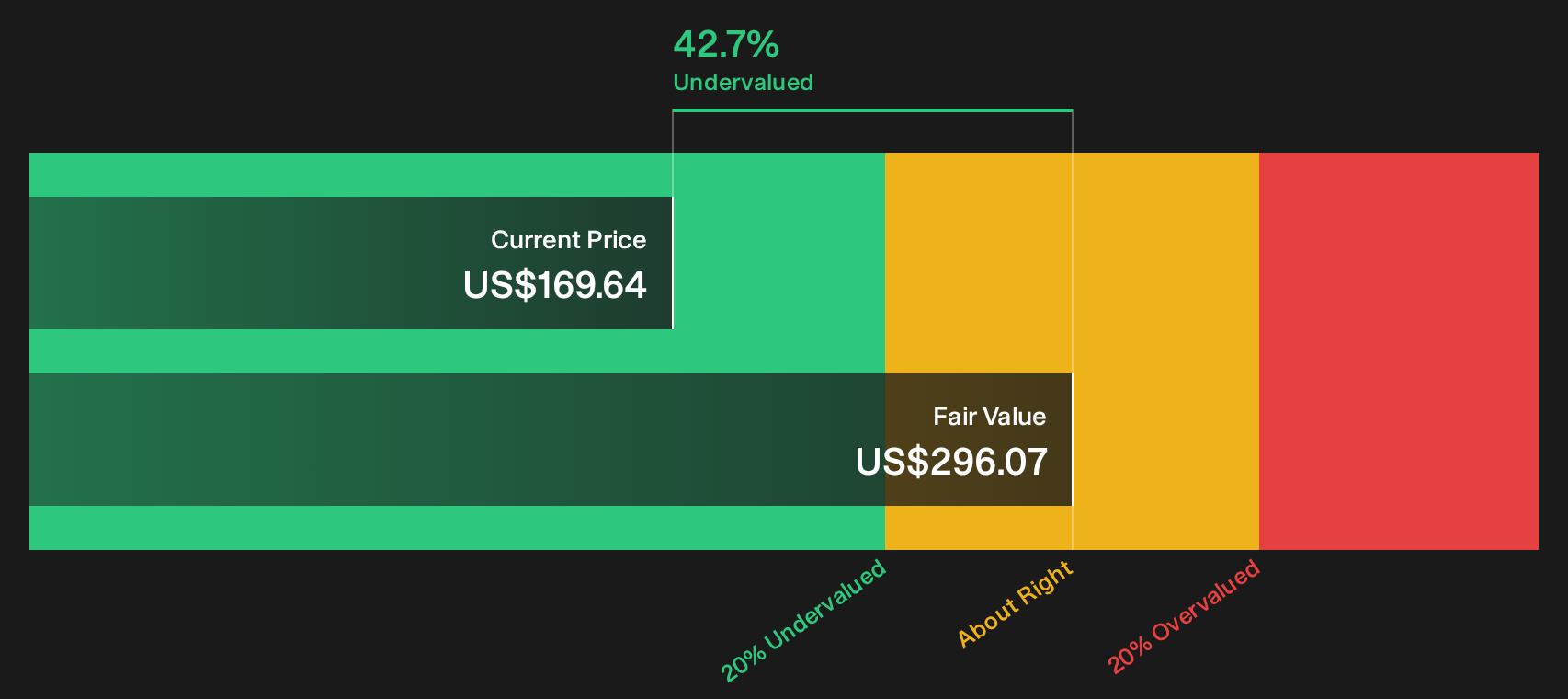
Put differently, the story casts Hershey as a business that protects the downside through brand strength and cash generation, while offering limited upside if expansion in salty snacks and international markets falls short of expectations baked into the current valuation. For readers comparing this to the earlier fair value work that showed the stock trading 42.7% below an estimate of intrinsic value, it underlines how sensitive outcomes can be to assumptions about long term growth and risk.
Result: Fair Value of $79.25 (OVERVALUED)
Still, Hershey’s narrative could shift quickly if cocoa costs fail to ease as assumed, or if salty snacks struggle to turn strong brands into sustained category share gains.
Find out about the key risks to this Hershey narrative.
Another View: Hershey Through The DCF Lens
Esteban’s $79.25 fair value leans on conservative growth. Our DCF model points in the opposite direction, with Hershey at $169.64 trading below an estimated future cash flow value of $296.07, which frames the shares as undervalued rather than stretched. Which cash flow story feels more realistic to you?
For readers who want to see the full cash flow path that underpins that figure, start with the SWS DCF model walk through here, then compare it to your own expectations for cocoa, salty snacks and earnings quality over the next decade Look into how the SWS DCF model arrives at its fair value..
Next Steps
Mixed signals around Hershey’s valuation can make the story feel murky. Move fast, pull up the numbers yourself, and pressure test both sides of the argument with the 3 key rewards and 1 important warning sign.
Looking for more Hershey-sized investment ideas?
Do not stop with Hershey. Use this momentum to scan fresh opportunities that fit your own risk, income, and quality filters with the Simply Wall Street Screener.
- Target potential mispricings by assessing companies that look beaten down on headline numbers yet still pass strict quality checks through the 29 high quality undervalued stocks.
- Lock in potential income streams by focusing on businesses that combine higher yields with staying power using the 5 dividend fortresses.
- Dial down risk by concentrating on financially robust operators with strong balance sheets that can better handle shocks inside the list of solid balance sheet and fundamentals (24 results).
Have feedback on this article? Concerned about the content? Get in touch with us directly. Alternatively, email editorial-team@simplywallst.com