


EN
What Moody's (MCO)'s Higher Third Quarter Earnings Mean For Shareholders
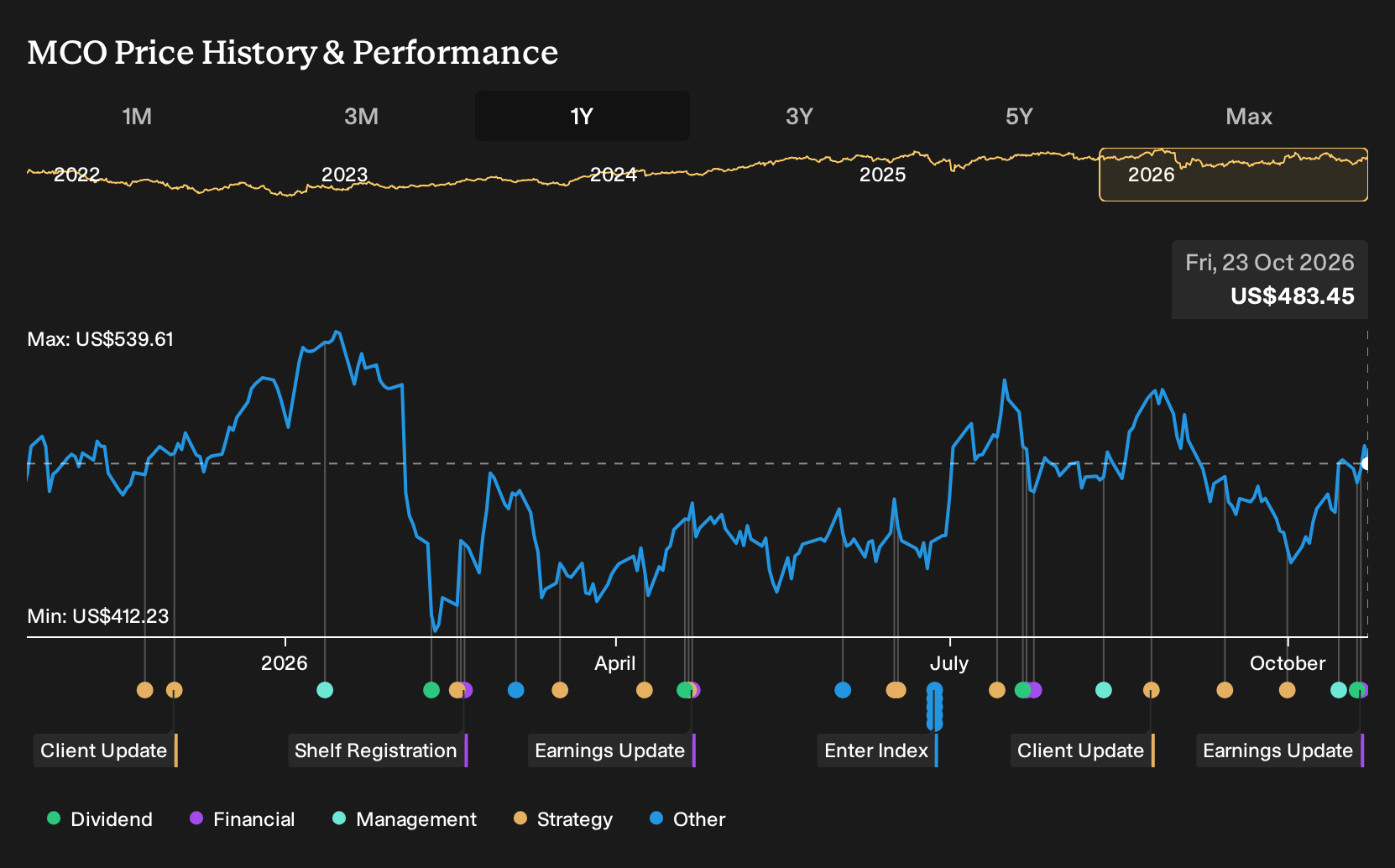
- Moody's reported third quarter 2026 revenue of US$2,023 million and net income of US$734 million, with diluted EPS from continuing operations of US$4.24. The company also affirmed a quarterly dividend of US$1.03 per share and announced board and committee changes earlier in October.
- The combination of higher earnings per share over both the quarter and first nine months of 2026, together with ongoing dividend payments, shows how Moody's is pairing operating performance with continued capital returns, while also updating audit and governance oversight through recent board appointments.
- We will now look at how Moody's investment narrative could be affected by this increase in third quarter earnings per share.
Scan earnings-driven stories like Moody's and spot other companies pairing rising EPS with ongoing payouts using our hand picked 5 dividend fortresses
Moody's Investment Narrative Recap
To own Moody's, you need to believe the franchise can keep turning demand for credit ratings and risk tools into steady earnings, even when issuance cycles are choppy. The latest quarter showed higher sales and EPS on both a three and nine month view, which supports that story but does not remove the cyclicality in deal activity that still drives a lot of Moody's Investors Service.
The key near term swing factor remains how issuance and private credit workflows hold up against management's cautious guidance. The biggest risk is that investors are assuming smoother execution in Moody's Analytics recurring revenue and AI efficiency plans than future segment disclosures ultimately support.
The dividend affirmation of US$1.03 per share for payment in December 2026 is the update that ties closest to the earnings release. It signals that Moody's is continuing to return cash while funding investments in areas like private credit analytics, cloud distribution and AI integrations that have been central to the recent narrative.
For you, the link between a recurring payout and the current catalyst set is about discipline. If free cash flow or leverage were to come under pressure, capital returns could be an area the board rebalances, so watching the dividend alongside any updates on cash generation, restructuring costs and debt levels remains important.
Moody's narrative projects US$9.8b revenue and US$3.5b earnings by 2029. This implies that analysts are working with a 6.4% yearly revenue growth rate and an earnings increase of about US$700m from current earnings of US$2.8b.
Uncover how Moody's fair value indicates a 16% potential upside to its current price before other investors close the valuation gap.
Exploring Other Perspectives
Eight fair value estimates from the Simply Wall St Community span roughly US$432 to US$562, so some retail analysts see Moody's as materially undervalued, while others lean toward a richer pricing. Set that wide spread against risks around issuance cooling or free cash flow pressure. Use it as a prompt to explore contrasting viewpoints, not a single story.
Explore 7 other Moody's fair value estimates, including one that indicates as much as 11% downside from the current price.
Decide For Yourself
Don't just follow the ticker. Dig into the data and build a conviction that's truly your own.
- A great starting point for your Moody's research is our analysis highlighting 3 key rewards and 1 important warning sign that could impact your investment decision.
- See our latest analysis for Moody's. The report includes a comprehensive fundamental analysis summarized in a single visual, the Snowflake, making it easy to evaluate Moody's overall financial health at a glance.
Looking For More Ideas Beyond Moody's?
Once you have a view on Moody's, broaden your opportunity set by lining it up against other businesses with different risk, income, and balance sheet profiles using the Simply Wall St Screener.
- For investors who want income without ignoring quality, compare Moody's dividend profile with a curated 5 dividend fortresses that screens for higher yields and resilient fundamentals.
- If value is your anchor, measure Moody's against a 29 high quality undervalued stocks that combines robust cash flows with cheaper P/E and P/FCF multiples.
- For a focus on financial resilience, weigh Moody's leverage and liquidity against a list of solid balance sheet and fundamentals (24 results) that highlights companies with stronger debt coverage and asset backing.
Have feedback on this article? Concerned about the content? Get in touch with us directly. Alternatively, email editorial-team@simplywallst.com