


EN
Why D Wave Quantum (QBTS) Could Be 67% Undervalued On Lawsuit Fallout
D-Wave Quantum (QBTS) is back in focus after multiple securities class action lawsuits accused the business and senior executives of overstating its financial and operational prospects between February and August 2026, which has pressured sentiment around the stock.
The legal headlines and softer sentiment have lined up with a sharp reset in D-Wave Quantum’s share price, which is down 30.6% over the past month and 58.6% year to date, even though the three year total shareholder return is still extremely high, while the one year total shareholder return has fallen 64.3%.
Seize this moment to compare D-Wave Quantum’s legal overhang with other quantum computing plays by scanning our hand picked 25 quantum computing stocks.D-Wave Quantum still has real products, partners and revenue growth on the table, yet the share price has been sharply reset. Is this now a mispriced asset or a fair mark down of the risk?
Most Popular Narrative: 67% Undervalued
On Simply Wall St, the most followed narrative values D-Wave Quantum at a fair value of $35.24 against a last close of $11.66, which frames the current legal uncertainty in comparison with a much higher long term scenario.
Broadening use of quantum and AI for drug discovery, financial services and telecom optimization, combined with more than 100 revenue generating customers and a strong cash position, may create a platform to compound bookings and narrow adjusted net losses over time.
See why 110 investors see D-Wave Quantum as 67% undervalued.
Result: Fair Value of $35.24 (UNDERVALUED)
Still, the story can break if large system deals dry up, or if higher R&D and sales spending fails to convert that record backlog into sustained revenue.
Find out about the key risks to this D-Wave Quantum narrative.
Another View On D-Wave Quantum’s Valuation
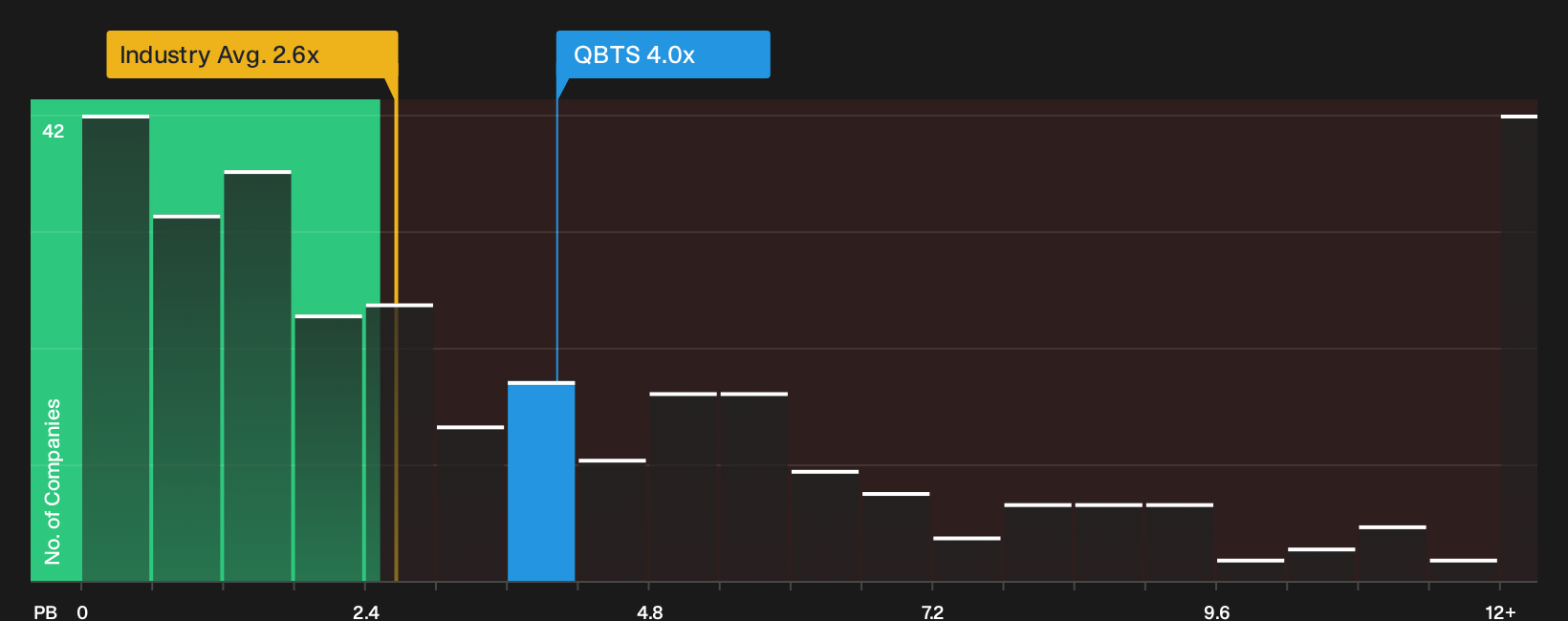
The analyst narrative focuses on long term earnings and price targets. A simpler cross check looks at today’s P/B of 4x for D-Wave Quantum versus 2.6x for the wider US Software group and 13.1x for direct peers, which highlights both premium and discount signals depending on the comparison used.
Paying above the sector average multiple can indicate that investors are already factoring in ambitious revenue and margin outcomes. At the same time, the gap to peer levels suggests that some investors might see room for the share price to shift closer to those higher ratios if execution aligns with expectations. The key question is which group of investors has the more accurate view of the risk.
See what the numbers say about this price — find out in our valuation breakdown.
Next Steps
Mixed signals around D-Wave Quantum can feel messy, so consider acting promptly to weigh the legal risks against the long term upside and study the 1 key reward and 2 important warning signs.
Looking for more investment ideas beyond D-Wave Quantum?
If you stop at D-Wave Quantum, you risk missing other opportunities that may better match your goals, risk comfort and time horizon.
- Target robust balance sheets and fundamentals by scanning our list of solid balance sheet and fundamentals (25 results).
- Hunt for potential mispriced quality by checking the 27 high quality undervalued stocks.
- Zero in on resilient, lower risk profiles through the 30 resilient stocks with low risk scores.
Have feedback on this article? Concerned about the content? Get in touch with us directly. Alternatively, email editorial-team@simplywallst.com