


EN
How Bigger Credit Line Will Impact Avnet (AVT) Investors
- Avnet and Avnet Holding Europe BV recently amended their Third Amended and Restated Credit Agreement, lifting total committed capacity to US$2.75b, raising potential additional commitments to US$1b, and removing the SOFR credit spread adjustment while leaving other terms largely unchanged.
- This refinancing move gives Avnet more room to fund working capital swings and potential investment projects without immediately relying on capital markets access.
- We will now see how Avnet's investment narrative around capital efficiency interacts with this larger, lower spread credit facility.
Scan how Avnet’s expanded credit capacity compares with other balance-sheet heavy businesses by reviewing the curated list of solid balance sheet and fundamentals (25 results) that could handle similar financing moves.
Avnet Investment Narrative Recap
To own Avnet, you need to be comfortable with a distribution business that lives on tight margins but aims to compound value through operating discipline, capital efficiency and exposure to complex supply chains in areas like AI hardware, industrial and transportation. The bigger credit facility does not change that core story. It mostly reinforces the idea that liquidity will be available to support working capital and customer demand swings.
The short term swing factor still sits in mix and pricing, especially around memory and Asia, where pressure on gross margin has already shown up. Extra debt capacity could amplify that risk if operating cash flow lags. For now, the amendment looks more like plumbing than a directional shift in the business outlook.
With no other fresh operational announcements in the same period, the credit agreement amendment is the key disclosure to tie back to current catalysts. Management has been talking about operating leverage, with adjusted operating income reported to be growing faster than sales and return on working capital at 19%. Access to up to US$2.75b of committed capacity supports that push by giving room to fund inventory and customer programs.
At the same time, debt is flagged as not well covered by operating cash flow, and all liabilities come from higher risk funding rather than customer deposits. That combination makes execution on working capital and gross margin all the more important. If Avnet can maintain tight cost control, support Farnell margin ambitions and manage exposure to memory pricing, this larger facility could simply be a tool that keeps those operational catalysts in play without forcing equity issuance at awkward times.
What The Analyst Scenario Implies For Avnet
Analysts sketch a version of Avnet where higher credit capacity, improving margins and growing end market demand all intersect with a sizeable step up in financial output over the next few years. That view hinges on revenue compounding at 10.3% a year and profit margins lifting from 1.2% today to 3.7% by around 2029, which is a big shift for a distributor that still has to work through mix, memory exposure and Asia driven pricing pressure.
On earnings, consensus points to profit of US$334.4 million today moving to US$1.4b by about October 2029. That implies earnings a little more than 4x current levels, assuming the company hits both the margin and top line assumptions embedded in the Simply Wall St report. For that outcome to line up with the current analyst price target logic, the stock would also need to trade on a P/E of 8.6x those 2029 earnings, compared with 26.2x today and a current US Electronic industry P/E cited at 30.3x.
On the revenue side, the consensus framework uses US$37.1b in sales by 2029 as the anchor. That sits on top of the 10.3% annual growth rate assumption and the move to a 3.7% profit margin. It effectively connects operational goals such as better working capital turns, tighter SG&A relative to gross profit and Farnell margin targets with a longer run story that is more about scale economics than sudden step changes in pricing power.
Putting that together with the refreshed credit agreement, Avnet now has a larger funding pool to support the sort of inventory and customer program build that tends to show up if those top line and earnings paths are on track. The bigger facility at lower SOFR spreads does not change the analyst model inputs on its own, but it can influence how comfortably the business can pursue those revenue and margin ambitions without constantly leaning on equity markets or shorter term funding.
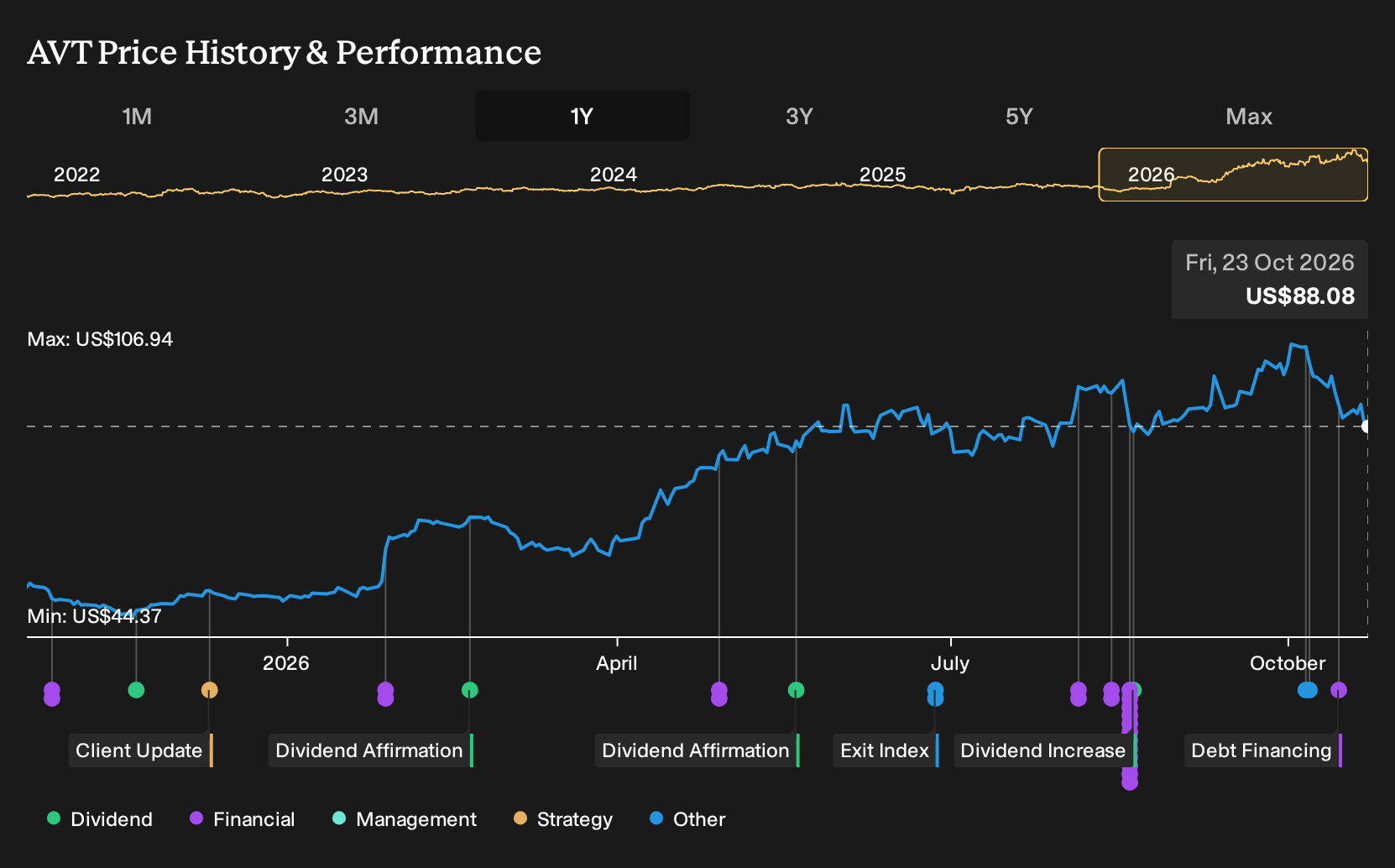
Market expectations look finely balanced around this scenario. The consensus price target of US$106.25 sits only 0.6% below the recent US$106.94 share price, while individual analyst targets range from US$80.00 to US$120.00. That tight gap between the current price and the average target, alongside a wide spread across individual views, shows how closely Avnet’s actual execution on working capital, mix, memory pricing and Farnell profitability will be watched against the numbers embedded in these forecasts.
Avnet's narrative projects US$37.1b revenue and US$1.4b earnings by 2029. This requires 10.3% yearly revenue growth and an earnings increase of roughly US$1.1b from current earnings of US$334.4 million.
Uncover why Avnet's fair value points to a 21% potential upside to its current price, which could narrow quickly.
Exploring Other Perspectives
Some of the most optimistic analysts focus less on margin pressure and more on Avnet’s ability to turn AI related demand and record Asia activity into higher quality earnings. They were already projecting about US$38.0b in revenue and US$1.6b in profit by 2029 before this larger credit facility. In comparison, more cautious targets are closer to US$37.1b in revenue and US$1.4b in profit, which highlights how wide the range of views can be. Treat the new financing as a fresh data point that could influence these narratives in different ways and consider both ends of the range before forming your own view on the stock.
Explore 2 other Avnet fair value estimates, including one that suggests as much as 36% upside from the current price!
The Verdict Is Yours
Disagree with existing narratives? Extraordinary investment returns rarely come from following the herd, so go with your instincts.
- A great starting point for your Avnet research is our analysis highlighting 4 key rewards and 3 important warning signs that could impact your investment decision.
- See our latest analysis for Avnet. The report includes a comprehensive fundamental analysis summarized in a single visual, the Snowflake, making it easy to evaluate Avnet's overall financial health at a glance.
Looking For More Investment Ideas Beyond Avnet?
If Avnet has sharpened your thinking on balance sheets, credit lines and execution risk, use that same lens to scan other opportunities that match your style rather than your watchlist history.
- For investors who want potential mispricing with financial resilience, review a curated set of 27 high quality undervalued stocks that pair solid cash generation with cleaner balance sheets.
- If capital preservation sits high on your checklist, start with a 30 resilient stocks with low risk scores that screens for businesses with stronger financial health scores and fewer red flags.
- When you want to widen the research funnel without sacrificing fundamentals, cast a wider net across a 21 high quality undiscovered gems that many investors may not be watching closely yet.
Have feedback on this article? Concerned about the content? Get in touch with us directly. Alternatively, email editorial-team@simplywallst.com