


EN
How Investors Are Reacting To Lennar (LEN) Community Expansion Plans
- Lennar has recently opened or broken ground on several master planned and single family communities across Georgia, Alabama, New Jersey and downtown Las Vegas, while issuing US$600 million of fixed rate senior notes due 2029 and 2032 for general corporate purposes.
- The combination of new community launches in markets like McDonough and downtown Las Vegas, together with fresh bond financing, highlights how Lennar is using its asset light, land light approach to fund a broader project pipeline despite affordability pressure that weighed on its latest quarterly results.
- We will now examine how Lennar's investment narrative is affected by this expansion of master planned communities funded by recent bond issuance.
Scan how Lennar's community build out compares with other housing developers by running the list of solid balance sheet and fundamentals (25 results) that already filters for robust funding and healthier fundamentals.
Lennar Investment Narrative Recap
To own Lennar, you need to believe its asset light, land light model can keep homes turning quickly even while affordability pressure weighs on demand. The short term swing factor is how effectively Lennar converts its controlled homesites into timely closings after a weaker third quarter, without letting incentives erode already compressed margins.
The main risk right now is a further squeeze on affordability that drags deliveries below the 80,000 to 81,000 target and keeps profit margins stuck below last year. Recent openings and groundbreakings expand the community base but do not meaningfully change that near term tug of war between volume and pricing power.
The launch of King Oaks in McDonough, Georgia is the clearest operational tie in to the current catalyst. It shows Lennar leaning into full service communities with amenities and smart home features baked into the Everything's Included program. That approach can help keep production aligned with demand if buyers still value convenience over bare bones pricing.
For your thesis, the interesting angle is how King Oaks fits alongside Foxwood in Alabama and The Foundry in Las Vegas as a spread of price points and geographies. This cluster of projects tests whether Lennar's faster build times and land light structure can offset higher land and option costs without further pressure on already lower net margins.
Lennar's narrative projects US$40.6b revenue and US$2.7b earnings by 2029. This leans on 8.3% yearly revenue growth and an earnings increase of about US$1.4b from the current US$1.3b base.
Uncover why Lennar's fair value indicates an 8% potential downside to its current price that leaves little room for error.
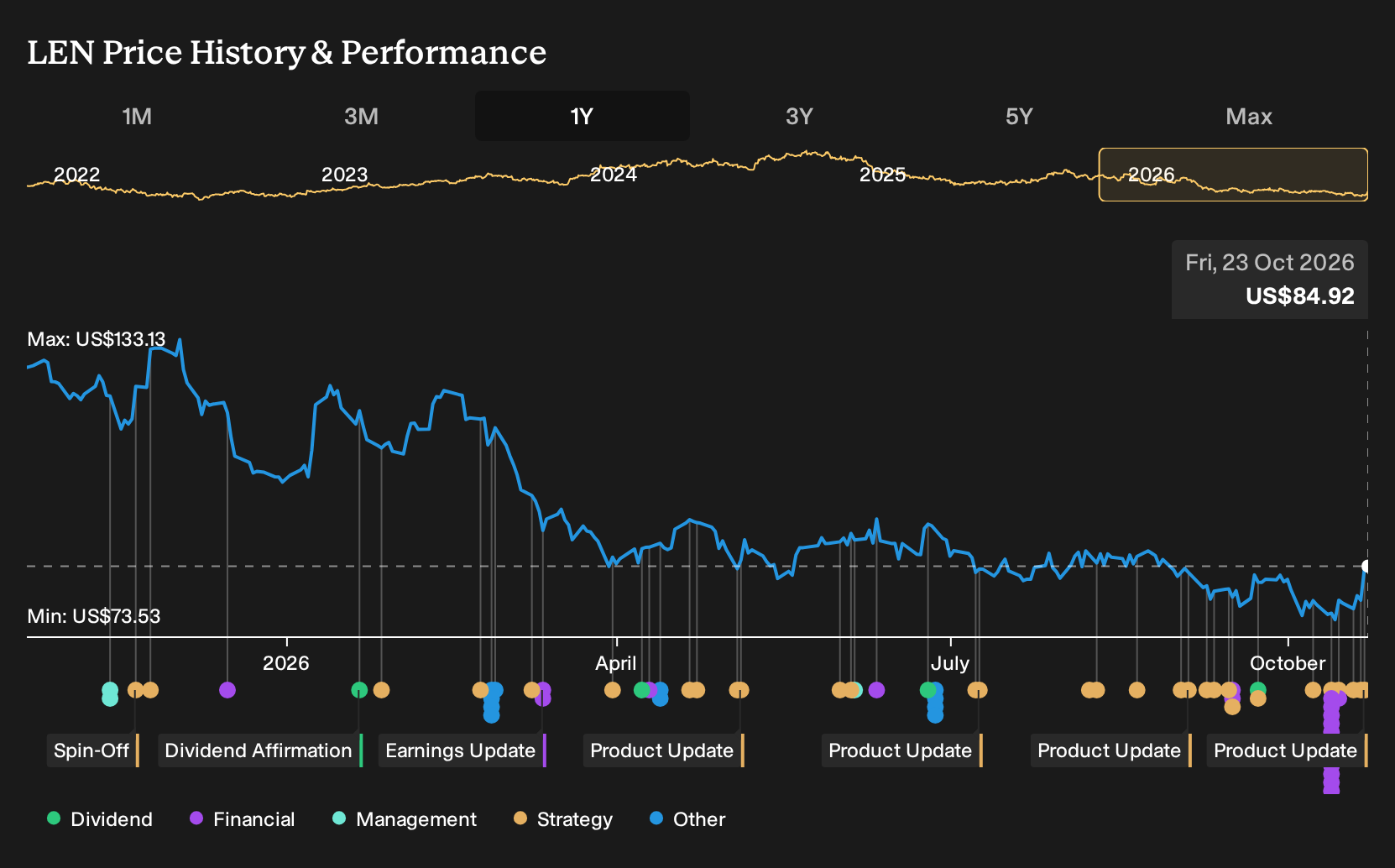
Exploring Other Perspectives
Some of the lowest Lennar analysts lean hard into the affordability risk you see in King Oaks and The Foundry. They were penciling in revenue of about US$35.7b and earnings of roughly US$1.1b by 2029, far below the US$40.6b and US$2.7b consensus view. That gap shows how sharply opinions can differ and why it can be useful to explore several narratives that may shift as these new communities and the US$600m in recent bonds feed into updated models.
Explore 4 other Lennar fair value estimates, including one that suggests as much as 34% downside from the current price!
The Verdict Is Yours
Disagree with existing narratives? Extraordinary investment outcomes rarely come from following the herd, so consider relying on your own analysis.
- A great starting point for your Lennar research is our analysis highlighting 3 key rewards and 1 important warning sign that could impact your investment decision.
- See our latest analysis for Lennar. The report includes a comprehensive fundamental analysis summarized in a single visual, the Snowflake, making it easier to evaluate Lennar's overall financial health at a glance.
Looking For More Ideas Beyond Lennar?
Once you have a view on Lennar, it can help to widen the lens and compare it with other stocks that share similar balance sheet strength, income potential or upside characteristics.
- For investors who want potential upside with strict quality filters on cash flows and balance sheets, scan our 27 high quality undervalued stocks that already screens for both.
- If income is a priority and you want businesses combining yields above 5% with a focus on stability, start with our curated set of 5 dividend fortresses that can help anchor a dividend watchlist.
- To broaden your watchlist with financially resilient companies and lower risk profiles, run the 30 resilient stocks with low risk scores and compare their fundamentals with what you see at Lennar.
Have feedback on this article? Concerned about the content? Get in touch with us directly. Alternatively, email editorial-team@simplywallst.com