


EN
Quarterly results continued to double increase, and the Ningde Era (03750) fell into the “golden pit”?
When the price of lithium carbonate fell from 200,000 yuan/ton to 100,000 yuan/ton, profits in the lithium battery industry fell one after another, but as a leading downstream lithium battery, revenue and profit both increased dramatically during the Ningde Era (03750).
The Zhitong Finance App learned that on October 20, Ningde Times released its report for the third quarter of 2026. Revenue for the third quarter and profit deducted for non-shareholders increased by 58.58% and 14.86% respectively, while revenue for the first three quarters was 442.137 billion yuan, up 56.19% year on year, and shareholders' net profit was 64.53 billion yuan, up 31.6% year on year. Furthermore, in the first three quarters, the company's net cash flow from operating activities reached $61,625 billion.
Earning 239 million yuan a day, the Ningde era made a lot of money during this cycle driven by lithium carbonate, and the company's industrial chain was fully laid out. Even though lithium carbonate prices fell sharply in the third quarter, the company still achieved a double increase in performance, highlighting its resilience as a leader. According to the data, the cumulative domestic power battery load volume from January to August 2026 was 489.1 GWh, and the company steadily topped the list with a market share of over 40%, which is about twice as high as the second place.
However, due to the drop in lithium carbonate prices, combined with the recent sharp drop in the global index, triggered panic selling. The market value continued to retreat during the Ningde era. Currently, the PE (TTM) value is 15.7 times higher. So, is the company worth picking up on the omission?
“Two-wheel drive”, quarterly results continue to double increase
The Zhitong Finance App learned that on a quarterly basis, from the first quarter to the third quarter of 2026, Ningde Era's revenue growth rates were 52.46%, 56.90%, and 58.58%, while shareholders' net profit was 20.738 billion yuan, 22.546 billion yuan and 21.246 billion yuan respectively. The year-on-year growth rates were 48.55%, 36.40%, and 14.54% respectively. The company's quarterly profit margin performance was relatively stable, with a net shareholder interest rate of 14.6% for the first three quarters.
The company has two core businesses, namely power battery systems and energy storage battery systems. Quarterly sales growth was strong. In the third quarter, the company's total sales volume of power batteries and energy storage batteries exceeded 260 GWh, an increase of about 58% over the previous year. Of these, energy storage batteries accounted for about 65 GWh, accounting for a quarter. Driven by sales, both businesses maintained a high level of growth. The revenue shares of the two major businesses in the first half of the year were 72.72% and 20.16%, respectively.
Data source: Publicly disclosed data
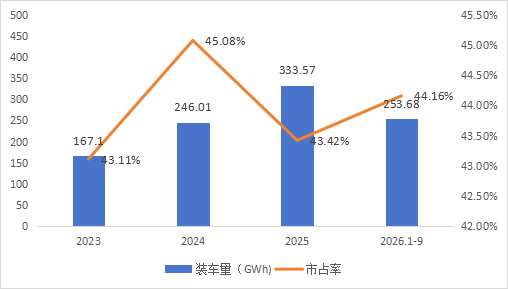
However, both major businesses are expected to grow. In January-September, the cumulative sales volume of power and energy storage batteries in China was 1681.7 GWh, with a cumulative year-on-year increase of 57.6%. Among them, cumulative sales of power batteries increased 38.2% year on year, and energy storage batteries increased 111.8%, accounting for 64.6% and 35.4% of total sales, respectively. The Ningde era was number one in the industry. The load volume of power batteries in the first three quarters was 253.68 GWh, with a market share of 44.16%, an increase of 1.41 percentage points over the previous year.
It is worth noting that the energy storage battery business has become the focus of the company's overseas market. The company exclusively supplies energy storage systems to the Australian National Electricity Market (NEM), currently the largest battery energy storage project in operation, exceeding 3 GWh; signed a 2 GWh Tianheng sodium electric energy storage cooperation agreement with SolarPro, a leading company in the renewable energy sector in Eastern Europe; and signed a memorandum of understanding with Alfen N.V., a leading European new energy integrator. Starting in 2027, it plans to deploy 5 GWh of Tianheng sodium electric energy storage systems in Western European countries such as the Netherlands.
The profitability of the Ningde era was stable. The gross margin for the first three quarters of 2026 was 22.7%, and the cost ratio fluctuated. However, the core administrative expenses rate fell by 2.1% during the period, down 0.8 percentage points from the previous year. The company continued to increase investment in R&D. R&D expenses increased by 22.89%, and the R&D expense ratio was 4.19%. In the first three quarters, the company's ROE was 16.68%, or 22.24% annualized. As of September 2026, the company's cash and equivalents reached $369.814 billion.
R&D and production capacity support, growth highlights of the three major product lines
Ningde Era Ningde Era Ningde Era is downstream of the lithium battery industry chain. Most of the battery orders are in long-term agreement, and upstream lithium mines have also been laid out. Therefore, the price sensitivity to upstream lithium carbonate is low, and performance resilience is high. Judging from the data, sales and revenue grew at the same time, and the average price did not change significantly. The company's two-wheel drive strategy is based on power batteries. There are three main product line growth highlights, namely solid-state batteries, sodium-ion batteries, and energy storage systems.
In terms of solid-state batteries, the company revealed that the energy density of sulfide solid-state batteries reached 500Wh/kg. Condensate batteries (a type of semi-solid state route) were first released, and all-solid-state batteries will enter small-batch production in 2027 according to the plan. In September 2026, seven departments including the Ministry of Industry and Information Technology issued the “15th Five-Year Plan for the Development of the New Battery Industry”, which clearly states that initial large-scale application of all-solid-state batteries will be achieved by 2030. Furthermore, the IEC international standard for solid-state batteries led by China has also been officially established. For the Ningde era, the dual implementation of standards and policies meant that its accumulation in the sulfide material system is expected to transform from “leading laboratories” to “leading industrialization”.
In terms of sodium-ion batteries, since 2026, the company has disclosed 18 energy storage orders, with a total scale of 96.96 GWh, of which sodium electricity storage orders are about 70 GWh, accounting for more than 70%. In April 2026, the company released a “new sodium” passenger car power battery with an energy density of 175 Wh/kg, a capacity retention rate of over 90% at minus 40℃, a cycle life exceeding 10,000 cycles, and plans to achieve large-scale mass production in the fourth quarter. The first model, Changan Qiyuan A06, achieved a battery life of more than 400 kilometers with a 45-degree battery pack, directly entering the mainstream price range of 100,000 to 130,000 yuan.
Meanwhile, energy storage systems are moving from “selling batteries” to “selling systems.” The company's 314Ah batteries have been iterated to 587Ah large cells, and the share of AC side shipments has increased rapidly. In terms of power exchange ecology, more than 2,500 chocolate power exchange stations have been built, and it is expected to exceed 3,000 throughout the year. Overseas, it is the “ballast stone” of profits. The 14 GWh plant in Germany has already been put into operation, the first phase of 39 GWh at the Debrecen plant in Hungary (with a planned total production capacity of 100 GWh) began trial production on September 22, and the 50 GWh plant in Spain is progressing steadily.
What supports all of this is the continuous intensive investment in R&D and production capacity during the Ningde era. In the first three quarters, the company spent 18.517 billion yuan on R&D, an increase of 22.89% over the previous year. By the end of the first half of the year, it had built a production capacity of about 1,050 GWh, a production capacity under construction of 764 GWh, and a total planned production capacity of over 1.8 TWh. However, depreciation due to rising production capacity, upfront costs for overseas projects, and cost dilution in the early stages of commercialization of new technology all mean that the second curve will still have to go through a period of “investment before and return later” before taking over.
Falling into the “golden pit”, focusing on shareholder returns and a high value ratio
In the capital market, since the second half of this year, the Ningde era was affected by the price of lithium carbonate, and the market capitalization fell sharply, but based on performance resilience and the three major growth points, the company has attractive valuations.
Up to now, the company's PE (TTM) is 15.7 times, while the lithium battery sector is 18.76 times, but it should be noted that the lithium battery sector, especially upstream companies, are highly sensitive to lithium carbonate prices. Lithium carbonate prices continue to fall. Profits are expected to decline further in the fourth quarter. The dynamic PE sector is far higher than that of Ningde. Of course, Ningde's market capitalization will still be suppressed by the sector, and information such as performance growth and dividend repurchases will need to be restored.
The company attaches importance to shareholder returns. In terms of repurchases, an A-share cancellation repurchase plan of 20 billion to 40 billion yuan is in progress. As of September 30, 3.303 billion yuan has been implemented, and the cumulative repurchases have exceeded 3.7 billion yuan since September. In terms of dividends, it has implemented a high percentage of dividends every year, and the current dividend rate is 2.8%. By the end of the third quarter, the company's total monetary capital and transactional financial assets exceeded 430 billion yuan, and cash reserves were abundant.
From an investment bank's point of view, there are some differences, but the proportion of optimism is high. CICC maintains a “outperforming the industry” rating, with a target price of HK$580 to HK$650; Lyon is optimistic about its long-term development path, believing that it can overcome short-term challenges and maintain a dominant position, and maintain a “high confidence to outperform the market” rating of the Ningde era, with a target price of HK$770. The target prices given by the above two investment banks were 92.1% and 127.5% higher than the current price, respectively.
Taken together, revenue and profit increased both in the three quarters of the Ningde era. Two-wheel drive+industrial chain layout+industry Big Mac made performance more resilient. Growth highlights of the three major product lines drove performance growth expectations. However, the fall in the price of lithium carbonate affected the entire lithium battery sector, causing the company's valuation to continue to decline, and it has already fallen into the “golden pit.” In anticipation of performance growth, undervaluation+repurchase+dividends, compounded by the optimism of most investment banks, the value ratio in the Ningde era was high.