
- PRICING
- LIVE QUOTES
- LEARN
- HELP


EN
Deckers (NYSE:DECK) reports sales below analyst estimates in Q3 CY2026 earnings, stock drops
Footwear and apparel conglomerate Deckers (NYSE:DECK) missed Wall Street’s revenue expectations in calendar Q3 2026 (fiscal Q2 2027) as sales rose 3.5% year on year to $1.48 billion. The company’s full-year revenue guidance of $5.71 billion at the midpoint came in 2.8% below analysts’ estimates. Its GAAP profit of $2.31 per share was 28.7% above analysts’ consensus estimates.
Is now the time to buy Deckers? Find out by accessing our full research report, it’s free.
Deckers (DECK) Q3 CY2026 highlights:
- Revenue: $1.48 billion vs analyst estimates of $1.51 billion (3.5% year-on-year growth, 1.8% miss)
- EPS (GAAP): $2.31 vs analyst estimates of $1.80 (28.7% beat)
- The company dropped its revenue guidance for the full year to $5.71 billion at the midpoint from $5.89 billion, a 2.9% decrease
- EPS (GAAP) guidance for the full year is $7.88 at the midpoint, beating analyst estimates by 4.6%
- Operating Margin: 26.3%, up from 22.8% in the same quarter last year
- Constant Currency Revenue rose 2.8% year on year (8.3% in the same quarter last year)
- Market Capitalization: $11.64 billion
“We delivered earnings above our expectations in the second quarter by maintaining disciplined marketplace management and a focus on expense control in a challenging consumer environment,” said Stefano Caroti, President and Chief Executive Officer. “As we move through the back half of fiscal 2027, we are taking deliberate actions to strengthen our connection with consumers, sharpen execution, and concentrate resources behind our greatest opportunities. We remain confident in the significant global opportunities ahead for both HOKA and UGG, and our ability to drive sustainable growth and create long-term shareholder value."
Company overview
Established in 1973, Deckers (NYSE:DECK) is a footwear and apparel conglomerate with a portfolio of lifestyle and performance brands.
Revenue growth
Reviewing a company’s long-term sales performance reveals insights into its quality. Any business can experience short-term success, but top-performing ones enjoy sustained growth for years. Over the last five years, Deckers grew its sales at a 14.2% compounded annual growth rate. Though this growth is acceptable on an absolute basis, we need to see more than just topline growth for the consumer discretionary sector, which can display significant earnings volatility. This means our bar for the sector is particularly high, reflecting the non-essential and hit-driven nature of the products and services offered. Additionally, five-year CAGR starts around Covid, when revenue was depressed then rebounded.
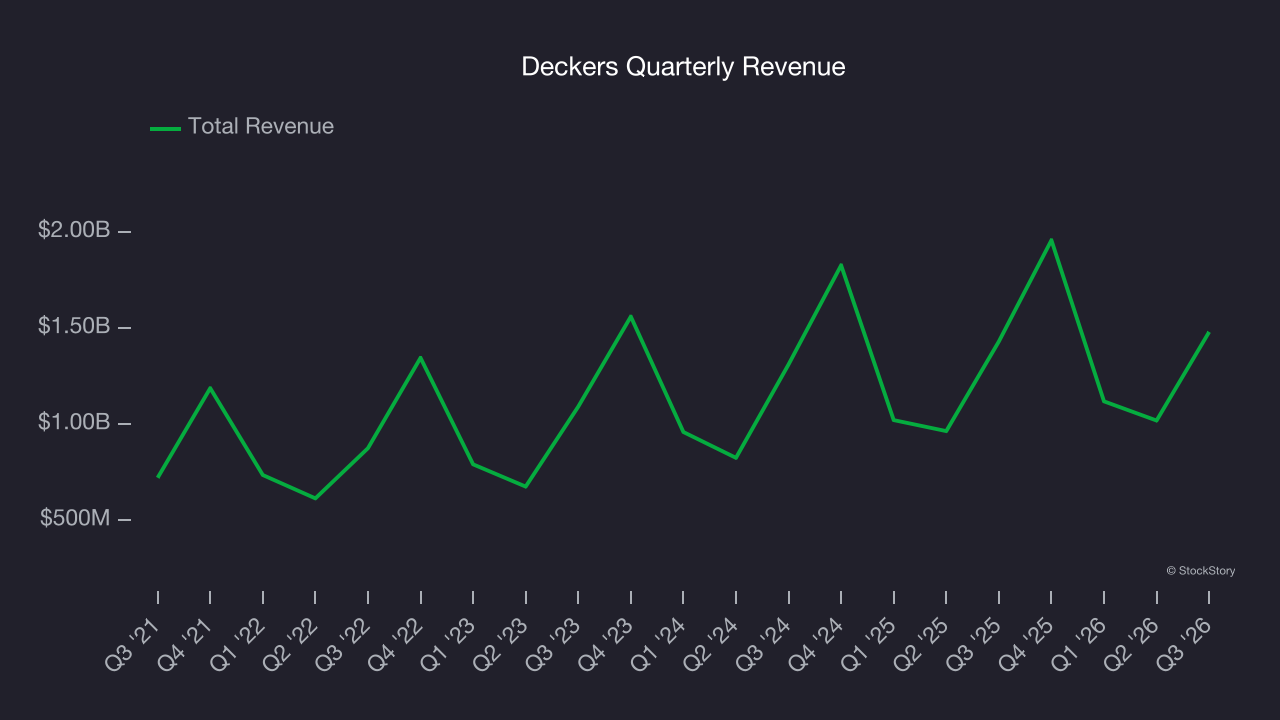
We at StockStory place the most emphasis on long-term growth, but within consumer discretionary, a stretched historical view may miss a company riding a successful new product or trend. Deckers’s recent performance shows its demand has slowed as its annualized revenue growth of 9.4% over the last two years was below its five-year trend. We’re wary when companies in the sector see decelerations in revenue growth, as it could signal changing consumer tastes aided by low switching costs. 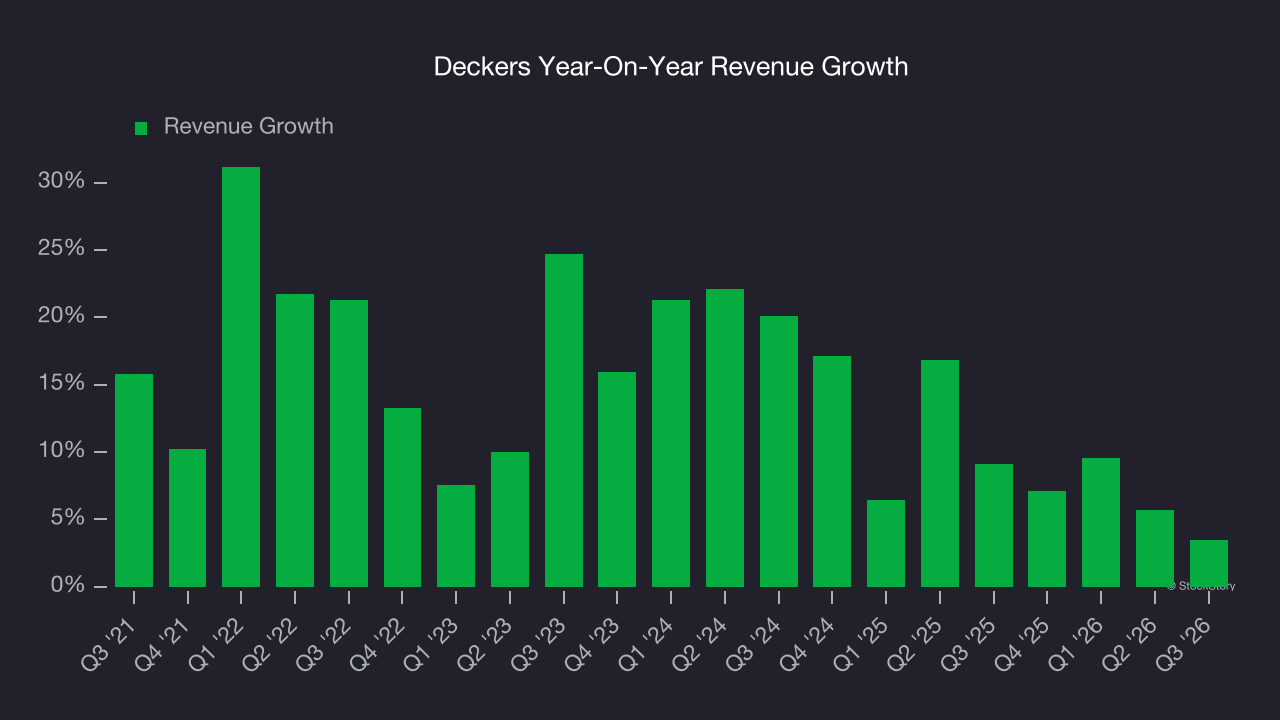
We can dig further into the company’s sales dynamics by analyzing its constant currency revenue, which excludes currency movements that are outside their control and not indicative of demand. Over the last two years, its constant currency sales averaged 8.9% year-on-year growth. Because this number aligns with its reported revenue growth, we can see that foreign exchange has not had a meaningful impact on topline. 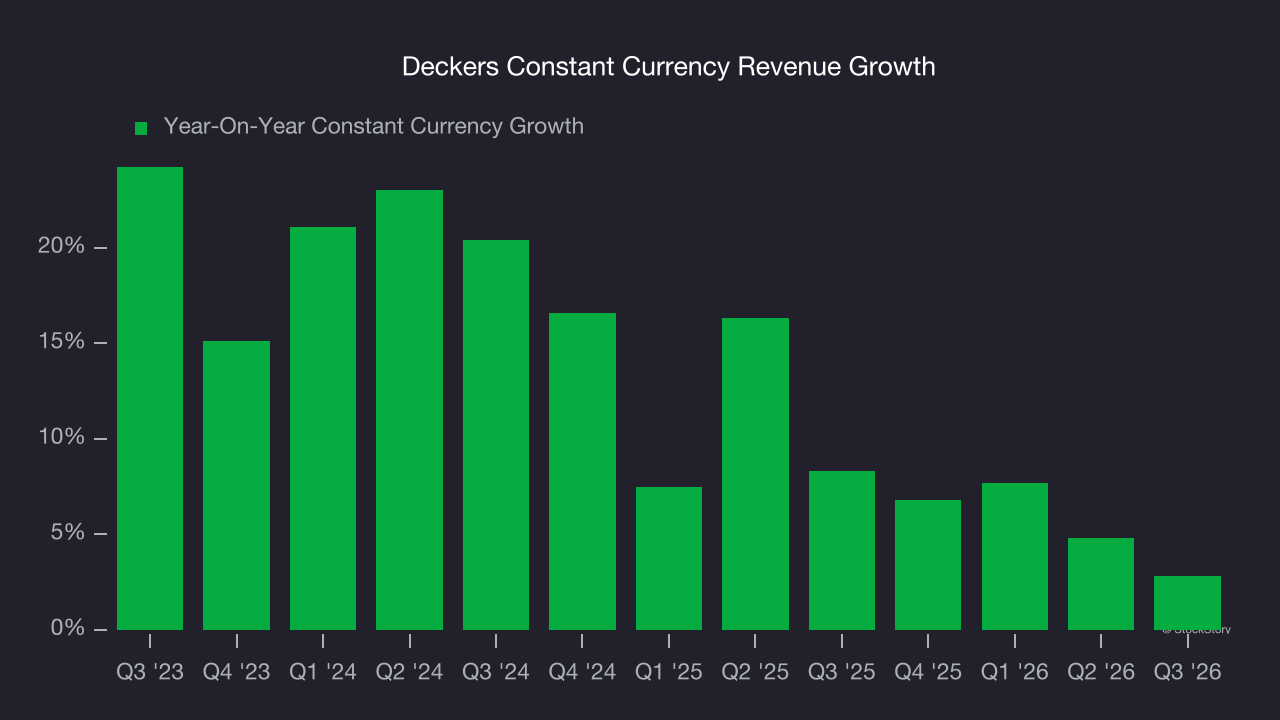
This quarter, Deckers’s revenue grew by 3.5% year on year to $1.48 billion, falling short of Wall Street’s estimates.
Looking ahead, sell-side analysts expect revenue to grow 8.9% over the next 12 months, similar to its two-year rate. This projection doesn’t excite us and suggests its newer products and services will not lead to better top-line performance yet.
ALSO WORTH WATCHING: Nvidia’s Quiet Partner. Nvidia’s chips cost a hundred grand. The connectors that make them work cost even more. One company makes them all.
Every AI server needs specialized infrastructure the chip companies don’t make. High-speed cables. Power connectors. Thermal sensors. This 90-year-old company built a monopoly on it. The AI boom just started. This stock is still flying under the radar. Claim The Stock Ticker Here for FREE.
Operating margin
Operating margin is a key measure of profitability. Think of it as net income - the bottom line - excluding the impact of taxes and interest on debt, which are less connected to business fundamentals.
Deckers’s operating margin has more or less stayed the same over the last 12 months , and we generally like to see margin increases due to economies of scale and cost efficiency over time.
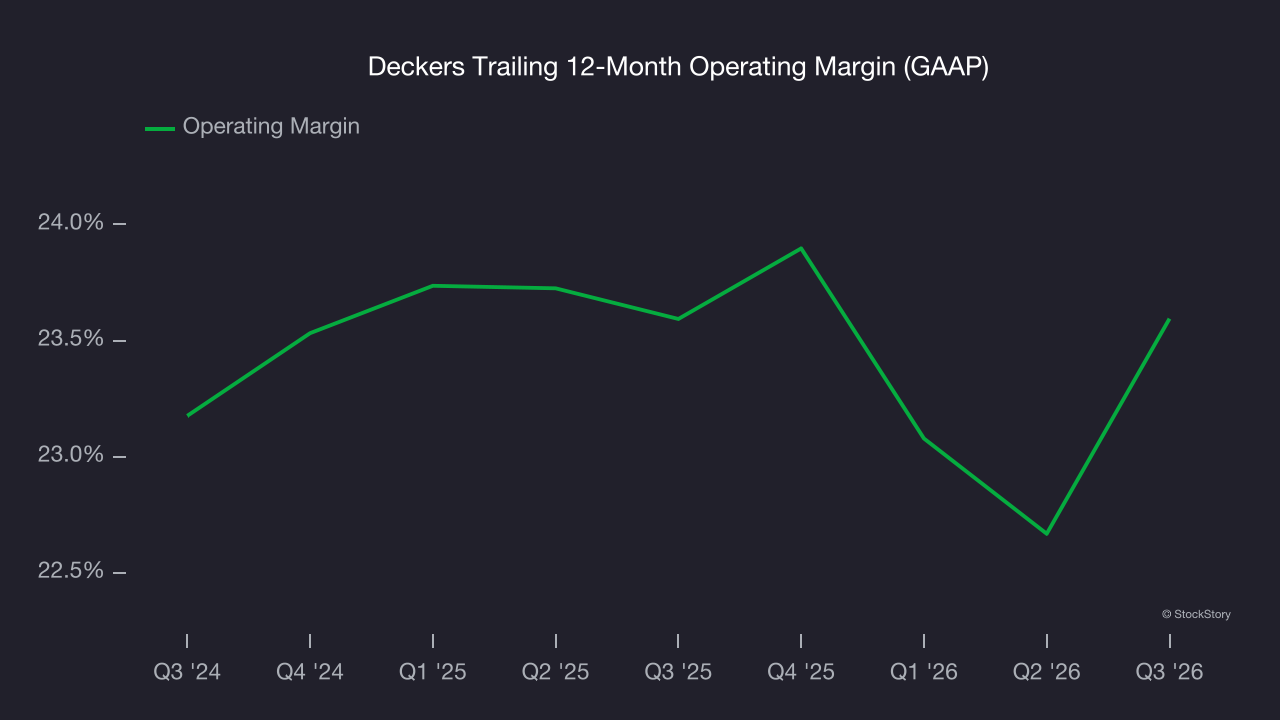
This quarter, Deckers generated an operating margin profit margin of 26.3%, up 3.5 percentage points year on year. This increase was a welcome development and shows it was more efficient.
Earnings per share
We track the long-term change in earnings per share (EPS) for the same reason as long-term revenue growth. Compared to revenue, however, EPS highlights whether a company’s growth is profitable.
Deckers’s EPS grew at 23.8% compounded annual growth rate over the last five years. On the bright side, this performance was better than its 14.2% annualized revenue growth and tells us the company became more profitable on a per-share basis as it expanded.
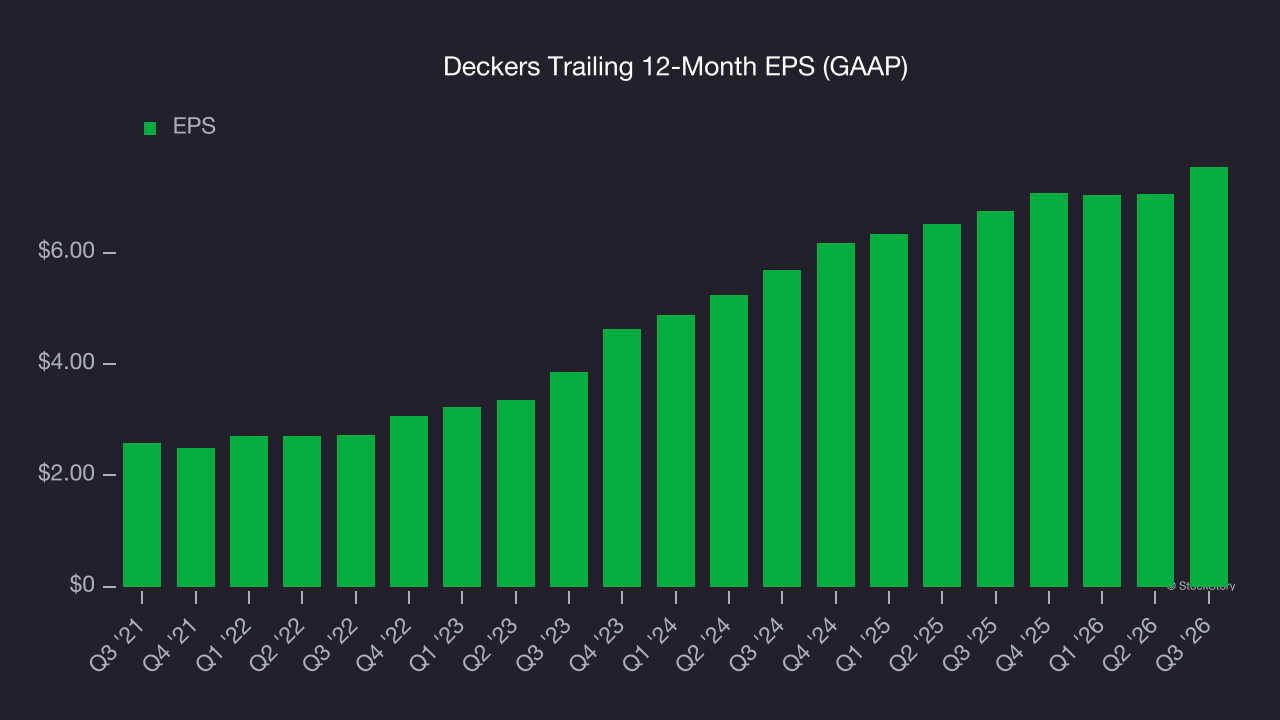
In Q3, Deckers reported EPS of $2.31, up from $1.82 in the same quarter last year. This print easily cleared analysts’ estimates, and shareholders should be content with the results. Over the next 12 months, Wall Street expects Deckers’s full-year EPS to grow 4% from $7.54 to $7.84.
Key takeaways from Deckers’s Q3 results
It was good to see Deckers beat analysts’ EPS expectations this quarter. We were also glad its full-year EPS guidance exceeded Wall Street’s estimates. On the other hand, its full-year revenue guidance missed and its revenue fell short of Wall Street’s estimates. Overall, this was a softer quarter. The stock traded down 8.2% to $78.26 immediately following the results.
Deckers may have had a tough quarter, but does that actually create an opportunity to invest right now? We think that the latest quarter is only one piece of the longer-term business quality puzzle. Quality, when combined with valuation, can help determine if the stock is a buy. We cover that in our actionable full research report which you can read here (it’s free).