
- PRICING
- LIVE QUOTES
- LEARN
- HELP


EN
3 Trading Platform Stocks Built For AI And Market Volatility
Markets are watching Barclays slash 5,000 roles as AI takes over more trading and back-office work, while job cuts, cost savings of £600m, and a mixed Q3 trading outcome pull attention to who wins and who risks being left behind. This shift creates a live test of which banks can turn volatility and automation into resilient earnings. This article walks through three stocks exposed to that story.
The three stocks below are only a sample of this shift. The wider screen surfaces 46 more large banks and brokers whose trading engines, electronic desks, and risk platforms could also be tightly wired into volatility themes and AI tooling.
If you want to identify which of those 46 look most compelling for your watchlist, head straight into the AI-Enabled Trading and Market-Volatility Beneficiaries in Global Banks screener to analyze the full set and focus on the highest-conviction ideas.
Futu Holdings (FUTU)
Overview: Futu Holdings runs the digital brokerage platforms Futubull and moomoo, giving retail investors electronic access to securities, derivatives, margin financing and wealth products that can directly benefit from AI driven trading and periods of heavy market volatility.
Operations: Futu generates about HK$24.1b from online brokerage and margin financing services, reflecting a business model closely tied to trading activity.
Market Cap: US$14.8b
Futu Holdings is one of the purest plays on the screener theme. Its entire model is built around electronic trading, retail activity and AI enabled tooling that can turn volatile markets into more transactions on its platforms.
"The rapid growth in funded accounts remains a live driver, with total funded accounts reaching about 3.84 million in Q2 2026 and overseas markets contributing nearly 60% of these, which can support future revenue and fee income growth from a larger, more diversified client base."
What happens to that growth profile if a single unseen pressure quietly reshapes how much trading volume high value clients are willing to put through Futu?
That hidden pressure is exactly where risk and opportunity start to split for Futu, and the full narrative for Futu Holdings explains how that client behavior could either accelerate or stall.

Swissquote Group Holding (SWX:SQN)
Overview: Swissquote Group Holding runs an online bank and multi asset trading platform that gives clients streamlined, AI friendly access to global markets.
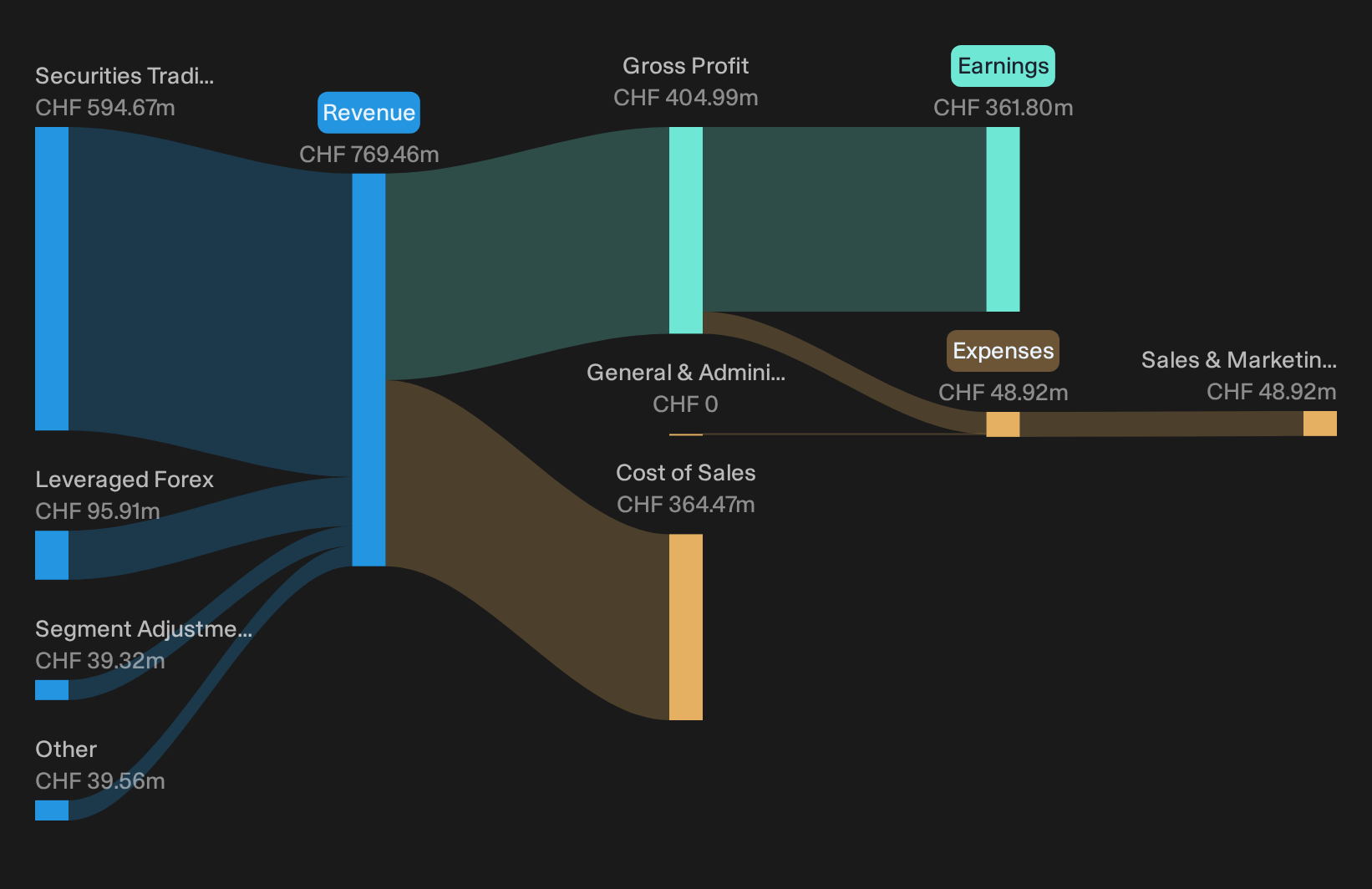
Operations: Swissquote generates about CHF 594.7 million from Securities Trading and CHF 95.9 million from Leveraged Forex, with smaller segment adjustments.
Market Cap: CHF5.4b
For this screener, Swissquote Group Holding matters because its trading heavy model, AI tooling and online banking services are all wired into how volatility and automation reshape where trading flows and fee income settle.
"Acceleration of AI assisted software development, where Swissquote reports early productivity benefits from tools such as GitHub Copilot and Claude and targets a 2 to 3 times improvement in developer output by 2027 to 2028, can expand the product pipeline without a comparable rise in headcount and so widen the gap between revenue growth and operating cost growth, supporting operating margin and earnings."
The real swing factor is what happens if one quiet shift in how efficiently those new tools are adopted changes the cost base trajectory.
If that shift is already forming, the full narrative for Swissquote Group Holding shows how Swissquote Group Holding could see efficiency gains by decoupling cost pressure from product expansion.
UP Fintech Holding (TIGR)
Overview: UP Fintech Holding runs Tiger Trade, an online brokerage and wealth platform where active cross-border investors trade multiple instruments electronically.
Operations: UP Fintech Holding reports about $607 million in revenue from its Brokerage segment, directly linked to trading activity on its platform.
Market Cap: $730 million
UP Fintech Holding matters for this AI and volatility theme because its entire setup is built around fast, cross-border electronic trading where smarter routing, automation and market swings can quickly change how much commission and fee income flows through the platform.
"Expansion of UP Fintech Holding’s user base and client assets in Singapore, Hong Kong, Australia, New Zealand and the U.S., with these markets contributing the majority of recent net asset inflows and new funded accounts, could gradually rebalance revenue and earnings away from onshore Mainland China."
What happens to that rebalancing story if one unresolved cost and compliance pressure keeps eating into the operating margin investors are counting on?
If that pressure is already building, the full narrative for UP Fintech Holding shows how UP Fintech Holding could turn compliance drag into accelerating cross-border scale and richer fee potential.

Seeking Alternatives Before Others Catch On
Fresh ideas move first. By the time momentum is flying and headlines catch up, early entry points are gone. Scan these under the radar lists now and act early.
- Spot cash generators before the crowd by scanning a 33 high quality undervalued stocks that filters for strong balance sheets while prices still look dropped and out of sync with fundamentals.
- Ride structural trends in automation by reviewing 93 robotics and automation stocks where curated operators could be building quiet momentum before robotics spending becomes more widely adopted.
- Position for income while prices are still catching up by checking a 7 dividend fortresses that highlights high-yield payers aiming to keep distributions resilient.
Have feedback on this article? Concerned about the content? Get in touch with us directly. Alternatively, email editorial-team@simplywallst.com