
- PRICING
- LIVE QUOTES
- LEARN
- HELP


EN
Where Will Oracle Stock Be in 2029?
Key Points
Oracle stock has dropped substantially over the past year, but it can step on the gas due to its strong backlog.
Oracle's focus on reducing strain on its balance sheet and keeping costs in check bodes well for its financial performance over the next three years.
Oracle stock could more than double by 2029 in a conservative scenario.
Oracle (NYSE:ORCL) should ideally have been one of the biggest winners of the artificial intelligence (AI) infrastructure boom, but a closer look at the company's stock price performance suggests that hasn't been the case so far.
Oracle stock has dipped 53% over the past year. The company has been taking on significant debt to fund the aggressive build-out of data center capacity to fulfill the massive contractual backlog it is carrying. The ballooning debt has caused panic among investors. However, we will look past the noise and check if Oracle can prove the naysayers wrong and head higher over the next three years.
Missed AI’s "Act 1"? Act 2 Could Be 15x Bigger. Most investors think they missed the AI boat because they didn't buy Nvidia in 2005. But according to our analysts, we’re only at the end of "Act 1"—the R&D phase. "Act 2" is the global rollout. Continue »

Image source: Getty Images.
Oracle's debt is a concern, but investors shouldn't miss the bigger picture
Oracle has a debt of just over $169 billion, according to Yahoo! Finance. That's significantly higher than its $37 billion cash pile. Moreover, the company's aggressive capital spending has dented its free cash flow.
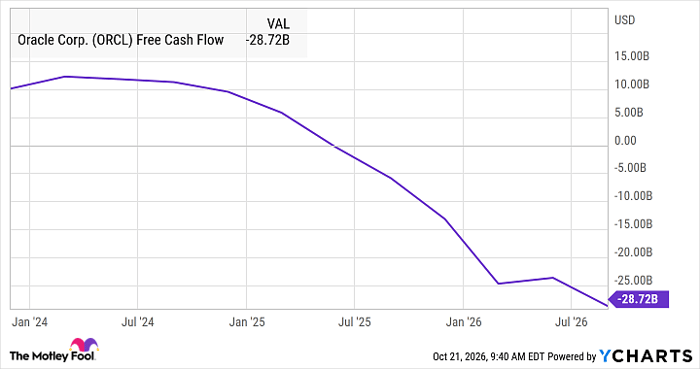
ORCL Free Cash Flow data by YCharts
So, it is easy to see why investors have been spooked about Oracle's prospects, especially at a time when interest rates are rising, inflation is hotter-than-expected, and there are concerns about whether AI infrastructure companies will get access to capital amid high borrowing costs. However, that's one way to look at things.
The reason why Oracle has been ramping up capex and is taking on debt is that it wants to quickly convert its sizable contractual backlog into revenue. The company reported $664 billion in remaining performance obligations (RPO) at the end of the first quarter of fiscal 2027 (ending Aug. 31, 2026).
The metric, which refers to the total value of a company's unfulfilled contracts at the end of a quarter, increased by $209 billion from the year-ago period. Notably, Oracle's infrastructure build-out efforts are accelerating growth. It reported a 30% year-over-year increase in revenue in fiscal Q1 to $19.3 billion, driven by a 121% spike in cloud infrastructure revenue to $7.4 billion. That was a solid improvement over the 12% revenue growth Oracle clocked in the same period last year.
Additionally, Oracle's non-GAAP earnings per share (EPS) growth rate also jumped from 6% in the year-ago period to 30% last quarter. Looking ahead, Oracle's growth is poised to continue accelerating, as the company is receiving more contracts than it can fulfill. For instance, Oracle booked over $30 billion in contracts for its cloud AI services last quarter, well above the revenue it generated during the quarter.
Moreover, Oracle has found a way to reduce the burden on its balance sheet by asking customers for prepayments or to bring their own hardware. The company notes that the "vast majority" of contracts it signed in fiscal Q1 were under these models. So, Oracle should be able to arrest the slide in its free cash flow and avoid taking on more debt under this model. Not surprisingly, analysts expect an improvement in Oracle's growth over the next two years, compared with the anticipated 34% fiscal 2027 revenue growth.
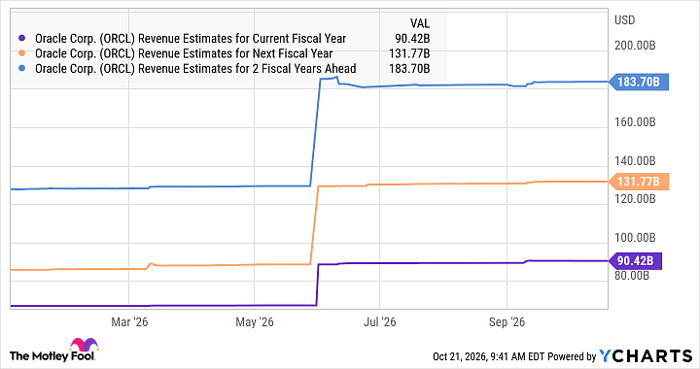
ORCL Revenue Estimates for Current Fiscal Year data by YCharts
The stock could go on a terrific bull run
The acceleration in Oracle's revenue growth should filter down to the bottom line as well, primarily due to its smart strategy of reducing costs by asking customers to prepay or bring their own hardware. This explains why analysts have turned bullish about its earnings growth prospects.
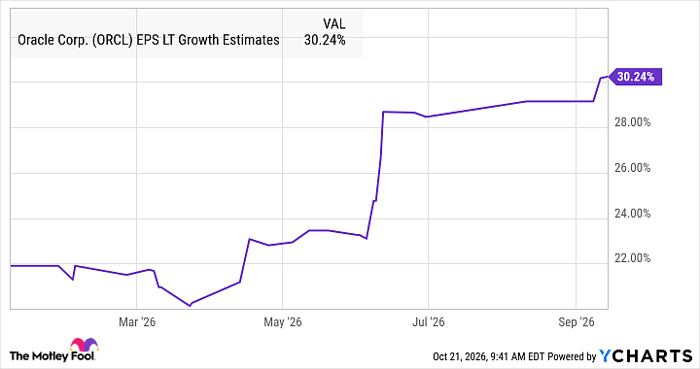
ORCL EPS LT Growth Estimates data by YCharts
What's worth noting is that analysts are anticipating a significant step-up in Oracle's earnings growth in fiscal 2029, following an increase of just 7% in the current one.
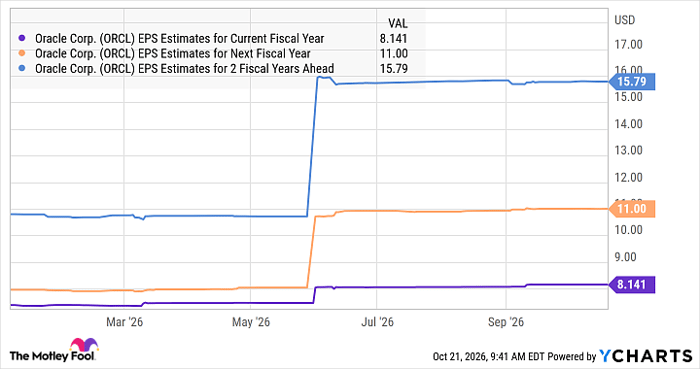
ORCL EPS Estimates for Current Fiscal Year data by YCharts
If Oracle's earnings reach $15.79 in fiscal 2029 (which ends in May 2029), its stock price could jump to $300 even if it trades at just 19 times earnings at that time (in line with the S&P 500 index's forward earnings multiple). That's 129% higher than Oracle's stock price right now, suggesting that investors should consider utilizing the recent pullback in this AI stock before it goes on a bull run.
Harsh Chauhan has no position in any of the stocks mentioned. The Motley Fool has positions in and recommends Oracle. The Motley Fool has a disclosure policy.