
- PRICING
- LIVE QUOTES
- LEARN
- HELP


EN
Store Expansion Plan Might Change The Case For Investing In AutoZone (AZO)
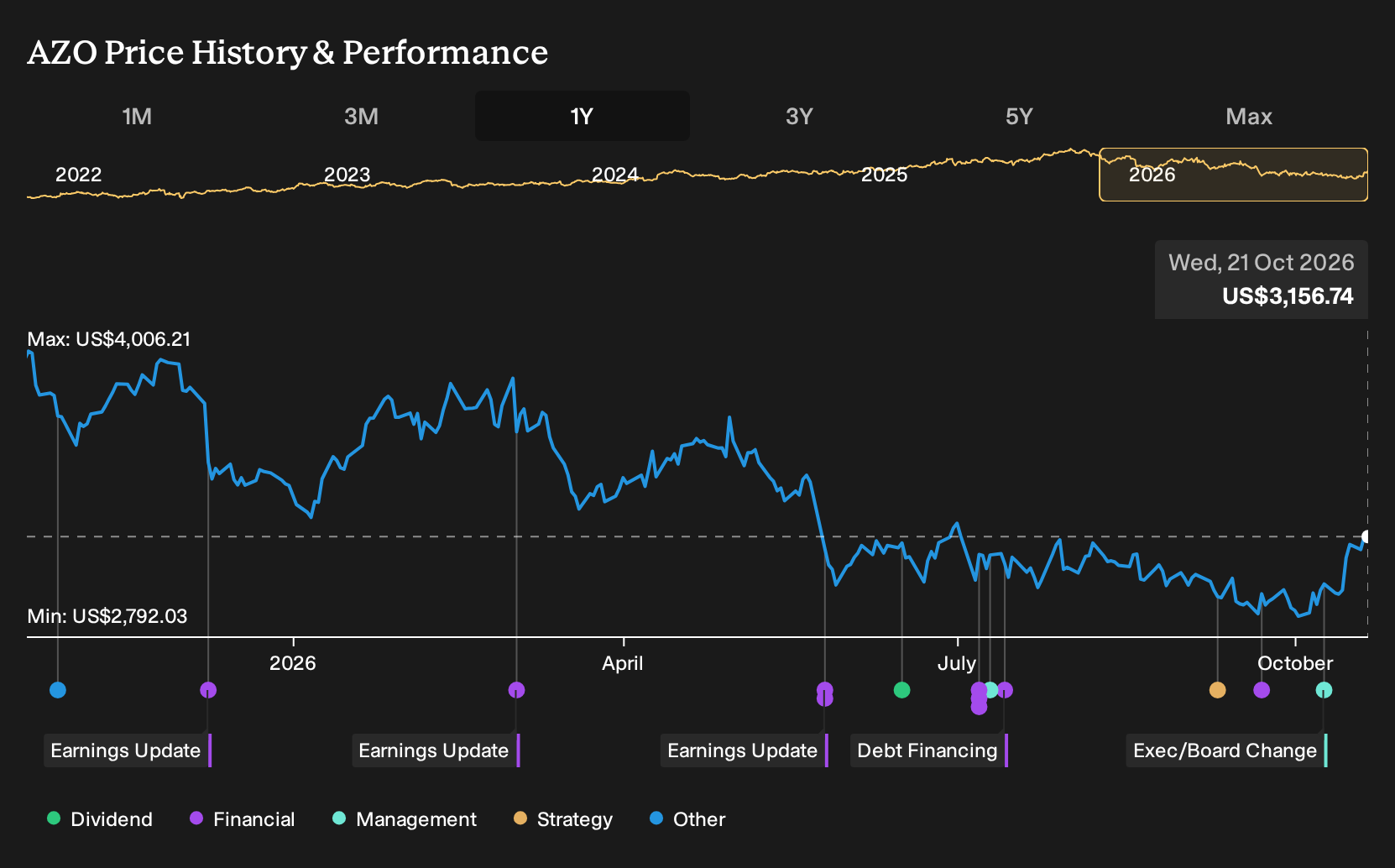
- AutoZone reported that director Claire R. McDonough told the board in early October 2026 she will not seek reelection after accepting a new executive role elsewhere, citing calendar conflicts with future board meetings.
- Management also outlined plans to open about 400 new stores in fiscal 2027, even as guidance points to flat to low single digit same store sales and weaker domestic DIY demand. This highlights a clear emphasis on footprint growth and commercial customer mix.
- We will now look at how AutoZone's plan to add about 400 new stores could reshape the existing investment narrative around mix shift.
Scan for other retailers pursuing similar footprint expansion with muted same store sales by checking our hand picked list of solid balance sheet and fundamentals (25 results), which can handle growth plans without overstretching financially.
AutoZone Investment Narrative Recap
To own AutoZone, you need to believe the commercial shift and store expansion can offset softer DIY demand and flat to low single digit same store sales guidance. The key short term swing factor is whether commercial growth and Mega Hubs keep traffic and ticket size healthy as DIY customers remain stretched by inflation.
The biggest risk is that weak DIY traffic and high debt combine with heavy investment in roughly 400 new stores to pressure returns if those locations ramp slowly. Claire R. McDonough deciding not to seek reelection looks immaterial to that near term operating story.
The plan to open about 400 new stores in fiscal 2027 is the clearest recent signal for investors tracking AutoZone. Management is choosing to keep leaning into footprint and commercial coverage even as comparable sales are described as flat to only slightly positive for the year.
For you, the question is whether that buildout, together with a growing Mega Hub network and mature supply chain investments, can support earnings and cash generation despite weaker DIY demand and negative shareholders equity. Execution on new store returns and commercial penetration remains the central operational catalyst.
What The AutoZone Forecasts Are Really Asking You To Believe
AutoZone's consensus narrative ties the store buildout directly to some fairly specific numbers. Analysts are modeling revenue growth of 7.0% a year over the next three years, supported by a slight lift in profit margins from 12.6% today to 12.8% by 2029 as the commercial mix deepens and the Mega Hub network scales.
On the profit line, the stock analysis work assumes earnings move from US$2.6b today to US$3.2b by 2029. That is an increase of about US$0.6b in absolute terms, even as the share count is expected to shrink by about 2.38% a year through ongoing buybacks, which concentrates that profit over fewer shares.
AutoZone's narrative projects US$24.9b revenue and US$3.2b earnings by 2029. This requires 7.0% yearly revenue growth and an earnings increase of about US$0.6b from US$2.6b today.
Uncover why AutoZone's fair value indicates an 18% potential upside to its current price that could narrow quickly.
Exploring Other Perspectives
Fair value estimates from 3 private investors in the Simply Wall St Community cluster tightly between about US$3,438 and US$3,720 per share, so you are seeing different models but not wild outliers. Those views sit beside clear tension for AutoZone between pressured DIY traffic and catalysts such as commercial growth, Mega Hubs and the 400 store opening plan. Taken together, they underline how widely opinions can differ and why it helps to weigh several alternative viewpoints before leaning into any single AutoZone thesis.
Explore 2 other AutoZone fair value estimates, including one that suggests there could be as much as 18% upside from the current price.
Reach Your Own Conclusion
Disagree with existing narratives? Extraordinary investment returns rarely come from following the herd, so consider your own analysis carefully.
- A great starting point for your AutoZone research is our analysis highlighting 3 key rewards and 2 important warning signs that could impact your investment decision.
- See our latest analysis for AutoZone. The report includes a comprehensive fundamental analysis summarized in a single visual, the Snowflake, making it easy to evaluate AutoZone's overall financial health at a glance.
Looking For More Investment Ideas Beyond AutoZone?
Once you have a view on AutoZone, it often helps to compare it with other potential opportunities that fit different risk and return profiles using the Simply Wall St Screener.
- Target quality at a discount by scanning for companies that combine solid fundamentals with appealing valuations through the 33 high quality undervalued stocks.
- Prioritise resilience and capital preservation by focusing on businesses with steadier profiles using the 31 resilient stocks with low risk scores.
- Hunt for lesser known opportunities with strong underlying metrics by reviewing the 21 high quality undiscovered gems.
Have feedback on this article? Concerned about the content? Get in touch with us directly. Alternatively, email editorial-team@simplywallst.com