
- PRICING
- LIVE QUOTES
- LEARN
- HELP


EN
Musk drew the AI and robot supercake, but Goldman Sachs didn't buy it: Robotaxi and “Optimus” can't support Tesla (TSLA.US)'s grand narrative for the time being
The Zhitong Finance App learned that the latest performance data report and performance conference call for American artificial intelligence, humanoid robots, autonomous driving technology and electric vehicle manufacturing giant Tesla (TSLA.US) fully showed that the tech giant is trying its best to further transform AI supercomputing systems, full autonomous driving capabilities, and the world's most advanced “AI+ industrial” robot process into stronger B-side and C-side payment prospects, but Wall Street financial giant Goldman Sachs clearly hasn't considered these positive developments and the AI and Robotaxi (fully autonomous driving) drawn by CEO Musk taxis) and robot flatbreads are enough to support global capital flocking to Tesla stock.
According to Tesla's earnings data, total revenue for the third quarter was about US$28.046 billion, which was basically the same year on year and fell short of the US$28.13 billion expected by Wall Street analysts; the company's adjusted earnings per share was $0.48, higher than market expectations of $0.45; after excluding regulatory points, the gross margin of automobiles rebounded to 18.1%, and free cash flow accelerated to a positive rate of about US$1,531 billion.
Tesla's Q3 operating profit was nearly 20% higher than analysts' unanimous expectations. The gross profit margin for the quarter was 19.6%, which can be described as exceeding expectations for a month-on-month recovery, nearly 2 percentage points higher than market expectations. Tesla also lowered its annual capital expenditure target from over 25 billion US dollars to 20 billion US dollars. In the performance conference call, Musk stated that Tesla's goal is to produce about 5 million cars per year by around 2030 — he emphasized that FSD (fully autonomous driving) software systems are currently the core driver of demand.
In terms of the specific business structure, the automobile business revenue was 20.56 billion US dollars. Although the year-on-year growth rate changed from positive to negative, it was nearly 4% higher than analysts' unanimous expectations. This also meant that the decline in Tesla's automobile business revenue was not as serious as analysts expected; the year-on-year growth rate of service and other revenue slowed to 33%, but was more than 7% higher than expected; while energy generation and energy storage revenue fell 16% year over year, which is more than 26% lower than analysts' agreed expectations, a major drag on revenue that did not meet expectations in the third quarter.
At the same time, the huge increase in paid users of the FSD fully autonomous driving subscription software driven by Tesla's AI supercomputing system, the expansion of Robotaxi driverless mileage, and the entry of Optimus (or “Optimus” humanoid robot) into early production, it is expected that Optimus will be delivered to companies other than Tesla around the end of next year. The first high-value scenarios will be heavy industry and dangerous repetitive work around the clock. These latest developments can be said to have strengthened Tesla's physical artificial intelligence (Physical AI) narrative.
Tesla, under Musk's leadership, is simultaneously advancing FSD technology upgrades, European FSD and RoboTaxi official regulatory approval and adoption, and breakthrough car software monetization, and Cybercab fully driverless taxis (that is, Robotaxi) and humanoid robots to accelerate the launch of Musk's “physical AI supermap” to draw up Tesla's growth prospects.
According to Nvidia CEO Hwang In-hoon's opinion, “physical AI” (physical AI) emphasizes that autonomous robotics/car operating systems can sense, reason, and complete a complete set of actions in the real world, and an era where “physical AI” assists the evolution of human civilization is coming. “Physical AI” emphasizes enabling robotics/autonomous systems to sense, reason, and complete a complete set of actions in the real world, and these three types of capabilities are the key AI tool chain to advance the AI language model from “only dialogue” to “can work in the physical world.”
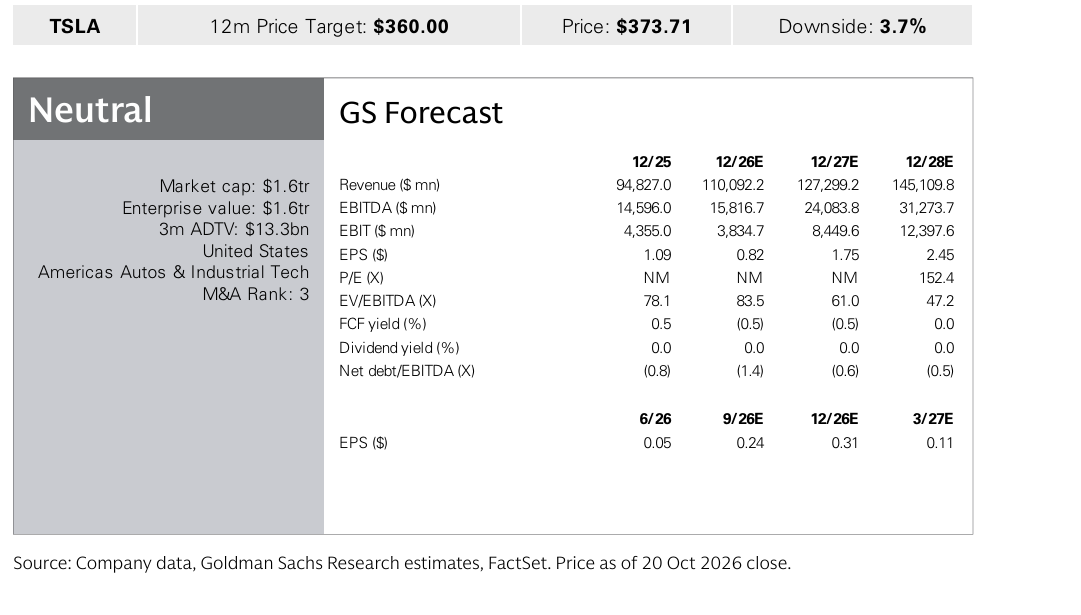
Goldman Sachs clearly stated that its initial evaluation of the financial report was positive, but it still maintained a cautious neutral (neutral) rating and maintained a 12-month target price of only $360: compared to the October 20 closing price of $373.71 used in the report, it corresponds to a decline of about 3.7%. Goldman Sachs's overall position on Tesla can be summed up as follows: it acknowledges the progress of AI and robotics-related businesses, but it has yet to see strong enough valuation appeal and real prospects for cash flow creation. The stock market reaction also showed this sharp divergence: the stock price rose 3.41% on October 21, and after closing at $386.47, it changed from an increase of about 2% to a fall of about 2% after the market; recalculated from the closing price of the day, Goldman Sachs's target price corresponds to a decline of about 6.85%. As of Thursday's pre-market trading session for US stocks, Tesla's stock price fell by more than 5% to around $366.
Gross margin was fixed first, and AI investment is still reshaping profit sheets
The most significant improvement in Tesla's Q3 performance report was on the gross profit side, and the implementation of operating profits is still one step behind. The overall gross profit margin was 19.6%, higher than Goldman Sachs's forecast of 18.5% and FactSet's agreed estimate of 17.5%; the automobile gross profit margin of 18.1% also surpassed both by 16.3% and 16.8%. However, operating profit was only US$718 million, lower than Goldman Sachs's estimate of US$1,043 million and FactSet's US$1,473 million, which is basically in line with the company's consolidated consensus estimate of US$721 million, showing a clear difference between different expectations.
Reduced revenue from regulatory credits, as well as increased R&D, computing power depreciation, and new product commissioning costs, have weakened the transmission of improved gross profit to operating profit. What is particularly noteworthy is that the adjusted EPS after excluding the equity incentive fee (SBC) was $0.48, which exceeded Goldman Sachs expectations; the adjusted EPS after SBC was only $0.20, lower than its forecast of $0.24. Goldman Sachs's target price of $360 is 150 times the total EPS for the 5th to 8th quarters and included in the SBC valuation scale.
Improved cash flow has increased investment affordability, but there is still a need to make hierarchical judgments between energy demand and current revenue and profit. Energy revenue of $2,881 billion is about 23% lower than Goldman Sachs's forecast. Despite energy storage deployment reaching 13.7 GWh and a record backlog of orders, the Texas Megafactory has also begun production. The call further revealed that gross energy margin rose to 33.1%, mainly supported by tariff refunds and warranty preparation adjustments; Megapack's production capacity was close to being sold out in 2027, reflecting subsequent demand.
In terms of cash flow and capital expenditure data, capital expenditure for the quarter was 4.732 billion US dollars, significantly lower than Goldman Sachs's estimate of 8 billion US dollars, helping the company achieve positive free cash flow, with a cash and investment balance of about 45.4 billion US dollars. The Goldman Sachs report was released before the conference call, and management then lowered the annual capital expenditure forecast from over $25 billion to about $20 billion, while securing a maximum loan amount of $30 billion. The latest investment in terms of cash flow and capital expenditure means — Tesla's short-term financial pressure can be described as being significantly reduced, but future cash returns will still depend on additional production capacity and the commercialization efficiency of the AI business.
FSD has begun to be cashed out, and the revenue trajectory of Robotaxi and “Optimus Prime” has not yet been able to support Tesla's high valuation
FSD has achieved observable payment growth, and Robotaxi is verifying large-scale operations. Goldman Sachs pointed out that active FSD paying users reached 1.74 million, up about 18% month-on-month and 67% year-on-year; the adoption rate of FSD in new car deliveries in North America exceeded 75%, up from more than 55% in the previous quarter, and made more progress in market entry in Europe. However, the Goldman Sachs analyst team pointed out that this newly calculated user index includes one-time purchases and subscriptions, and cannot all be regarded as monthly subscription revenue.
Goldman Sachs research reports that as of October 18, the cumulative mileage of the fee-charged and fully driverless Robotaxi reached 3.1 million miles, up from 1 million miles on September 3; Cybercab, the Robotaxi product line has expanded its operational coverage in Austin, and the list of subsequent cities continues to expand. The conference call proposed aiming for the first batch of customer vehicles to join the Robotaxi network under an electronic geofencing (geofencing) and fleet management framework in the second quarter of 2027. Goldman Sachs emphasized that the key to Tesla's commercial value further exceeding expectations is to transform driverless driving capabilities into higher vehicle utilization and lower cost per paid mile; management confirmed that the target cost of 0.30 US dollars has not been achieved — that is, the Robotaxi business has not yet achieved the target cost of 0.30 US dollars per mile; Musk expects the business to “attract attention” from the second quarter of next year and become an “important contribution” in the third and fourth quarters of next year.
Optimus Prime's valuation potential comes from replicable labor capacity, and is currently still in the phase where engineering and manufacturing are climbing together. Goldman Sachs confirmed that Optimus has begun production on the Fremont production line, but the hardware and manufacturing process are still iterating; the call will further point the delivery time to external corporate customers around the end of 2027, and plans to integrate AI5 chips around April 2027.
Tesla management, including Musk, also plans to increase the computing power scale from about 265 MW to 400 MW by the end of the year, promote the construction of the Austin fab and equipment commissioning in 2027, and expand production capacity for Semi, energy storage, and battery materials to ease supply constraints. Goldman Sachs's latest research report on Tesla's performance still anticipates revenue of about $127.3 billion and $145.1 billion for 2028, respectively, and EPS of $1.75 and $2.45, respectively, indicating that the model itself already includes a stronger AI-driven growth trajectory. However, Goldman Sachs analysts emphasized that what really determines whether the valuation can be further revised is whether FSD, Robotaxi, and robots can contribute incremental profits earlier and on a larger scale than the current market unanimously predicts; the report also clearly lists these developments as upward factors.
Wall Street is increasingly divided: who wants to pay the “physical AI premium” in advance?
Wall Street institutional ratings and target price updates after the Tesla earnings report and performance conference showed that Piper Sandler, a well-known investment agency, raised the target price from $450 to $475 and maintained an incremental (incremental) rating. He believes that the main profit and loss drivers have improved significantly. In particular, he is optimistic about the adoption of FSD based on Tesla's exclusive AI supercomputing system and the rapid expansion of the RoboTaxi fleet size; based on the October 21 closing price, according to Piper Sandler, Tesla's potential room for growth over the next 12 months is about It was 22.91%.
UBS raised the target price from $391 to $425, maintaining a neutral rating, corresponding to an increase of about 9.97%, and significantly raised the 2027 and 2028 EPS forecasts to $2.02 and $3.17, based on FSD and energy business support for profit margins; however, it does not expect Robotaxi to make a significant financial contribution until the end of 2027 or 2028. The significant differences between Piper Sandler and the UBS analyst team's estimates and Goldman Sachs can be described as differences in judging the speed of profit cashing out of FSD, Robotaxi, and robots, the pace of growth, and the extent to which they contribute to valuation.
Derived from technology and commercial mechanisms, FSD, Robotaxi, and Optimus correspond to three different monetization stages: FSD obtains revenue through existing vehicles and payment functions; Robotaxi further transforms driving ability into continuously provided travel services; and Optimus needs to transform perception, decision making, and action execution into reliable production and labor. Vehicle data and software can support Robotaxi's expansion, but robots must also accumulate their own operating experience and solve the problems of hand dexterity, contact control, and durability. The advantages of driving data cannot be directly equated with robot capabilities.
Therefore, for investors focusing on Tesla's fundamental growth prospects and “Musk's belief investment theme,” the three core evidences that need to be closely tracked and observed in the medium to long term are: FSD's payment retention progress, Robotaxi's unit economics (Unit Economics), and Optimus's reliable operation in real tasks and actual investment and output returns from large enterprise customers. Only when these indicators continue to improve can the prospects of cutting-edge AI agents and robots accelerate into Tesla's profit forecasting.