
- PRICING
- LIVE QUOTES
- LEARN
- HELP


EN
Will $5 Billion Growth Plan Change Kroger's (KR) Narrative
- Kroger has laid out a multi year plan that includes around US$5b of investment, roughly 110 new stores by 2029 and a heavier push into e commerce, fresh food and private label.
- The retailer is coupling those expansion plans with a target of about US$4b in annual structural cost savings, aiming to reshape how it funds pricing, digital growth and future store investments.
- We will look at how Kroger's multi year US$5b reinvestment program interacts with its existing cost efficiency and digital profit narrative.
Scan beyond Kroger to evaluate how other retailers are pricing in growth, balance sheets, and reinvestment plans with a curated list of list of solid balance sheet and fundamentals (25 results)
Kroger Investment Narrative Recap
To own Kroger, you need to buy into a grocery chain leaning hard into fresh food, private label and e commerce, funded by structural cost cuts rather than a looser balance sheet. The near term swing factor is whether its profitable digital and retail media operations can keep contributing while it leans into sharper pricing.
The biggest risk sits in execution. Kroger is committing US$5b of reinvestment, planning roughly 110 new stores and absorbing tariff noise and legal uncertainty around Albertsons. Recent share gains and EPS expectations raise the bar, but the core thesis still rests on cost savings translating into stable margins.
The clearest operational announcement to focus on is Kroger’s multiyear plan to invest US$5b in price, store openings and digital capacity while targeting about US$4b in annual structural cost savings. That pairing indicates that management expects self funded reinvestment rather than a big shift in financial risk.
For catalysts, the planned 110 new stores and expanded e commerce fulfillment give Kroger more ways to scale its already profitable online and media businesses. The live test is whether these sites and digital tools reach the traffic and efficiency needed to offset tariff pressures and any lingering trust issues on pricing accuracy.
Kroger Forecasts and Analyst Assumptions
Kroger's narrative projects US$156.4b revenue and US$3.2b earnings by 2029. That profile lines up with analyst assumptions of 1.6% yearly revenue growth and an earnings increase of about US$2.1b from US$1.1b today.
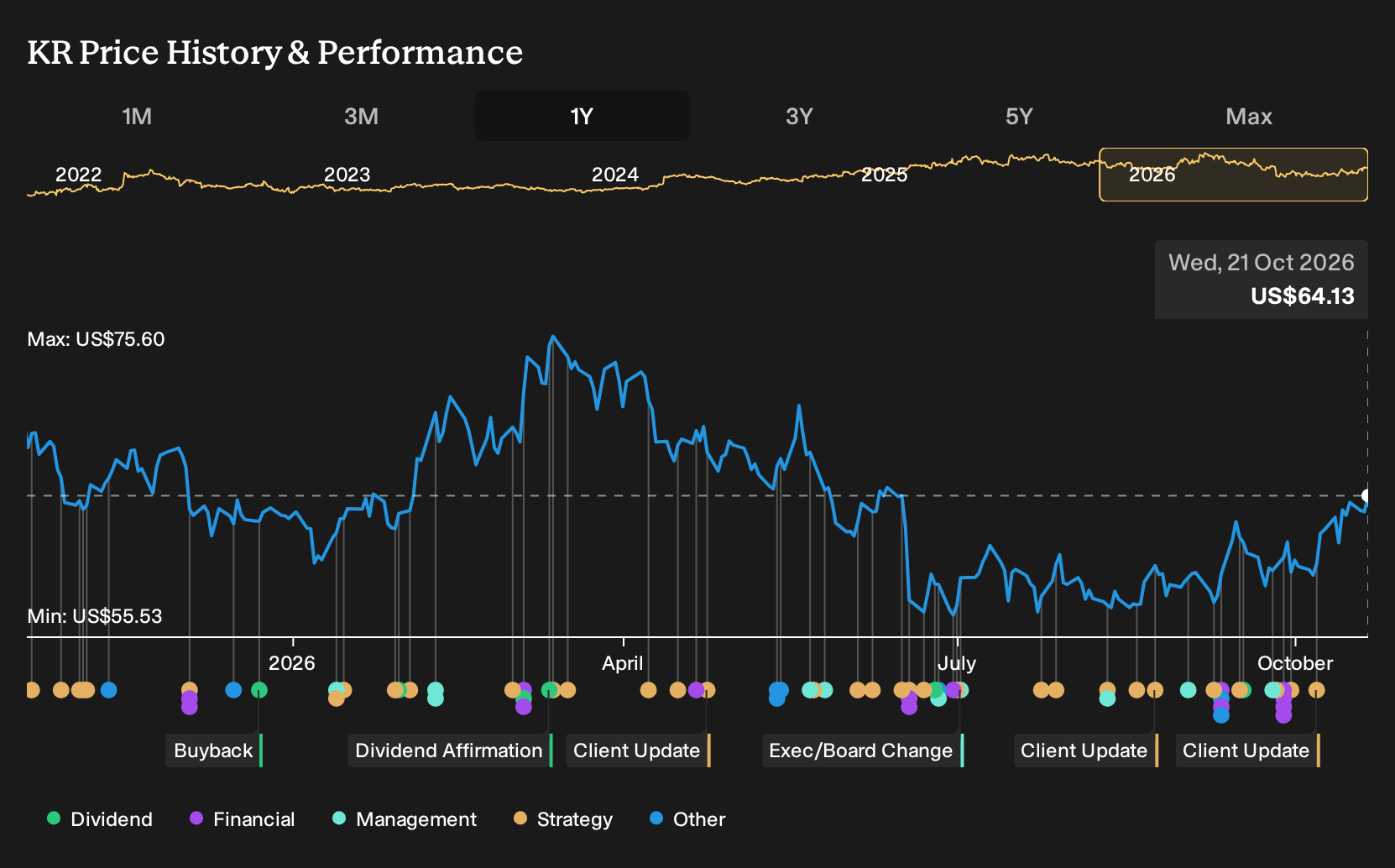
Uncover how Kroger's fair value indicates a 6% potential upside to its current price, which could narrow quickly if Kroger executes cleanly on this plan.
Exploring Other Perspectives
One alternate view on Kroger focuses on the risk that higher transport and fuel costs may gradually reduce e commerce profits. More cautious analysts were estimating about US$156.3b of revenue and US$2.7b of earnings by 2029. That is well below the upper US$3.8b earnings scenarios and illustrates the wide range of opinions. Use this news as a prompt to compare both sets of expectations and decide which perspective is closer to your own view of the business.
Explore 4 other Kroger fair value estimates, including one that suggests it could be worth just $68.14.
Decide For Yourself
Disagree with existing narratives? Extraordinary investment returns rarely come from following the herd, so consider forming your own view.
- A great starting point for your Kroger research is our analysis highlighting 3 key rewards and 4 important warning signs that could impact your investment decision.
- See our latest analysis for Kroger. The report includes a comprehensive fundamental analysis summarized in a single visual, the Snowflake, making it easy to evaluate Kroger's overall financial health at a glance.
Looking for more Kroger sized investment ideas?
If the Kroger story has sharpened your thinking on balance sheets, pricing power and reinvestment, you can use that same lens to scout other opportunities with the Simply Wall St Screener.
- If capital preservation comes first for you, you can start with a basket of companies that score well on resilience by reviewing the 31 resilient stocks with low risk scores.
- If you prefer cash returns in your account, you can focus on businesses offering stronger income profiles through the 7 dividend fortresses.
- If you want early stage stories with room to prove themselves, you can filter for higher quality smaller stocks using the 21 high quality undiscovered gems.
Have feedback on this article? Concerned about the content? Get in touch with us directly. Alternatively, email editorial-team@simplywallst.com