
- PRICING
- LIVE QUOTES
- LEARN
- HELP


EN
Boeing's Turnaround Just Hit a Pivot Point. Here's What It Means for the Entire Aerospace Supply Chain.
Key Points
Suppliers like GE Aerospace, Howmet, Hexcel, and Woodward are set to benefit from increased production.
Wall Street expects strong EPS growth for these suppliers in 2027 and 2028.
The single most important thing Boeing (NYSE: BA) can do to turn its business around is improve the delivery rate on its most important aircraft, the narrow-body 737 MAX. Given that increasing production has always been a key driver of profit margin expansion (unit costs tend to fall as production increases), it will increase earnings and cash flow for Boeing. In addition, improving 737 MAX production will positively impact the aerospace supply chain built around the company.
Why Boeing's suppliers are set for a strong 2027
The aerospace giant is traditionally the single largest U.S. exporter (dollar value) and can account for a couple of percentage points of U.S. exports. As such, improving 737 MAX production is a needle mover for the U.S. economy.
Missed Nvidia in 2009? This Rare Signal Is Flashing Again. In 2009, a "Double Down" signal flashed for a little-known chipmaker called Nvidia. For the first time in years, that same "Total Conviction" signal is flashing for a company 1/100th the size of Nvidia. Continue »
However, it's a gauge shaker for the supply chain, and arguably no bigger impact than on the company that makes the sole engine option for the 737 MAX, namely the GE Aerospace (NYSE: GE) and Safran joint venture CFM International.
The good news for both companies is that Boeing is ramping up production. However, Boeing CEO Kelly Ortberg told investors in September at a Morgan Stanley conference that it had not yet stabilized production at 47 a month and it had "probably taken us a little bit longer than what I had anticipated maybe when we talked at the earnings call" in July.
That said, Ortberg also noted that "The supply chain is in really good shape, including CFM on the engines, for our rate ramps on 737," and the issue appears to be related to the wings that Boeing produces itself.
As such, don't panic if you are a GE Aerospace investor; this doesn't appear to be an issue with CFM's ability to produce the LEAP engines for the Boeing 737 MAX, and hopefully Boeing will announce it's still on track to hit its next target of 52 a month by the end of the year. Ortberg also noted that "once we get to 52 and 57, that's when you're going to see the supply chain more aligned with us relative to inventories."
Putting this together in plain English, when Boeing moves to a rate of 52 a month and then to 57 a month, its suppliers' earnings (revenue will be recognized) and cash flow (they can now produce closer to "just-in-time") should improve significantly as Boeing will have cleared the pre-built inventory from its suppliers.
Bottom line: Improving 737 MAX production not only benefits suppliers' sales opportunities; it also means (based on Ortberg's comments) that suppliers' revenue and cash flow will receive a boost in 2027 as the production rate ramps up on the 737 MAX.

Image source: Boeing.
Four companies set to benefit
That view is supported by Wall Street estimates for the following Boeing suppliers.
Company |
Main Connection to Boeing |
EPS Growth in 2027 |
EPS Growth in 2028 |
|---|---|---|---|
GE Aerospace |
LEAP engines (CFM) for the 737 MAX, engines for the 787 Dreamliner |
14.9% |
14.2% |
Howmet Aerospace (NYSE: HWM) |
Castings, fasteners, and hardware for the LEAP engine and the 737 MAX |
21.7% |
16% |
Hexcel (NYSE: HXL) |
Advanced composite carbon fiber materials |
30.3% |
24.2% |
Woodward (NASDAQ: WWD) |
Fuel system, air management system, and actuation hardware for the LEAP |
14.3% |
18.2% |
Data source: Company presentations. S&P Global Market Intelligence.
GE Aerospace actually suffers in the near term when LEAP engines ramp up because aircraft engines tend to be loss-making. Still, more engine deliveries translate into lucrative long-term aftermarket revenue for aircraft engine manufacturers. Hexcel is primarily an original equipment manufacturer (OEM), as there's little aftermarket demand for composites; therefore, increasing aircraft production at Airbus and Boeing is its key revenue driver.
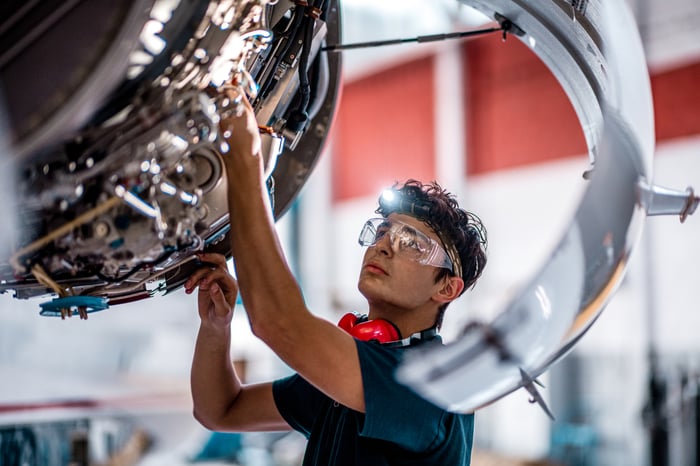
Image source: Getty Images.
Woodward and Howmet are both OEM and aftermarket companies, and they stand to substantially benefit from increased 737 MAX production, as they can fully take advantage of capital investments made to build out their production capacity in preparation for the 737 MAX production ramp. Similarly, the reduction in inventory that Ortberg referred to means that companies like Howmet and Woodward won't need to tie up cash in equipment inventory that Boeing is slow to use in production.
Whichever way you look at it, these four stocks have plenty of potential to outperform next year.
Lee Samaha has no position in any of the stocks mentioned. The Motley Fool has positions in and recommends Boeing, GE Aerospace, Howmet Aerospace, and Safran. The Motley Fool recommends Hexcel. The Motley Fool has a disclosure policy.