
- PRICING
- LIVE QUOTES
- LEARN
- HELP


EN
Warren Buffett's Latest Warning Is Sending Shockwaves Through Wall Street. Here's What History Says Could Happen Next.
Key Points
Some investors are getting worried about how much longer the AI-driven bull run can last.
The Oracle of Omaha also has sharp concerns about America's political and fiscal situation.
Warren Buffett is one of the most successful investors of all time. And over the past six decades, his Berkshire Hathaway portfolio has trounced the market, returning an average compound annual return of 19.7% compared to the S&P 500 index's average of 10.5%.
With such an amazing track record, people tend to listen to what he has to say. High-quality advice is more valuable than ever as the stock market grapples with challenges ranging from high corporate valuations, rising inflation, and political uncertainty.
Missed AI’s "Act 1"? Act 2 Could Be 15x Bigger. Most investors think they missed the AI boat because they didn't buy Nvidia in 2005. But according to our analysts, we’re only at the end of "Act 1"—the R&D phase. "Act 2" is the global rollout. Continue »
Let's discuss several recent warnings Buffett has given and decide what it could mean for your portfolio.
Buffett decries a "gambling mood" in the market
Warren Buffett is famous for focusing on value stocks, which are generally shares in companies that trade for affordable prices compared to their earnings and growth. However, these diamonds in the rough are getting harder to find. In a May interview with CNBC, Buffett criticized a "gambling mood" in the stock market and raised concerns about equity prices.
It isn't hard to see why he is getting worried. The cyclically adjusted price-to-earnings (CAPE) ratio is a valuation tool designed to help investors analyze the S&P 500's valuation from a long-term perspective. Right now, it stands at 40.7. That's well above its average of 17.4 and a level that has only been exceeded during the dot-com bubble when it hit an all-time high of 44 in late 1999 before a big crash.
Many on Wall Street now fear that the generative AI boom could be poised for a similar correction.
Buffett's also has concerns about America's fiscal situation
Unlike more outspoken business leaders like Elon Musk, Warren Buffett has typically avoided inserting himself directly into politics -- and wisely so. That said, the situation may be becoming too alarming to ignore. And in his final meeting as Berkshire Hathaway CEO in May 2025, Buffett had some very blunt words to say about the US fiscal situation.
"We wouldn't want to be owning anything that we thought was in a currency that was really going to hell, and that's the big thing we worry about with the United States currency. We're operating at a fiscal deficit now that is unsustainable over a very long period of time."
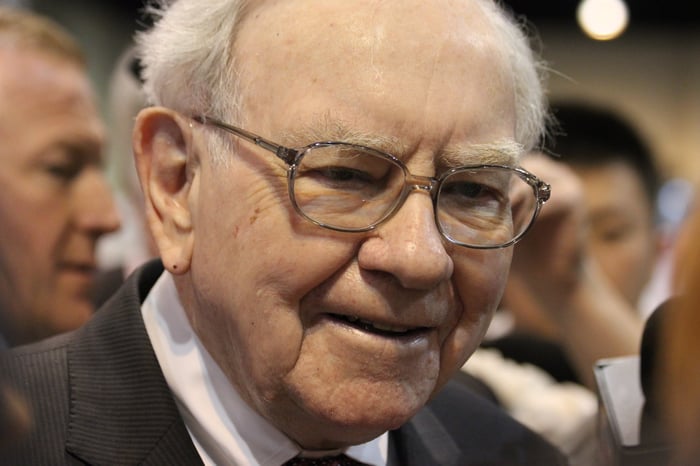
Image source: Getty Images.
A little over a year and a half later, and the situation he was warning about has become significantly worse. The Trump administration maintained its aggressive tariff policy, and the war in Iran has caused Brent Crude prices to spike 80% since the start of the year. September inflation has jumped to 3.7%, well above the Federal Reserve's long-running target of 2%.
Higher inflation erodes the value of cash and real returns in financial markets. It also forces the Fed to keep interest rates higher, increasing the cost of capital and making it harder for companies to invest in future growth. This could be particularly harmful for the AI industry.
How should investors respond?
The combination of pricey stocks coupled with a weakening bond market and rising inflation puts investors in a very difficult situation. With all the major asset classes facing unique challenges, there doesn't look to be many good options for wealth preservation, at least on the surface.
That said, time in the market usually beats trying to time the market. And we can all get some encouragement from some of Warren Buffett's earlier remarks.
In 2021, the Oracle of Omaha cautioned investors to "never bet against America," citing the country's ability to unleash human potential. This was during the COVID-19 pandemic, a period of widespread pessimism that the US ultimately bounced back from. Investors should remember that while the economic situation is tense right now, the US has successfully navigated worse crises, and this time probably won't be the exception.
Will Ebiefung has no position in any of the stocks mentioned. The Motley Fool has no position in any of the stocks mentioned. The Motley Fool has a disclosure policy.