
- PRICING
- LIVE QUOTES
- LEARN
- HELP


EN
UniFirst’s (NYSE:UNF) Q3 CY2026: beats on revenue
Workplace uniform provider UniFirst (NYSE:UNF) reported calendar Q3 2026 (fiscal Q4 2026) results beating Wall Street’s revenue expectations, with sales up 5% year on year to $645 million. Its GAAP profit of $1.90 per share was 3.6% below analysts’ consensus estimates.
Is now the time to buy UniFirst? Find out by accessing our full research report, it’s free.
UniFirst (UNF) Q3 CY2026 highlights:
- Revenue: $645 million vs analyst estimates of $634.3 million (5% year-on-year growth, 1.7% beat)
- EPS (GAAP): $1.90 vs analyst expectations of $1.97 (3.6% miss)
- Adjusted EBITDA: $94.86 million vs analyst estimates of $89.41 million (14.7% margin, 6.1% beat)
- Operating Margin: 6.5%, down from 8.1% in the same quarter last year
- Free Cash Flow Margin: 6%, down from 9.1% in the same quarter last year
- Market Capitalization: $4.82 billion
Steven Sintros, UniFirst President and Chief Executive Officer, said, “We are pleased with how we closed the fiscal year with a solid fourth quarter delivering improved growth and profitability. We remain focused on caring for our customers and communities, supporting our Team Partners, and demonstrating UniFirst's compelling value to both new and existing customers.”
Company overview
With a fleet of trucks making weekly deliveries to over 300,000 customer locations, UniFirst (NYSE:UNF) provides, rents, cleans, and maintains workplace uniforms and protective clothing for businesses across various industries.
Revenue growth
A company’s long-term sales performance is one signal of its overall quality. Any business can put up a good quarter or two, but many enduring ones grow for years.
With $2.52 billion in revenue over the past 12 months, UniFirst is a mid-sized business services company, which sometimes brings disadvantages compared to larger competitors benefiting from better economies of scale. On the bright side, it can still flex high growth rates because it’s working from a smaller revenue base.
As you can see below, UniFirst grew its sales at a decent 6.7% compounded annual growth rate over the last five years. This shows its offerings generated slightly more demand than the average business services company, a useful starting point for our analysis.
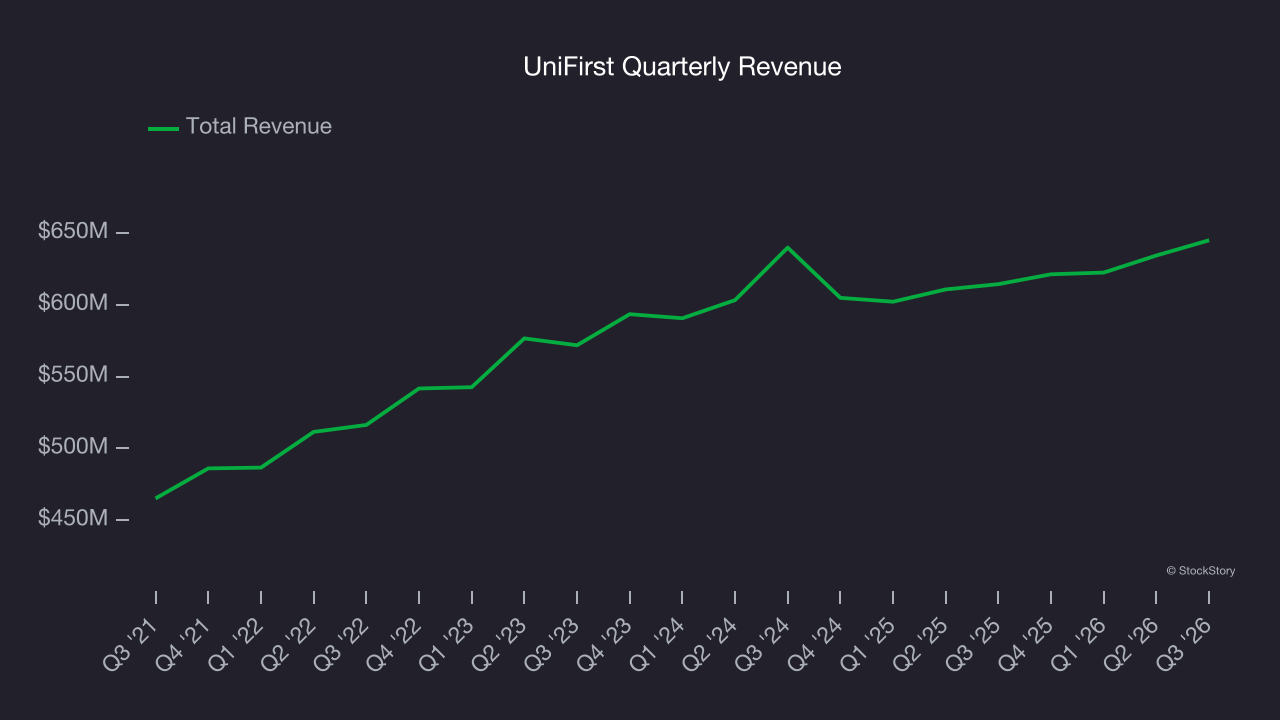
We at StockStory place the most emphasis on long-term growth, but within business services, a half-decade historical view may miss recent innovations or disruptive industry trends. UniFirst’s recent performance shows its demand has slowed as its annualized revenue growth of 2% over the last two years was below its five-year trend. We’re wary when companies in the sector see decelerations in revenue growth, as it could signal changing consumer tastes aided by low switching costs. 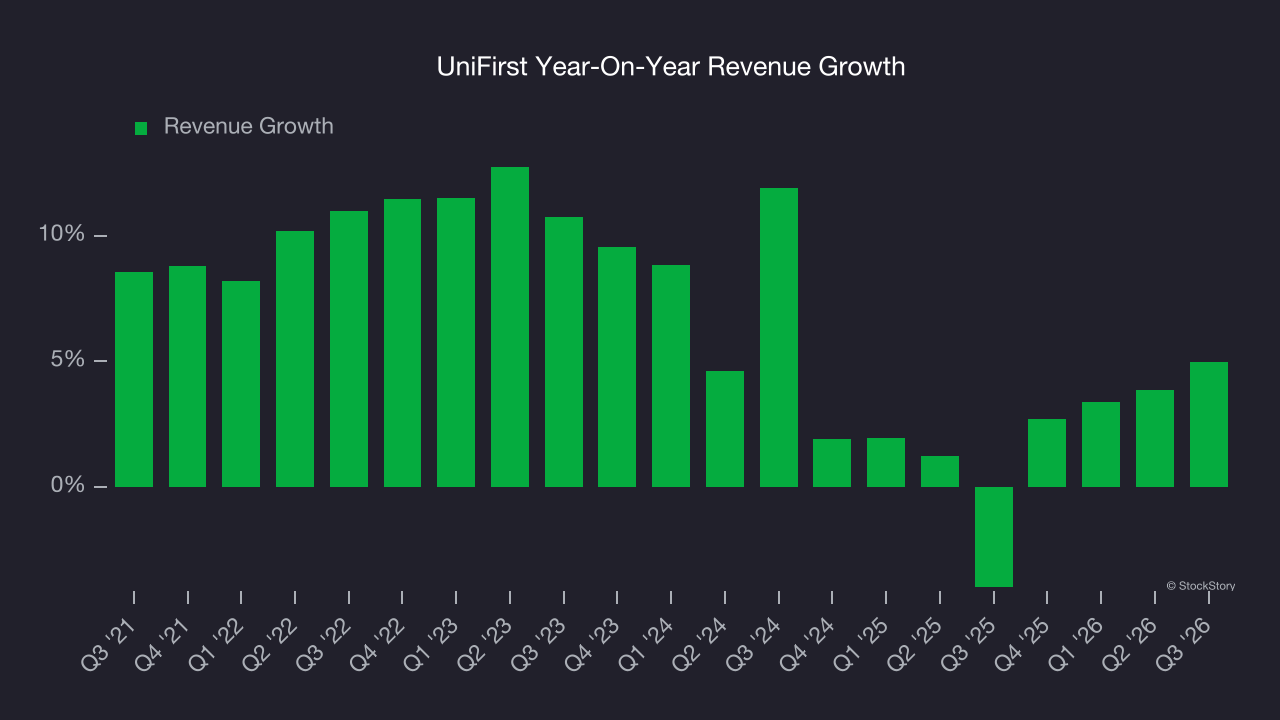
This quarter, UniFirst reported modest year-on-year revenue growth of 5% but beat Wall Street’s estimates by 1.7%.
Looking ahead, sell-side analysts expect revenue to grow 3.3% over the next 12 months, similar to its two-year rate. While this projection implies its newer products and services will catalyze better top-line performance, it is still below the sector average.
ONE MORE THING: 3 Hidden Platforms Growing 3X Faster than Amazon, Google, and PayPal. Amazon, Google, and Meta all followed the same playbook: Dominate an ignored market. Build an unbeatable moat. Scale until you’re unstoppable.
These three platforms are running that exact playbook right now. The early investors in Amazon made fortunes. The early investors in these could do the same. Get All 3 Stocks Here for FREE.
Adjusted operating margin
UniFirst’s adjusted operating margin has generally stayed the same over the last 12 months, averaging 7.6% over the last five years. This profitability was paltry for a business services business and caused by its suboptimal cost structure.
Looking at the trend in its profitability, UniFirst’s adjusted operating margin might have fluctuated slightly but has generally stayed the same over the last five years. This raises questions about the company’s expense base because its revenue growth should have given it leverage on its fixed costs, resulting in better economies of scale and profitability.
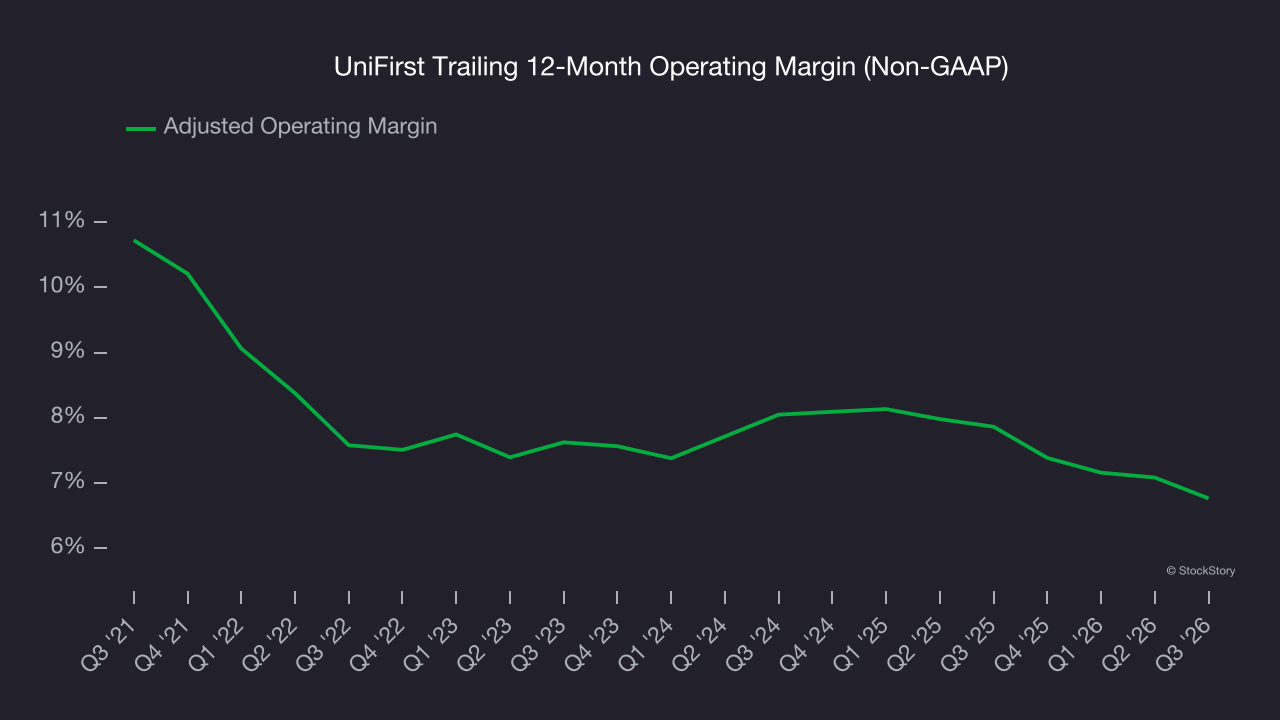
In Q3, UniFirst generated an adjusted operating margin profit margin of 7%, down 1.3 percentage points year on year. This reduction is quite minuscule and indicates the company’s overall cost structure has been relatively stable.
Earnings per share
We track the long-term change in earnings per share (EPS) for the same reason as long-term revenue growth. Compared to revenue, however, EPS highlights whether a company’s growth is profitable.
Sadly for UniFirst, its EPS declined by 5.4% annually over the last five years while its revenue grew by 6.7%. However, its adjusted operating margin didn’t change during this time, telling us that non-fundamental factors such as interest and taxes affected its ultimate earnings.
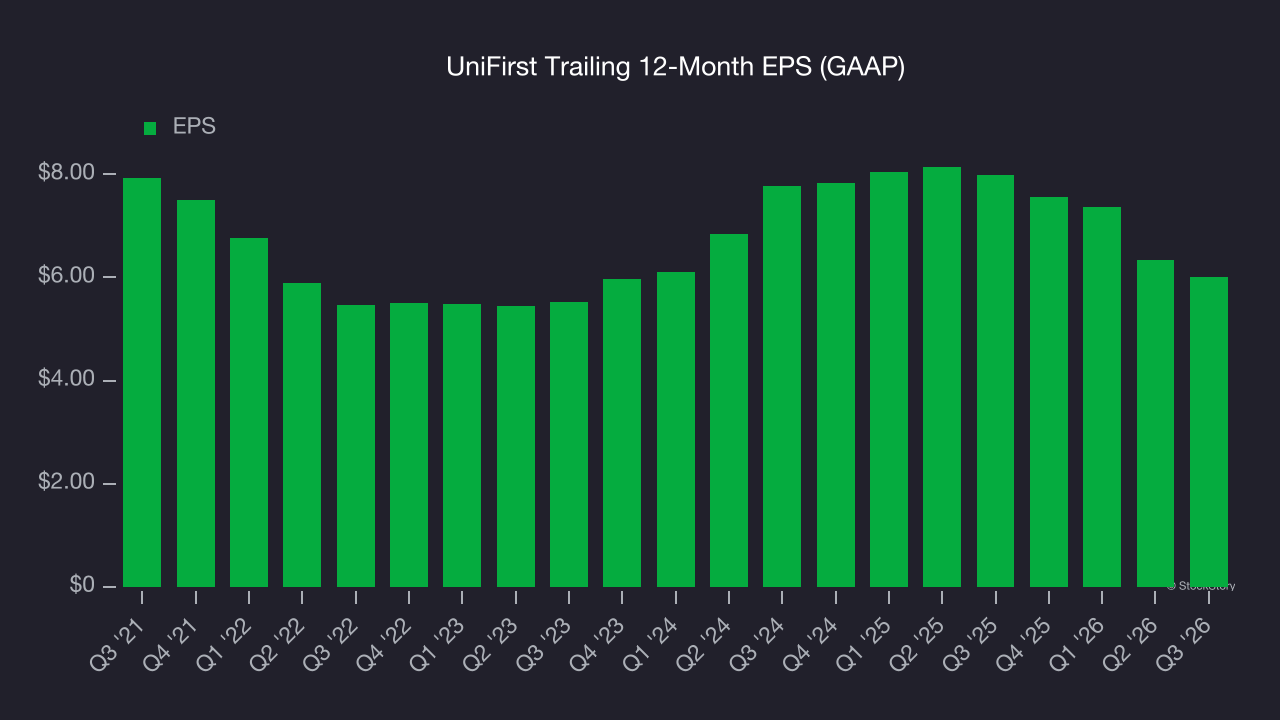
Like with revenue, we analyze EPS over a shorter period to see if we are missing a change in the business.
For UniFirst, its two-year annual EPS declines of 12% show it’s continued to underperform. These results were bad no matter how you slice the data.
In Q3, UniFirst reported EPS of $1.90, down from $2.23 in the same quarter last year. This print missed analysts’ estimates. Over the next 12 months, Wall Street expects UniFirst’s full-year EPS to grow 38.9% from $6.01 to $8.35.
Key takeaways from UniFirst’s Q3 results
It was encouraging to see UniFirst beat analysts’ revenue and EBITDA expectations this quarter. On the other hand, its EPS missed. Overall, this quarter was decent. The stock remained flat at $266.63 immediately following the results.
So do we think UniFirst is an attractive buy at the current price? What happened in the latest quarter matters, but not as much as longer-term business quality and valuation, when deciding whether to invest in this stock. We cover that in our actionable full research report which you can read here (it’s free).