
- PRICING
- LIVE QUOTES
- LEARN
- HELP


EN
Market questions prospects Goldman Sachs is still actively pricing Netflix (NFLX.US) “hot IP+ advertising monetization” growth narrative: target price points to 30% upward space
The Zhitong Finance App learned that the current rebound trajectory of global technology stocks is undergoing a major test during the earnings season, and the market's valuation differences over streaming giant NFLX.US (NFLX.US) are increasingly focused on whether the future growth path can be realized at an accelerated pace. On October 19, the semiconductor sector rebounded after nearly two weeks of adjustments. Shares of Micron and SanDisk, the two major memory chip leaders, rose sharply by about 3% and 5.5% respectively, outperforming the 1.7% increase in semiconductor ETF benchmark — ETF SOXX tracking the Philadelphia Semiconductor Index. However, after Netflix released earnings data for the third quarter on October 20, although profit for the third quarter exceeded expectations, the fourth quarter profit guidance given by management was weak and the annual advertising revenue forecast was lowered by nearly 6% to $64.66 after the market.
Wall Street financial giant Goldman Sachs sent a relatively optimistic bullish research report to the streaming media giant after Netflix released its earnings data and outlook. Goldman Sachs's core judgment is that the execution progress associated with user engagement and advertising revenue generation in the US market needs to be improved, but the long-term bullish investment logic consisting of the growth rate of subscription members, price increases in streaming subscription product lines, advertising monetization, and the increase in cash flow per share still holds true.
According to information, the Goldman Sachs analyst team continued to maintain a positive bullish rating of “buy” for Netflix (NFLX.US) and lowered the 12-month target price from $90 to $84: compared to the closing price of $68.69 used in the report, there was room for increase of 22.3%; compared to the above after-market price, it was 29.9%. Its bullish basis mainly focuses on the fact that after consistent market expectations and Wall Street analysts generally lower operating forecasts and multiplier pricing, investment in original content, monetization paths, profit margin expansion, and stock repurchases can still support attractive medium- to long-term returns.
Netflix is an important force in the global technology and internet industry, and is also a member of the classic US stock “FAANG” portfolio — however, this US stock portfolio is out of date. Currently, the most popular portfolio is the Big Seven US stock technology companies (that is, the Magnificent Seven, which includes Nvidia, Google, and Tesla). Netflix's core competency comes from collaboration between content production and procurement, personalized recommendations, streaming media transmission, and advertising technology: the recommendation system improves content discovery efficiency, and its own CDN (CDN) Open Connect supports large-scale global broadcasting, and monetization through subscriptions and advertising. Therefore, Netflix has distinct technology platform attributes, and its investment value depends on whether the appeal of content can continue to be transformed into user retention, pricing capabilities, and profit growth; the company expects revenue of about US$51.1 billion and an operating profit margin of 31.5% in 2026, reflecting the profit scale of this model.
Looking at global influence and commercial development capabilities, Netflix's core IP assets include “Squid Game” (Squid Game), “Stranger Things” (Stranger Things), “Wednesday” (Wednesday), “Bridgerton” (Bridgerton), and “K-Pop: The Witch Hunters” (KPop Demon Hunters). Among them, “Squid Game” and “Wednesday” received record views of about 265 million and 252 million times respectively in the 91 days before the first season went live, which is the most prominent representative of the large streaming platform's ability to communicate across cultures.
The IP assets of the “Stranger Stories” series have even formed a development system for stage plays, animation derivatives, products, and immersive experiences; “Bridgerton” extends to fashion, beauty, and themed dance parties; “The Witch Hunters” opens up music, toys, games, and offline experiences. The core economic value of these IPs is first reflected in attracting new subscriptions, promoting renewal, and supporting advertising monetization. The derivative business further extends its commercial life cycle; they are important content assets on the Netflix platform, but specific copyright and revenue distribution depend on their respective cooperation arrangements.
Profits won the current quarter, yet the market is constantly questioning the next year's growth trajectory
The key to Netflix's earnings report is the sharp divergence between profit performance for the quarter and future growth expectations. Netflix's third-quarter revenue was about US$12.884 billion, up 11.8% year on year, which is basically in line with market expectations; operating profit of US$4.459 billion, operating margin of 34.6%, and earnings per share of US$0.87, higher than the consensus of about US$0.82. However, profit exceeding expectations is mainly affected by delays in cost confirmation, and cannot be directly extrapolated as a continuous jump in profitability.
The company's management expects fourth-quarter revenue of US$13.442 billion, operating margin of 26%, and earnings per share of US$0.67, of which profit margin includes a drag of about 1.2 percentage points from expenses related to layoffs; annual revenue is expected to be around US$51.1 billion, and the operating margin remains at 31.5%. As a result, post-market selling pressure reflects investors' reassessment of the continuity of growth, while Goldman Sachs believes that the fourth quarter guidance may still be conservative. In addition, the two forecasts given by the company are slightly lower than the agreed market expectations — the company expects revenue of 13.442 billion US dollars for the fourth quarter. Compared with the market forecast of about 13.51 billion US dollars, the company expects annual revenue of about 51.1 billion US dollars, compared with the market forecast of about 51.21 billion US dollars; the gap in profit guidance is even more obvious: earnings per share for the fourth quarter are expected to be 0.67 US dollars, which is about 8.2% lower than the market forecast of $0.73.
Goldman Sachs emphasized in the research report that US content performance and user engagement are the common foundation for connecting membership growth, price increases, and advertising revenue. The US and Canada business revenue for the third quarter was US$5.628 billion, up 11% year over year, slightly higher than consensus, but revenue growth alone was insufficient to answer whether viewing engagement could continue to improve.
Goldman Sachs analysts emphasized in the research report that management is strengthening implementation in the US market through content team adjustments and follow-up films. The 2027 highlights include “The Chronicles of Narnia,” “Bridgerton,” “Wednesday,” and sports programs such as the NFL and Women's World Cup. Looking at the commercial mechanism, continuously attractive content can promote customer acquisition and renewal, increase users' acceptance of subscription prices, and expand the audience that advertisements can reach. Live streaming, authorized procurement, and third-party content aggregation have been added as a result, and most of the content investment is still used to form original works that differentiate the platform.
The reduction in advertising revenue revealed implementation gaps in monetization capacity building, and also explained why Goldman Sachs still retains long-term growth judgments. The company reduced its advertising revenue forecast for 2026 from US$3 billion to about US$2.7 billion, a decrease of 10%; according to management, the launch of some advertising products and integration of third-party systems are slower than planned, and the ability to measure advertising effectiveness still needs to be improved. Judging from the monetization mechanism, viewing traffic needs to go through ad procurement access, targeted delivery, and performance verification before it can be converted into a budget that advertisers continue to invest. Goldman Sachs believes that Netflix's first-party data, innovative advertising formats, and live streaming content have the potential to monetize for many years, and are still not fully included in the market. Thus, the central point of view of the advertising business is whether technical capabilities and commercial execution can work together to significantly improve monetization efficiency based on a growing audience of streaming platforms.
Goldman Sachs's target price was lowered, and cash flow and valuation still left room for repair
Goldman Sachs adjusted the certainty that growth would be realized and its valuation, while the long-term financial model still kept revenue and profit margins expanding at the same time. The Goldman Sachs analyst team estimates revenue for 2027 and 2028 to be $57.168 billion and US$63.811 billion, respectively, up 11.8% and 11.6% year over year; operating margins will rise to 32.3% and 33.6%, with earnings per share of 3.72 and 4.50 US dollars, respectively. Compared with the previous two years, revenue forecasts were lowered by about 0.4%, and earnings per share were lowered by about 1.3%, which is a moderate correction.
The Goldman Sachs research report also indicates that 2026 profit and free cash flow benefited from transaction termination fee revenue of approximately US$2.8 billion, so earnings per share in 2027 increased only slightly from the 2026 forecast value of $3.59, including the base effect caused by the withdrawal of one-time earnings. Combined with the compound earnings per share growth rate of about 21% from 2025 to 2028, Goldman Sachs still sees Netflix as a platform with medium- to long-term profit growth capabilities.
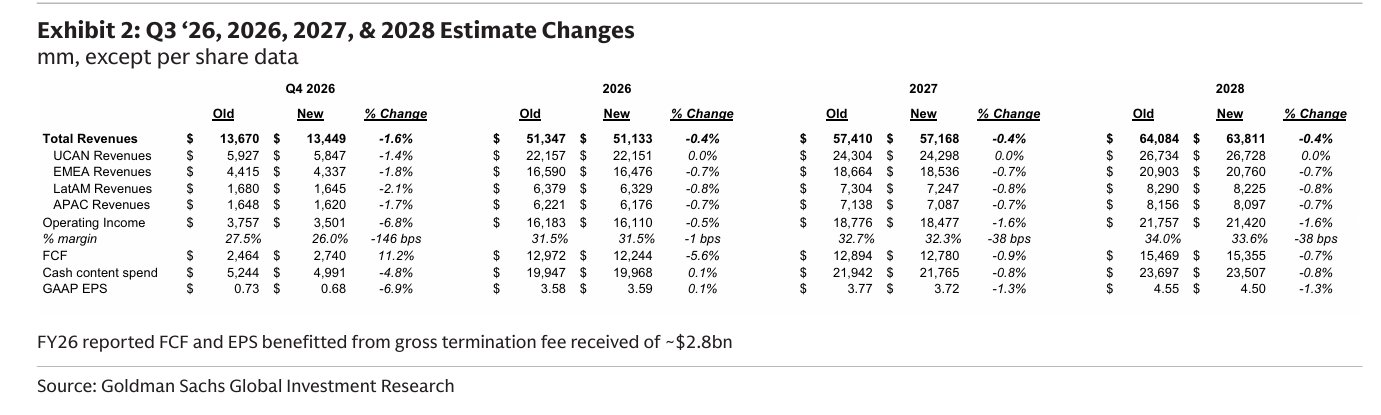
Cash flow data requires a simultaneous review of operating execution, content investment, and return on capital. Free cash flow for the third quarter was US$2,884 million, about 11.9% lower than the market consensus set out in the report; the company reduced its free cash flow guidance for the full year from US$12.5 billion to approximately US$12 billion, mainly due to real estate transactions expected to be completed in the fourth quarter. Goldman Sachs expects free cash flow to reach $12.78 billion and $15.355 billion in 2027 and 2028, respectively, to support continued investment in content and share repurchases. Netflix repurchased $4.8 billion of shares in the third quarter, with a remaining authorization of $22.3 billion; Goldman Sachs predicts a rise in free cash flow per share from $3.19 in 2027 to $3.97 in 2028. On the basis of maintaining business investment, liquidity, and prudent mergers and acquisitions standards, repurchases reduce share capital, so that the increase in operating cash flow is more fully reflected in the increase in value per share.
The target price of $84 is based on a lower valuation multiple, reflecting Goldman Sachs's repricing of business visibility. Each valuation model takes 50% weight: one part reduces the corporate value/GAAP EBITDA ratio from 20 times to 17 times; the other part reduces the valuation multiplier of the forward “free cash flow minus equity incentive fee” from 21 times to 20 times, and discounts it for three years at a discount rate of 12%. Based on the after-market earnings forecast of $64.66 and Goldman Sachs's 2027 earnings per share, the price-earnings ratio is about 17.4 times, while the target price of $84 corresponds to about 22.6 times.
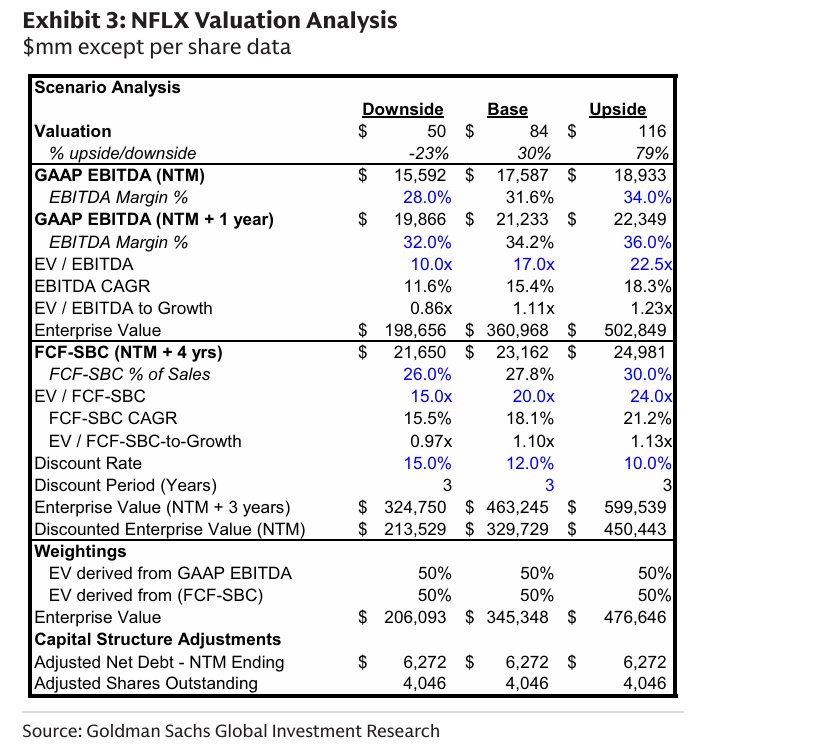
Furthermore, the optimistic, benchmark, and pessimistic scenarios shown in the Goldman Sachs research report were 116, 84, and 50 dollars, respectively. Compared with the above after-market prices, this is enough to show that its judgment is clearly sensitive to changes in business performance and valuation, and shows that the return risk in its judgment is asymmetrical — the potential upward space significantly exceeds the downside, showing a profitable risk-return structure. According to Goldman Sachs, Netflix's key catalyst for the next phase is the full-year revenue and profit margin outlook announced in January 2027: US content execution, membership and price increase performance, and progress in advertising capacity building will jointly determine whether the current undervaluation can be transformed into stock price repair.