
- PRICING
- LIVE QUOTES
- LEARN
- HELP


EN
Bunge Stock And 2 Grain Shipping Plays Facing Black Sea Insurance Shifts
Food security headlines around the Black Sea corridor are suddenly colliding with freight insurance politics, and that mix is reshaping how grain actually moves and gets priced. This creates a window where some stocks exposed to these shipping and insurance shifts could gain new attention while others risk falling behind. In this article you will meet 3 stocks from our Global Grain Traders, Bulk Agri-Shippers & Marine Insurers screener and see how they stack up against this new backdrop.
The three stocks in this piece are just a sample from a much wider universe, as the full screen surfaced 12 more companies with equally detailed grain, shipping and insurance stories that are not covered below. To see that broader field and start separating higher conviction ideas from the rest, head straight to the Global Grain Traders, Bulk Agri-Shippers & Marine Insurers screener.
TTS (Transport Trade Services) (BVB:TTS)
Overview: TTS (Transport Trade Services) is a Romanian freight forwarder that moves bulk cargo, including grain, through Danube and Black Sea ports.
Operations: TTS generates RON 443 million from forwarding, RON 300 million from river transport, RON 136 million from port operations, and RON 76 million from other services.
Market Cap: RON 1.3b
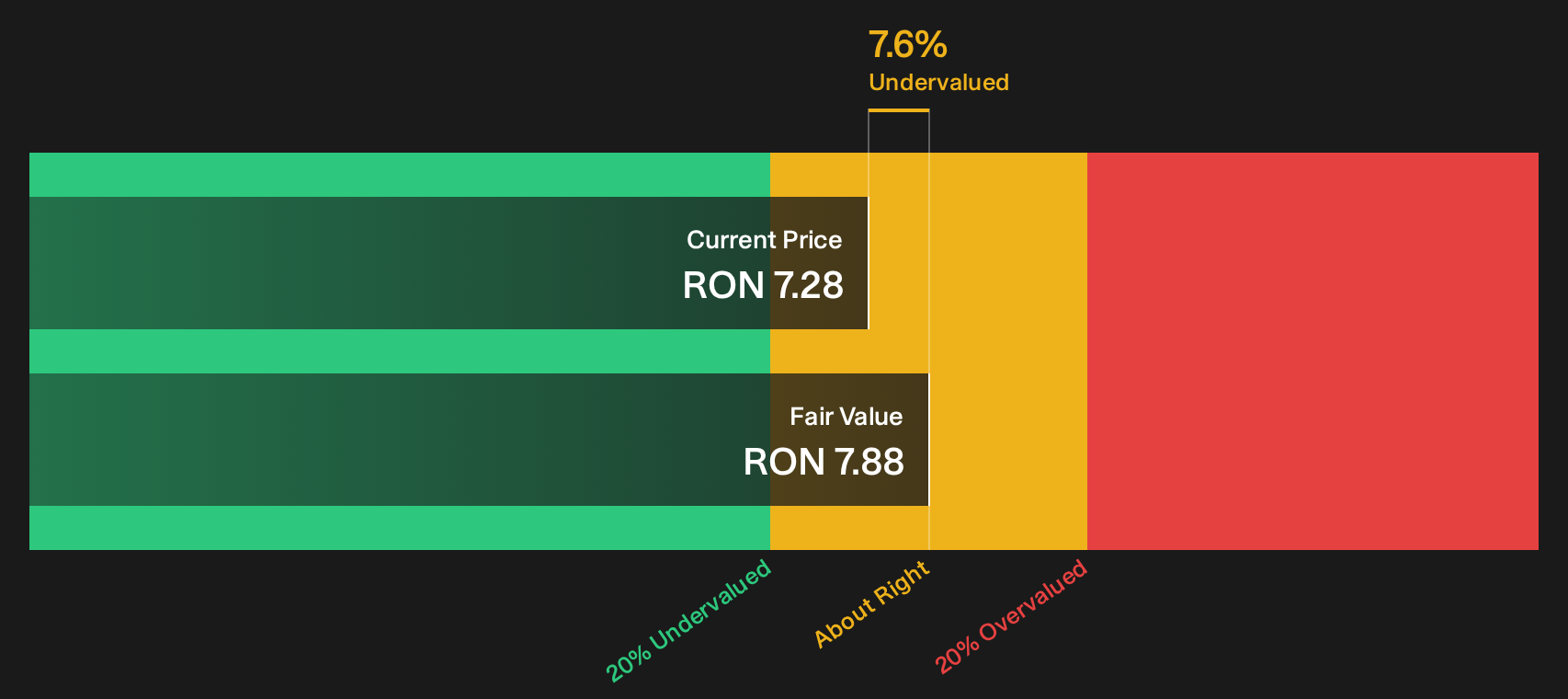
TTS links Danube grain flows to Black Sea export routes, combining freight forwarding, inland barges and port terminals in Constanta. Recent half-year results show the business moving from loss to profit, which is notable for a stock trading on 140.3x P/E and dependent on corridor volumes as well as an insurance reset if a single key assumption breaks.
If that hinges on a single breaking assumption, the DCF valuation analysis for TTS (Transport Trade Services) shows how much of TTS's rich P/E is tied to corridor and insurance sensitivity.
Bunge Global (BG)
Overview: Bunge Global is a global agribusiness that buys, stores, ships and processes grains and oilseeds, linking farmers to food, feed and biofuel customers worldwide.
Operations: Bunge Global generates US$44.3b from Soybean Processing and Refining, US$29.7b from Grain Merchandising and Milling, US$17.8b from Softseed Processing and Refining, and US$5.2b from Tropical Oils and Specialty Ingredients, after eliminations and small corporate items.
Market Cap: US$19.8b
Bunge Global sits at the busy crossroads of grain origination, bulk export flows and oilseed processing, so any easing of Black Sea bottlenecks or war risk insurance costs can affect how effectively it moves crops from surplus regions to buyers.
"The completion and integration of the Viterra merger provides substantial cost and commercial synergies and expands Bunge Global's global origination, processing and distribution footprint. It also positions the company to capture greater market share in higher growth regions, which can support higher revenue and operating margins over time."
What ultimately matters for investors is how a single pressure point in that enlarged network tilts future profitability when grain trade conditions shift.
That single pressure point is exactly where the real story starts, and the full narrative for Bunge Global shows how Bunge Global's enlarged network could accelerate or stall profitability.

EuroDry (EDRY)
Overview: EuroDry is a Greece based dry bulk shipowner whose Supramax, Ultramax and Panamax vessels carry grains and other bulk commodities worldwide.
Market Cap: US$130 million
EuroDry plugs this screen directly into seaborne grain flows, because its bulk carriers feel every shift in corridor access, voyage length and cargo mix.
"A relatively low global dry bulk order book at about 12.4% of the fleet and projected new deliveries of roughly 4% of existing capacity annually through 2028, together with an aging global fleet, limit net supply growth and can support vessel utilization and time charter equivalent revenues over time."
What happens to EuroDry's earnings power if a single assumption about future grain volumes and corridor access fails to hold?
If that single assumption is what worries you, the full narrative for EuroDry explains how EuroDry's fleet exposure could turn corridor risk into accelerating upside or a stalled opportunity.

Seeking Alternatives Before Momentum Flies
Fresh opportunities can be harder to find when momentum builds and prices start flying. Scan these ideas before the crowd, while the data still really matters, and consider your options carefully.
- Explore dependable income streams by scanning 221 dividend fortresses that aim to keep cash coming in even when markets feel choppy.
- Look for resilient balance sheets using the curated list of solid balance sheet and fundamentals (202 results) so you can focus on businesses built to handle shocks rather than relying on hope.
- Review potential hardware opportunities with 55 AI infrastructure stocks before demand stories are fully reflected in the pricing of these backbone suppliers of the AI build out.
Have feedback on this article? Concerned about the content? Get in touch with us directly. Alternatively, email editorial-team@simplywallst.com