
- PRICING
- LIVE QUOTES
- LEARN
- HELP


EN
The Bet Tidewater Holders Made
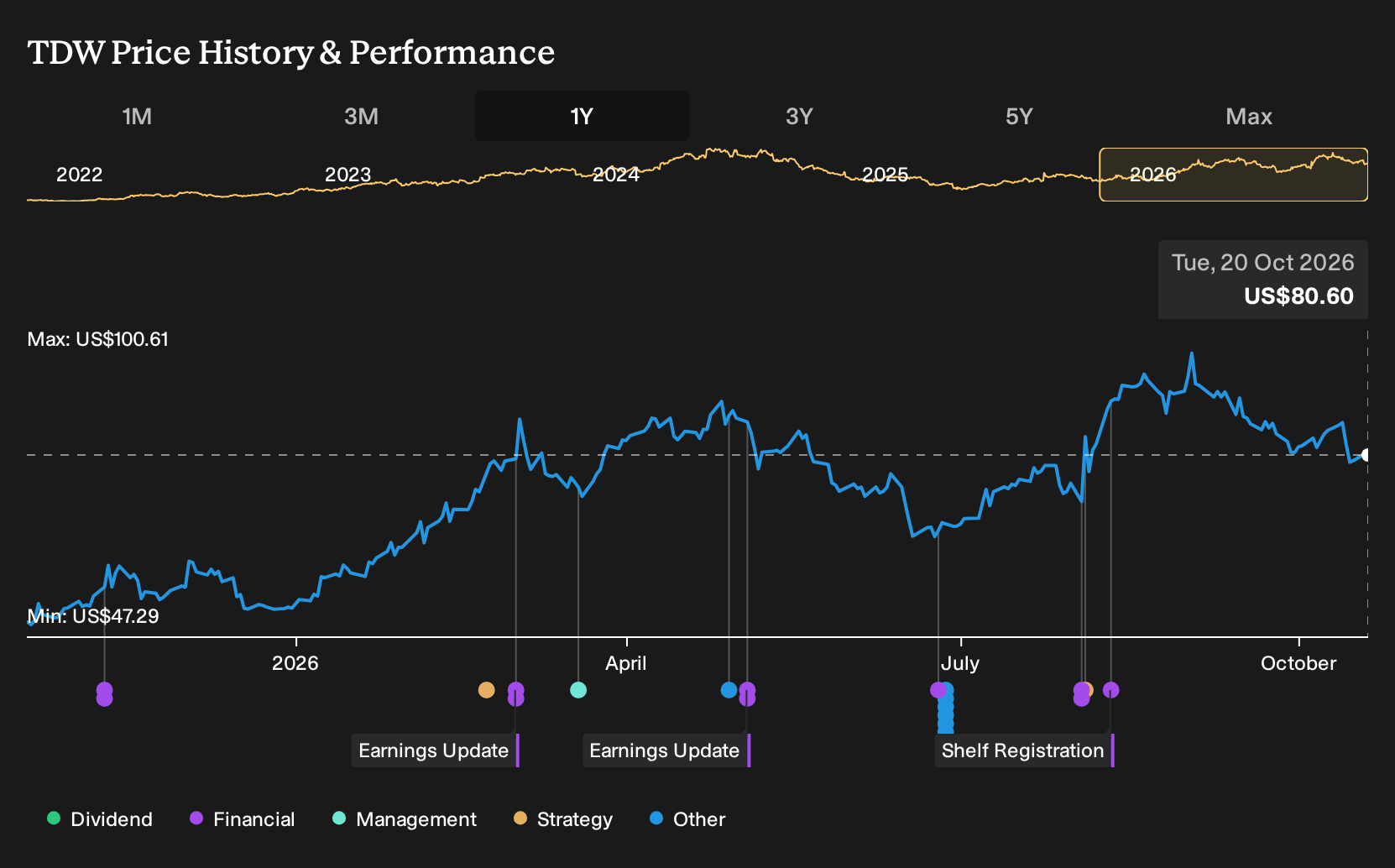
Tidewater’s year has revolved around one concrete move. Management agreed to spend US$500 million on Wilson Sons Ultratug Offshore to add 22 platform supply vessels in Brazil, even as later quarterly reports showed pressure on net margin. Investors who held Tidewater over the past year are up 70.4%, including dividends. If you were deciding whether to buy back on 2025-10-20, what did you need to believe about this kind of expansion and future utilization?
The useful thing about a Narrative is that the reasoning is checkable: the assumptions sit beside the argument, and together they imply an estimated Fair Value you can disagree with.
Tidewater has already moved. See which of 34 high quality undervalued stocks still trade below our estimates.
The Argument Tidewater Investors Were Weighing
The shares cost US$47.78 at the start of the period, and Tidewater sat between two very different stories about its future.
The bullish narrative pinned fair value at US$61.67, assuming revenue growth of 3.6% a year and profit margins reaching 20.2%, supported by tight vessel supply and a modernized fleet.
The bearish view put fair value at US$33.85, highlighting decarbonization headwinds and industry overcapacity, even while assuming margins could still reach 19.4% with a much lower 6.8x future P/E multiple.
What The Tidewater Results Actually Tested
The Wilson Sons Ultratug Offshore deal moving from agreement to completion gave Tidewater clear scale in Brazil, which backed the bullish focus on fleet expansion and utilization. Reported results pulled the other way. Revenue in Q2 2026 sat near Q2 2025 levels at about US$342 million, while net income dropped and net margin went from 21.4% to 6.3%. The evidence cut both ways.
The hinge assumption was not demand; it was profitability. For any similar stock, check whether acquisitions and higher vessel counts show up in stable or rising net margin before trusting a high-margin narrative.
What Tidewater's Run Leaves You Paying For Today
Tidewater’s share price is now US$80.6 after a 70.4% gain over the past year. The selected Narrative’s Fair Value sits below the current price, reflecting concern that cost intensity has risen even as vessel supply remains tight.
A buyer today effectively assumes Tidewater can turn contracted activity and acquisitions into resilient free cash flow. The question is how higher conflict and drydock costs affect that conversion if vessel tightness and day rates simply hold rather than improve.
"The main thing that has to go right is that Tidewater converts strong contracted activity and acquisitions like Wilson Sons into sustained free cash flow after covering higher maintenance and conflict related costs. The numbers imply that Tidewater’s share price already bakes in a continuation of recent high margins and vessel tightness, leaving limited room for upside if costs stay elevated or offshore activity normalizes."
Not everyone reads the same price the same way. → See the lower figure this Narrative lands on, and how it gets there
Find Your Own Contrarian Opportunity
You may be late to this rally, but that does not have to mean arriving late to every opportunity. Start with companies whose prices leave room for a different view of their future. Here are three trading below our estimates.
- Company 1 - 32% below our estimate - assumes GPU rack demand keeps straining power buildouts as data workloads tilt to artificial intelligence.
- Company 2 - 49% below our estimate - leans on online bettors shifting from physical venues as more regions permit digital wagering.
- Company 3 - 22% below our estimate - ties recurring software subscriptions to rising artificial intelligence workloads on its cloud backbone.
That is three of the list. See the full list of 25 financially solid companies →
Have feedback on this article? Concerned about the content? Get in touch with us directly. Alternatively, email editorial-team@simplywallst.com