
- PRICING
- LIVE QUOTES
- LEARN
- HELP


EN
Why Levi Strauss (LEVI) Is Back In The Spotlight
Levi Strauss (LEVI) delivered a mixed message to investors, combining Q3 sales growth and a 14% dividend increase with a slightly lower full-year revenue outlook attributed to foreign exchange effects.
Recent trading has been choppy for Levi Strauss. The 7-day share price return of 7.22% and 1-day gain of 0.93% suggest short-term momentum picking up after a 90-day share price decline of 16%, while the 3-year total shareholder return of 60.51% contrasts with a weaker 5-year total shareholder return. This hints at a story of recovery rather than a straight line higher.
Scan how Levi Strauss compares with other apparel and consumer brands showing resilient fundamentals and potential for a rebound using the 35 high quality undervalued stocks.
After Q3 earnings, a higher dividend, and a share price that has only recently started to recover, the key question is whether Levi Strauss still offers meaningful upside or if the easy gains are already gone.
Most Popular Narrative: 10.2% Overvalued
Levi Strauss last closed at $20.63, while the leading narrative on the stock pegs fair value closer to $18.72, which frames the recent rebound as richer than that narrative thinks the fundamentals support.
The framing shift on the U.S. distribution network transition is the most consequential piece of this call, and it is worth sitting with the actual commitment before assessing how management now talks about it.
The plan had been specific: close the Hebron distribution center, consolidate into Groveport, and do it with urgency because “the fact that we have given the intent, given notice, is indicative that we’re serious about it.” A Bank of America analyst cites the number management itself had set: “an immediate $5 million in cost savings per quarter as soon as you shut these parallel DCs down.” Management confirms the Hebron closure happened, on schedule, at quarter’s end. The $5 million in quarterly savings that closure was supposed to trigger has been pushed to 2027, with no month specified.
See why 1 investors see Levi Strauss as 10% overvalued.
According to LunaRodas, this kind of slippage between earlier commitments and current timelines is a central reason the narrative assigns a fair value of $18.72 to Levi Strauss while the stock trades above that level. The view is that management execution risk around distribution, direct to consumer growth and large projects like ERP justifies a discount to the current price rather than a premium.
Result: Fair Value of $18.72 (OVERVALUED)
Still, a faster recovery in direct to consumer comps or clearer progress on the U.S. distribution savings could quickly challenge the current Levi Strauss overvaluation story.
Find out about the key risks to this Levi Strauss narrative.
Another View on Levi Strauss Valuation
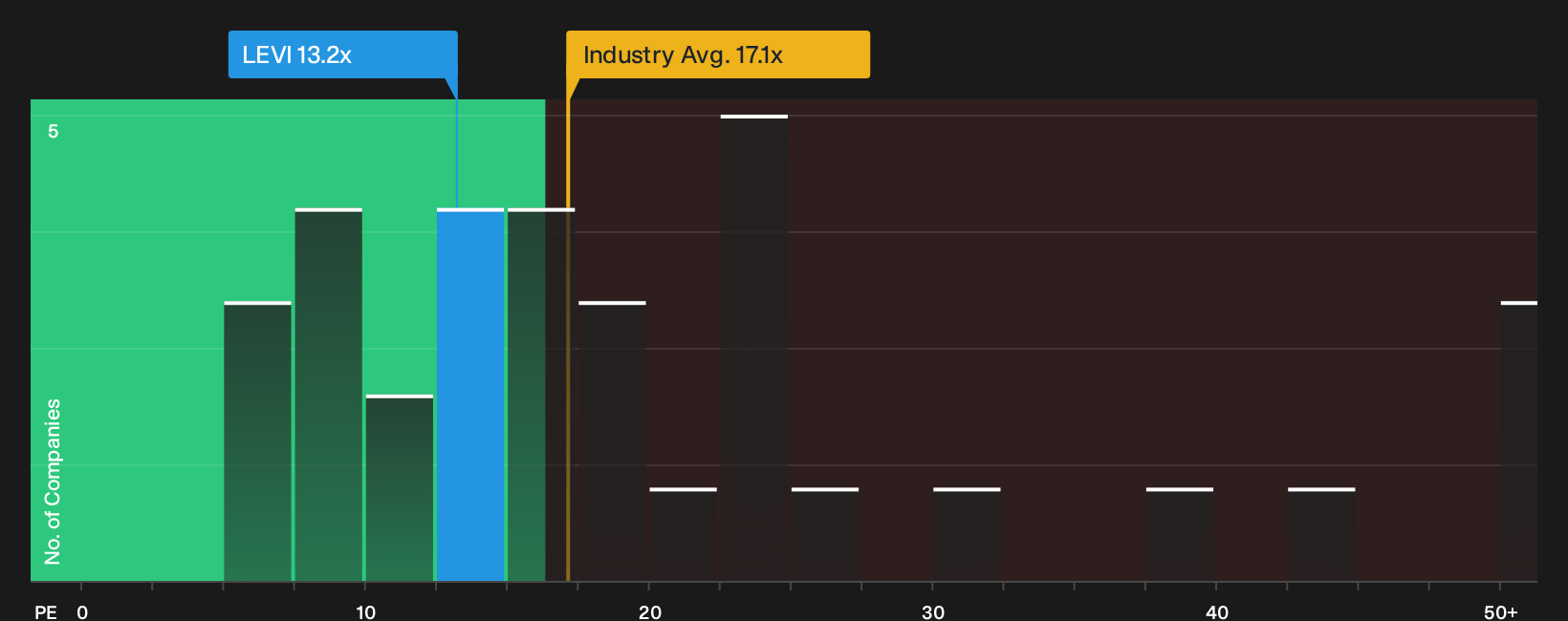
The narrative fair value of $18.72 paints Levi Strauss as 10.2% overvalued, yet the market is not pricing it like an expensive stock on earnings. The current P/E of 13.2x sits well below peers at 21.4x and also under the fair ratio of 17.6x. This points to a valuation gap that could either close through a lower price or through stronger conviction in the earnings stream. Which side of that adjustment do you think carries the bigger risk?
See what the numbers say about this price — find out in our valuation breakdown.
Next Steps
Mixed signals around Levi Strauss can feel confusing, so move quickly from headline impressions to the underlying facts and shape your own takeaway with the 3 key rewards and 1 important warning sign.
Looking for more investment ideas beyond Levi Strauss?
If Levi Strauss has you thinking differently about value and risk, do not stop there. Use the Simply Wall Street Screener to pressure test fresh ideas.
- Target quality at a discount by checking companies that score well on fundamentals and valuation through the 35 high quality undervalued stocks.
- Prioritize resilience by filtering for businesses with strong finances and low risk profiles using the 32 resilient stocks with low risk scores.
- Hunt for overlooked opportunities by scanning the 20 high quality undiscovered gems before everyone else pays attention.
Have feedback on this article? Concerned about the content? Get in touch with us directly. Alternatively, email editorial-team@simplywallst.com