
- PRICING
- LIVE QUOTES
- LEARN
- HELP


EN
Storage led the counterattack after eight straight losses for Philadelphia Semiconductors! Damo shouts that the HDD Super Cycle is not over, Seagate and Western Digital will soar 80%
The Zhitong Finance App learned that the US stock Philadelphia Semiconductor Index, which has the title of “a key weather vane for global AI computing power and semiconductor trading”, ended a downward trajectory for eight consecutive trading days on Monday. Among them, the memory chip industry chain also led the US stock market. At this time, Wall Street financial giant Morgan Stanley invested in the two major HDDs (hard drives, also commonly known as “mechanical hard drives”) superdominants headquartered in the US - Western Digital (WDC.US) and Seagate (STX.US), which can be described as giving strong bullish research reports Global stock market semiconductor board The pace of the block's phased bottoming out added fuel. The core judgment given by Morgan Stanley is that the HDD super upward cycle continues, but the stock price had previously been prematurely and excessively factored into peaking profits and intensifying price competition.
On October 19, the Philadelphia Semiconductor Index rose 1.6%, ending eight consecutive declines with a cumulative decline of 15.7%; Micron and SanDisk rebounded about 3% and 5.5% respectively, while Seagate and Western Digital rose 3.41% and 6.09% respectively. However, the rebound has yet to recover recent losses: as of Monday, Seagate and Western Digital still had cumulative declines of about 28.4% and 22.5% in October, even though increases during the year were still about 140% and 104%, respectively. Supply concerns caused by Toshiba's expansion of production, combined with the sharp decline in equity bonds of new cloud leaders such as CoreWeave caused by the surge in 10-year and 30-year US bond yields, and the growing pressure on AI financing in a broad sense have significantly lowered the market's pricing for the duration of the storage boom cycle.
The financial side also showed this divergence. Statistics from J.P. Morgan Chase, another Wall Street financial giant, on October 19 showed that as of October 16, global stock ETFs had inflows of 46.3 billion US dollars. Among them, SOXL (that is, a leveraged ETF that tracks three times the Philadelphia Semiconductor Index — US stock code “SOXL”) recorded a record high inflow of 7.2 billion US dollars in a single week, and the ETF product line tracking South Korea has accumulated a sharp inflow of 1.3 billion US dollars. It is the strongest since July, of which about 600 million US dollars went into the Korean ETF KORU by 3 times longer; Meanwhile, the DRAM-themed ETF was redeemed for the eighth week in a row, with the latest weekly outflow of 900 million US dollars. These financial developments can be described as highlighting that the market is actively betting on a semiconductor rebound, but confidence in the profit cycle of the memory chip industry chain, including HDD, SSD, DRAM, and even HBM, has not been restored simultaneously; this also makes the significance of the financial reports of storage giants more clear: whether price increases, profit margins, and cash flow growth trajectories can be realized beyond expectations will determine whether the memory chip and semiconductor counterattack can continue to be supported.
The Morgan Stanley team, led by senior strategist Erik Woodring, looks at the core logic of HDD growth prospects, running through the four levels of supply, pricing, technology upgrades and valuation: Toshiba is still constrained by key components and equipment, AI customers expand procurement, and the HDD supply and demand gap may continue to expand; rising marginal transaction prices and gradual contract pricing. Coupled with HAMR's near-line high-capacity HDD products reducing unit costs, it is expected that profits will continue to improve.
Morgan Stanley maintained the “Accumulation” (Accumulation) rating for Seagate and Western Digital, and re-listed Seagate on Morgan Stanley's IT hardware “Top Pick” (Top Pick) list, with the target price rising from $1,187 to $1,200; for Western Digital, the target price dropped slightly from $676 to $643, but it was viewed as a more attractive tactical allocation and investment opportunity for risky assets prior to financial disclosure. Based on the closing prices of $660.81 and $352.21 on October 19, the potential upside over the next 12 months is 81.6% and 82.6%, respectively.
AI data torrents awaken “sleeping hard drives”, and HDD oligarchs reap the “AI infrastructure dividends”!
The reason why the two major HDD oligarchs Western Digital and Seagate have greatly benefited from the almost “endless” storage demand brought about by the unprecedented global AI computing power torrent is the explosive expansion demand of large-scale AI data centers such as “Stargate” for Western Digital and Seagate data center class nearline HDDs (that is, near-line high-capacity HDDs) and Seagate high-performance eSDs.
The AI training/inference process not only consumes computing power, but also produces data that needs to be stored for a long time at an exponential rate. AI training/inference has brought the “data generation-cleaning-version-playback-archiving” chain to an exponential level. What data centers need is storage that balances cost and scale at the Exabyte level. At this level, nearline (nearline) HDDs are still one of the optimal solutions for “cost per terabyte/capacity per watt”, so when expanding AI infrastructure, cloud vendors and enterprises will invest large budgets into high-capacity near-line hard drives to handle data lake/object storage/cooling and heating stratification and long-term retention requirements.
HDDs benefit from the core mechanism of sky-level AI inference workloads in the age of AI agents. They are data assets accumulated by intelligence agents that continuously perform tasks, and need to be stored, protected, and reused for a long time at a sufficiently low cost; next-generation HDD technology focusing on HAMR (i.e. heat-assisted magnetic recording) expands the economic carrying capacity of such data by increasing storage density.
For cutting-edge AI application products such as Muse and Astra, a task may include multiple rounds of search, tool call, code execution, and image and video processing. Enterprises need to keep valuable work results, business status, historical versions, and audit records, and some data will also go into subsequent evaluation and training. From this, it is deduced that the wider the business covered by the smart device and the longer the continuous operation time, the more room for persistent data storage; therefore, the core logic that actually drives the continuous expansion of HDD procurement by cloud computing supercompanies is undoubtedly the amount of stored data and storage period that continues to explode even after screening, compression, and deduplication, that is, it is extremely suitable for the net storage of warm and cold data carried by HDDs and their storage period.
This storage component demand chain based on the continuous expansion of computing power requirements of AI agents is implemented through hierarchical storage, and various types of storage assume different responsibilities. The GPU's HBM carries active data required for computation. Host DRAM and NVMe SSDs expand high-speed caching and retrieval capabilities, while near-line HDDs are suitable for capacity-prioritized data lakes, original multi-modal data, historical versions, and backups. Hot content is then entered into the high-speed layer through caching and prefetching. Nvidia's CMX architecture clearly places frequently reused KV caches in a dedicated flash storage layer, leaving history, logs, and other inference products that need to be stored for a long time to the underlying objects and files.
Therefore, AI agent inference load not only expands high-speed cache requirements, but also long-term data bases. The opportunities for near-line HDDs mainly focus on the latter; real-time vector retrieval and active KV access still value the latency advantages of memory and SSD more. In particular, when large-scale data storage enters a warm and cold storage layer where capacity costs are the main constraint, the unit capacity cost advantage of HDDs over enterprise-grade SSDs becomes an important economic foundation for transforming data growth into HDD capacity requirements.
The technical value of HAMR is to break through the physical limitations of “smaller particles, more stable data, and reliable writing” of magnetic records. As magnetic particles shrink, thermal disturbances are more likely to affect information stability, and media with higher magnetic anisotropy need to be used, but this medium is also more difficult to be rewritten by magnetic heads. HAMR uses a laser to instantaneously heat a very small area to reduce the magnetic field strength required for writing, and quickly cools and stabilizes after writing, thereby saving more data on the same disc area. What it improves is surface density and single disk capacity; mechanical search and rotation delays still exist, and random access performance does not increase in the same proportion as capacity, which also determines that its advantages focus on massive, capacity-prioritized storage loads.
The fear of expanding production has not filled the supply gap, and AI data demand is strengthening HDD pricing power
The news of Toshiba's production expansion impacted investors' trust in “the three suppliers to maintain supply discipline,” but the Damo channel survey showed that Toshiba is still limited by magnetic media, production equipment, etc., and that the 2027 natural annual production capacity has basically been booked by customers, and the pricing may even be more positive than Seagate and Western Digital. Channel expectations quoted in the report indicate that the industry supply gap may expand from about 300 EB in 2026 to about 400 EB from 2027 to 2028. Therefore, the variable that determines the boom is whether actual deliverable capacity can keep up with the increase in demand. Furthermore, the new production line must be certified and cooperated by magnetic media, equipment, and customers before it can be converted into effective supply; currently, the Damo strategist team has seen no evidence of irrational expansion of production or price cuts to grab share.
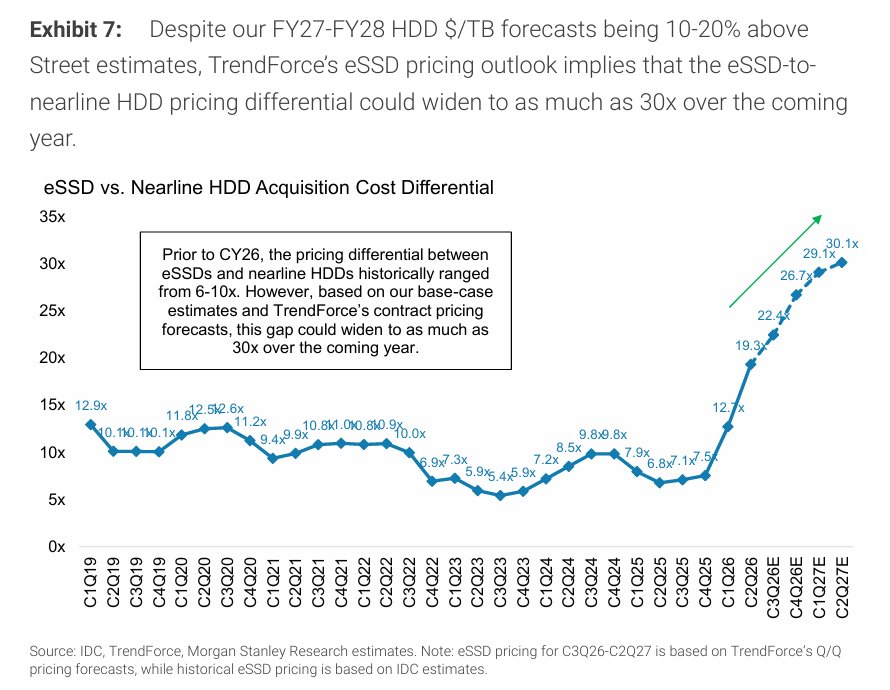
The demand side is expanding from traditional cloud service providers to cutting-edge AI laboratories, and some new customers are trying to purchase hundreds of EB of storage capacity. Looking at the underlying architecture, HBM and DRAM are responsible for high-speed data access during computation. SSDs serve low-latency and high-throughput workloads, while HDDs carry data lakes, historical data, backups, and long-term retention content. Training, inference, and intelligent applications have expanded the scale of data generation and retention, and large-scale storage continues to benefit. Seagate's heat-assisted magnetic recording (HAMR), Western Digital's energy-assisted vertical magnetic recording (ePMR), and UltraMR reduce manufacturing costs per TB by increasing single disk capacity, and improve rack space and energy efficiency. According to the Damo report, combined with TrendForce forecasts, the difference in the purchase price per TB between enterprise-grade SSDs and near-line HDDs is likely to increase by about 30 times in the next year, further strengthening the economy of HDDs in capacity priority scenarios.
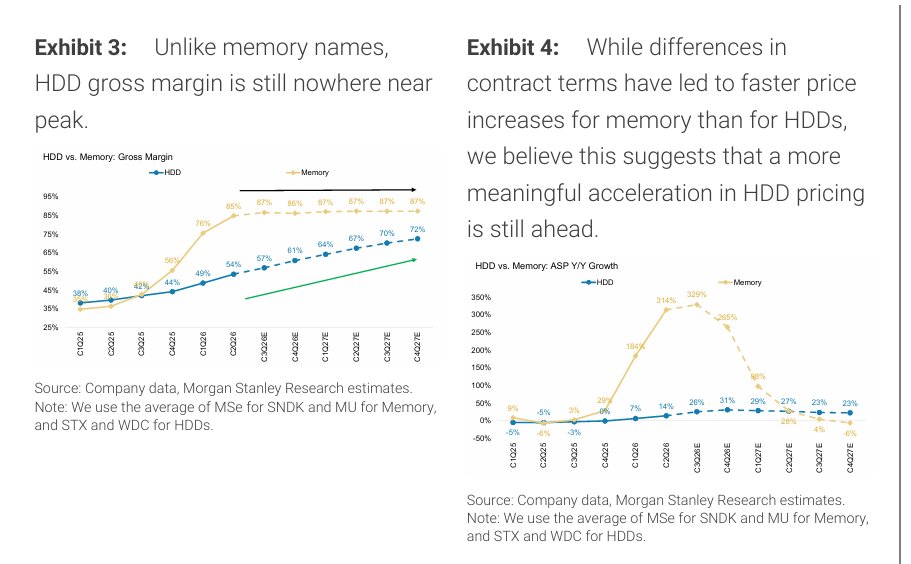
Profit elasticity is being unlocked through pricing. DAMO strategists learned that some non-Changxie near-line HDD transactions have reached 0.04-0.07 US dollars per GB, which is equivalent to 2.7 to 4.7 times the current comprehensive average price of about 0.015 US dollars; non-near-line products have seen price increases of 15% to 30% over the previous month. The former reflects a marginal transaction price for scarce capacity, which still needs to gradually enter overall revenue through contract renewals. Damo believes that HDD's slower pace of repricing than DRAM/NAND makes its profit cashing stage relatively lagging behind: currently, gross margin is in the middle of 50%, and the proportion of new revenue converted into gross profit has reached the mid-80% range. Coupled with 80% to 90% data center exposure, a three-vendor pattern, and lower capital intensity, the bank believes that HDD still has a basis for profit improvement and valuation premiums.
At the end of the market's early trading cycle, Damo is betting on earnings reports to turn “scarce production capacity” into strong cash
The Damo strategist team said that the focus of this round of memory chip earnings reports is to focus on the quarterly results up to September exceeding expectations and providing a stronger performance outlook and guidance range for the calendar quarter ending December.
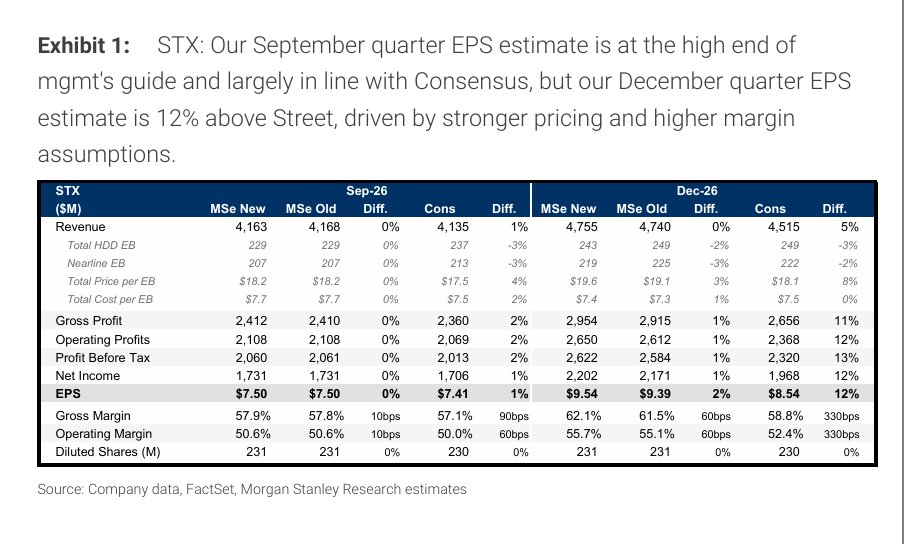
The first quarter of fiscal year 2027 corresponds to the quarter ended September 2026: Damo predicts Seagate's revenue of US$4.163 billion, gross profit margin of 57.9%, and adjusted EPS of US$7.50; Western Digital was US$4.189 billion, 56.0%, and US$4.13, respectively. In the December quarter, Seagate's revenue is expected to rise to US$4.755 billion, gross profit margin of 62.1%, and EPS of US$9.54, which is about 12% higher than the market consensus of US$8.54; Western Digital corresponds to US$4.794 billion, 59.5%, and US$5.25, which is about 10% higher than the consensus of US$4.78. If the floating price is more fully transmitted, Seagate's EPS for this season may still be more than 5% higher than Damo's forecast, and the Western Digital could reach $5.67. Western Digital's lower buyers' expectations also make it easier to surprise financial reports.
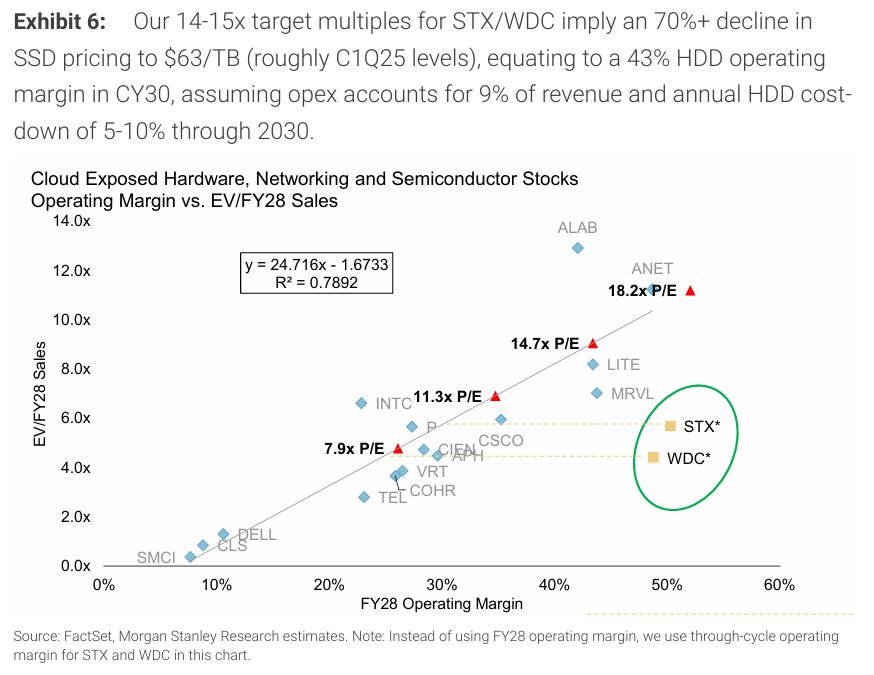
As can be seen from dismantling the target price adjustment, Damo basically maintained a bullish judgment on profits, while lowering the valuation multiplier to reflect the market's concerns about the sustainability of the cycle and the industry pattern. Therefore, the valuation change revealed Damo's real tendencies and positive stance — reducing the valuation multiplier corresponding to risk appetite, while basically retaining profit growth judgments. The bank rolled the valuation base period from natural year 2027 to fiscal year 2028, and reduced the target price-earnings ratios of Seagate and Western Digital from 20 times to 15 times and 14 times, respectively, corresponding to EPS forecasts of $80.10 and $45.95, which is still about 37% and 38% higher than market consensus. Under the assumption that the unit cost will drop by 5% to 10% per year, the long-term SSD/HDD price difference is about 6 times, and the HDD fee ratio is 9%, Damo believes that the cross-cycle operating profit margin can reach 45% to 50%.
The reverse analysis of Damo's quantitative model shows that the current valuation is only about 8 times, which is equivalent to the market taking into account the severe situation where profits peaked in the 2028 fiscal year, SSD prices fell from 245 US dollars to 46 US dollars per TB, and HDD long-term profit margins fell significantly. The reported bull market valuations were $1,645 for Seagate, $910 for Western numbers, and $522 and $297 for bears, reflecting the asymmetry in earnings risk in its judgment.
Ultimately, what needs to be verified is the transmission of “price increase - profit - cash flow - shareholder return”. Based on the calculation of operating cash flow minus capital expenditure in the reporting model, Seagate's free cash flow for the 2027 and 2028 fiscal years was about 8.125 billion US dollars and 15.508 billion US dollars, respectively, and Western Digital was about 7.469 billion US dollars and 14.775 billion US dollars; the model also expects the two companies to buy back 5.6 billion and 5.7 billion US dollars of shares respectively in fiscal year 2027. The above are all predictions, but it shows that Damo is optimistic not only about EPS growth, but also about the ability to convert that growth into distributable cash. According to the official schedule and research report schedule, the financial reports were disclosed by Western Digital on October 22 and Seagate on October 27. The key depends on whether the sales price per TB can accelerate, whether the unit cost can continue to decline as component prices rise, whether Western Digital 40TB products can climb smoothly, and whether manufacturers insist on prioritizing profit. If this operating evidence is realized, Monday's rebound in memory chips is expected to extend to a new round of profit-driven storage super-bull market.