
- PRICING
- LIVE QUOTES
- LEARN
- HELP


EN
Did Japan Launch Just Shift Rhythm Pharmaceuticals (RYTM) Investment Narrative?
- Rhythm Pharmaceuticals has commercially launched IMCIVREE in Japan for acquired hypothalamic obesity after inclusion on the National Health Insurance drug price list, supported by Phase 3 TRANSCEND data showing an 18.8% placebo adjusted BMI reduction.
- The move opens access to an estimated 5,000 to 8,000 acquired hypothalamic obesity patients in Japan, giving Rhythm Pharmaceuticals a defined rare disease population under a national reimbursement framework.
- We will now look at how Rhythm Pharmaceuticals' investment narrative could be influenced by Japan's reimbursed launch of IMCIVREE for hypothalamic obesity.
Scan how Rhythm Pharmaceuticals fits into the rare disease opportunity set by comparing it with a hand-picked 20 high quality undiscovered gems targeting under-followed treatments and specialist healthcare players.
Rhythm Pharmaceuticals Investment Narrative Recap
To own Rhythm Pharmaceuticals, you have to be comfortable with a rare disease model built around a single core drug, IMCIVREE, and a plan to expand that molecule across more indications and geographies. The reimbursed launch in Japan adds another defined, insured patient pool in hypothalamic obesity, but it does not change the fact that Rhythm still reports operating losses and spends heavily on R&D and SG&A.
For the near term, the key swing factor remains how quickly IMCIVREE adoption builds across its approved uses while international infrastructure is still young. The biggest risk stays the same. Rhythm is highly dependent on one asset, so any safety, efficacy, pricing or competitive issue around setmelanotide could hit revenue and extend the period of losses or future capital needs.
The Japan launch is tightly linked to one of the core listed catalysts, which is potential approvals and rollouts for IMCIVREE in new indications and territories. Rhythm is already a commercial stage rare disease player with about US$239.9 million of revenue and an international contribution of roughly US$74.8 million, so another reimbursed market plugs directly into that theme.
Investors watching Rhythm Pharmaceuticals now have a fresh real world test of its ability to scale outside the United States while working within country specific reimbursement systems. How efficiently the business converts the estimated 5,000 to 8,000 hypothalamic obesity patients in Japan into treated, reimbursed cases will feed into views on execution, the durability of pricing, and how realistic the more optimistic earnings and revenue forecasts look over the next few years.
Analyst expectations for Rhythm Pharmaceuticals imply revenues of US$1.1b and earnings of US$370.0 million by 2029. This aligns with a projected 66.3% yearly revenue growth rate and an earnings change of about US$580 million, from a loss of US$210.2 million today to those forecast profits.
Discover why Rhythm Pharmaceuticals' fair value indicates a 63% potential upside to its current price that could close more quickly than the market expects.
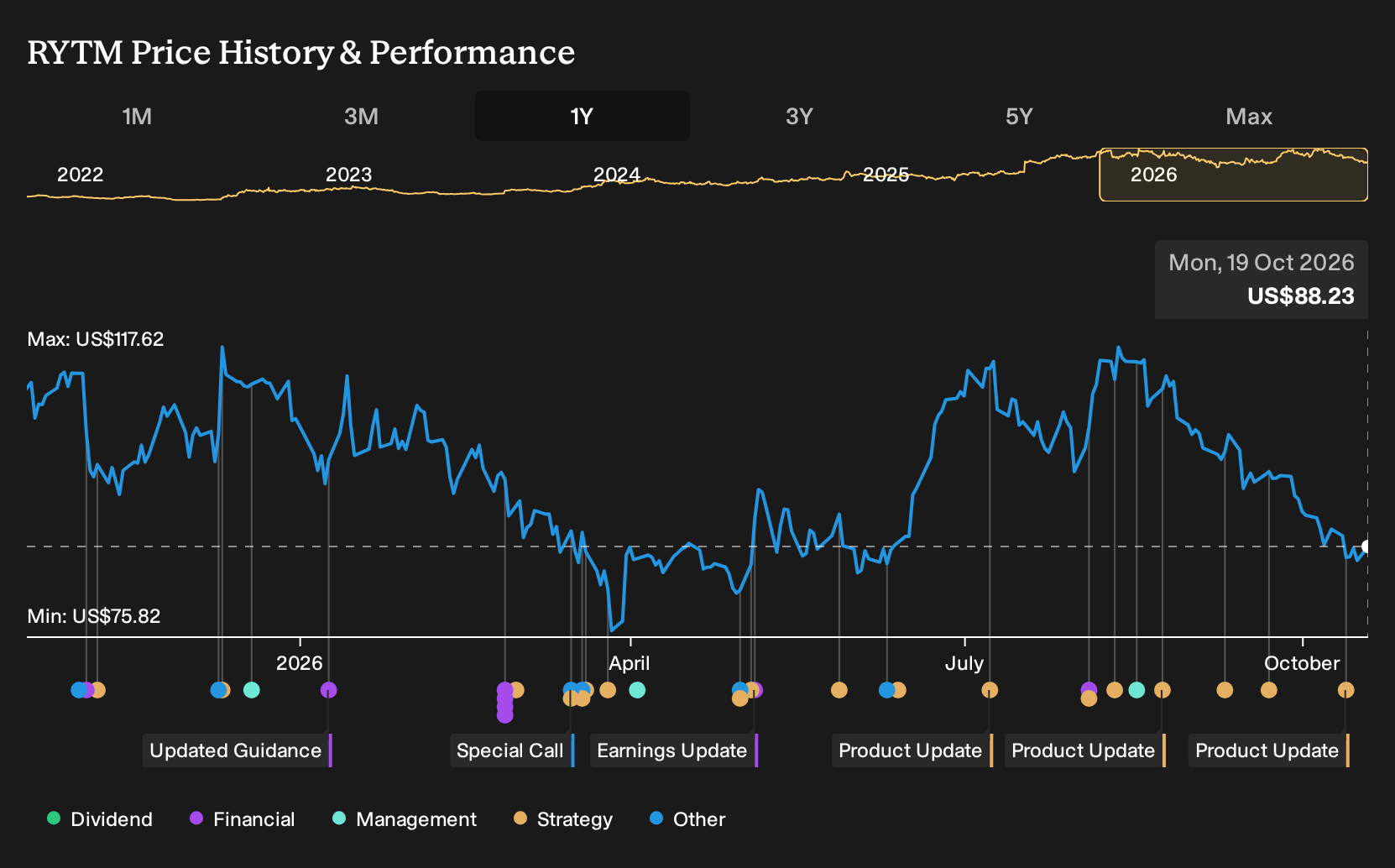
Exploring Other Perspectives
One alternate view on Rhythm Pharmaceuticals focuses on pricing risk rather than growth. Before this Japan launch, the most cautious analysts were only modeling about US$868.0 million of revenue and US$33.0 million of earnings by 2029. That is a far less confident story. Use this news as a prompt to compare those cooler forecasts with more optimistic scenarios.
Explore 2 other Rhythm Pharmaceuticals fair value estimates, including one that suggests it could be worth just $134.00.
Reach Your Own Conclusion
Disagree with existing narratives? Extraordinary investment returns rarely come from following the herd, so go with your instincts.
- A great starting point for your Rhythm Pharmaceuticals research is our analysis highlighting 3 key rewards that could impact your investment decision.
- See our latest analysis for Rhythm Pharmaceuticals. The report includes a comprehensive fundamental analysis summarized in a single visual, the Snowflake, making it easy to evaluate Rhythm Pharmaceuticals' overall financial health at a glance.
Looking For More Investment Ideas Beyond Rhythm Pharmaceuticals?
If the Rhythm Pharmaceuticals story has sharpened your view on risk, reward, and concentration in a portfolio, you can use that momentum to broaden your watchlist with other focused opportunities.
- For investors who want potential mispricing backed by fundamentals, scan a curated 35 high quality undervalued stocks that combines quality metrics with attractive entry points.
- If capital preservation sits high on your agenda, narrow your search to a 32 resilient stocks with low risk scores that filters for sturdier balance sheets and historically steadier trading profiles.
- When you value resilience and financial strength, build a shortlist from a list of solid balance sheet and fundamentals (25 results) that highlights companies with robust finances supporting their long term plans.
Have feedback on this article? Concerned about the content? Get in touch with us directly. Alternatively, email editorial-team@simplywallst.com