
- PRICING
- LIVE QUOTES
- LEARN
- HELP


EN
Learn Why The Bull Case For Intel (INTC) Could Change Following Tesla Foundry Deal
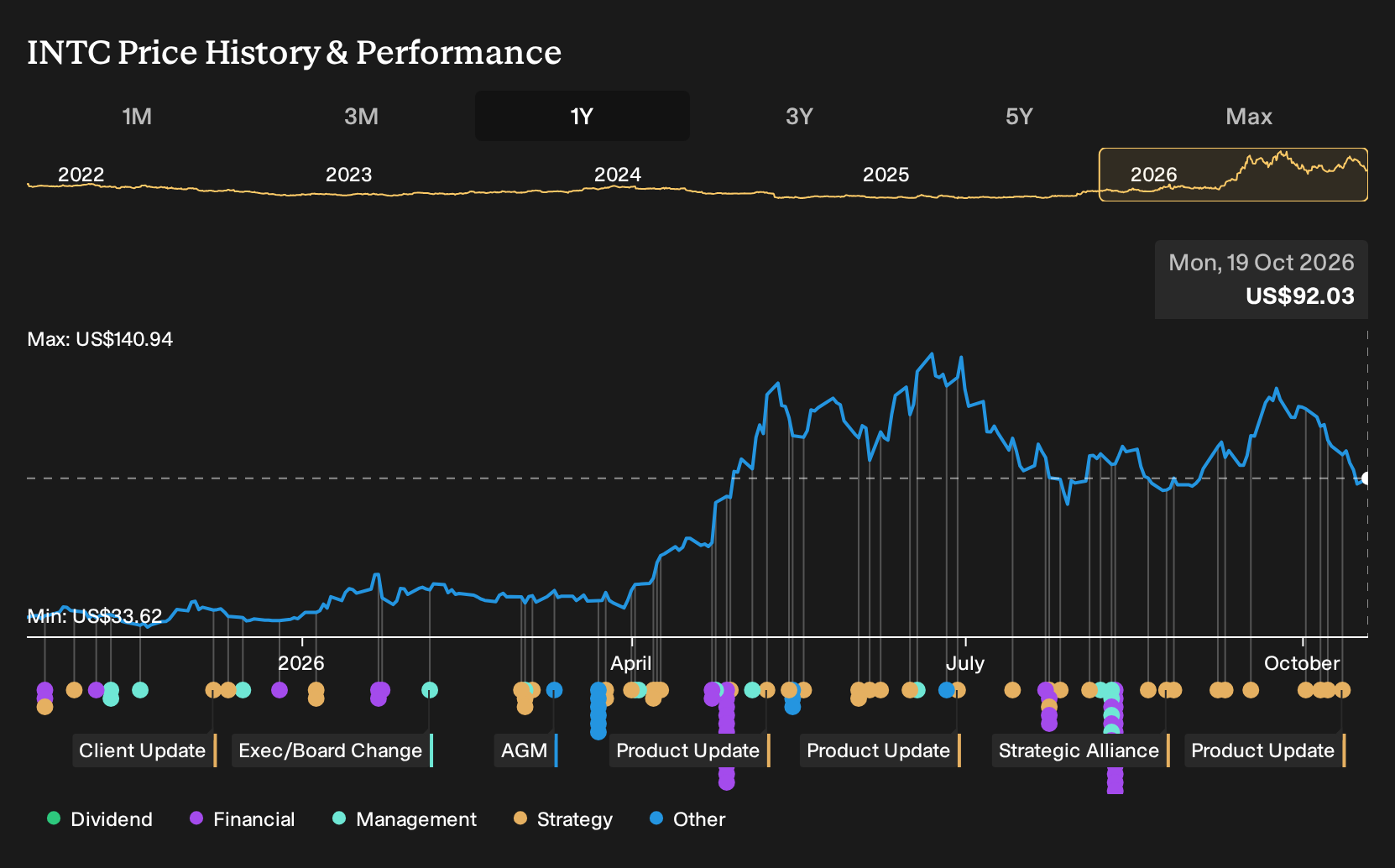
- Intel has outlined fresh details on its GPU D-series for high memory AI inference, new Xeon-based racks for agentic AI workloads, and third party collaborations that include a 14A foundry agreement with Tesla and expanded software distribution through Anaconda.
- The combination of AI focused hardware, advanced packaging research, and early marquee foundry customers points to Intel further linking its heavy capital program with concrete demand for future server and custom silicon capacity.
- We will now look at how Intel's investment narrative lines up with this Tesla 14A foundry deal and AI product progress.
Scan beyond Intel and see which other chipmakers are building for the same AI surge with our hand-picked 55 AI infrastructure stocks.
Intel Investment Narrative Recap
To own Intel, you need to believe its heavy US$20b plus annual CapEx and push into foundry and AI infrastructure convert into sustainable demand for 18A, 14A and advanced packaging. The most important near term swing factor is whether AI server, GPU and custom ASIC orders keep filling that future capacity. The latest GPU D series and Xeon rack disclosures help, but the key proof still sits in signed, multi year customer commitments.
The biggest current risk is that Intel Foundry’s roughly US$2.5b quarterly operating losses drag on longer if utilization or pricing disappoints while PC demand remains weak. Recent AI product news and the Tesla 14A deal support the long term story, yet they do not remove the possibility that capacity ends up ahead of profitable volume.
The Tesla agreement to use Intel’s future 14A process is the announcement that ties closest to this week’s AI hardware news. It links the build out of advanced packaging and next generation manufacturing directly to a marquee external client. For a shareholder, that matters because the core thesis rests on Intel turning massive factory spend into a credible foundry business rather than just internal CPU supply.
At the same time, that win raises the execution bar. Intel now has to ramp 18A and then 14A, scale EMIB T packaging and manage higher start up costs while Foundry remains loss making and PC volumes are expected to decline in 2026. Analyst upgrades and improved sentiment help in the short term, yet the real catalyst is still on time delivery of these contracts with acceptable margins.
Intel AI Capacity Versus Analyst Assumptions
Analysts are effectively underwriting Intel’s Tesla 14A win and broader AI push with a fairly punchy growth script. Consensus models point to revenue expanding at 16.5% a year over the next three years, profit margins turning from a 19.8% loss today into 24.2% in that window, and earnings swinging from a loss of US$11.3b to US$21.8b by 2029. That kind of shift lines up with management’s plan to fill new 18A and 14A capacity with AI server, GPU and foundry demand. It also leaves far less room for execution slip ups on costs, yields or customer ramps.
The earnings step change in those forecasts is extreme in plain dollar terms. Moving from a loss of US$11.3b to US$21.8b in profit implies an earnings improvement of roughly US$33.1b, even before factoring in that analysts also expect shares outstanding to climb about 5.7% a year. For investors, the question is not whether that turnaround is possible, but what has to go right across AI accelerators, Xeon racks, foundry tooling and pricing for those numbers to hold if Intel Foundry remains loss making into 2028 and PC volumes fall away in 2026.
Valuation work from the same analyst group anchors all of this in a 2029 snapshot. Their central case ties a consensus price target of US$116.37, just 0.4% above the recent US$115.93 share price, to revenue of US$90.1b and earnings of US$21.8b, on a P/E of 44.4x for that year. That multiple is framed as slightly below the current US semiconductor sector average at 46.9x. This suggests the current Intel share price already reflects both the Tesla foundry deal and a sizeable AI capacity ramp, rather than treating either as blue sky upside.
Intel's narrative projects US$90.1b revenue and US$21.8b earnings by 2029. This rests on 16.5% yearly revenue growth and an earnings improvement of about US$33.1b from a current loss of US$11.3b.
Uncover why Intel's fair value indicates a 26% potential upside to its current price, which could narrow quickly.
Exploring Other Perspectives
You are not alone if you see Intel’s latest GPU D series and Xeon rack news as exciting while still worrying about foundry complexity. The most pessimistic analysts were modeling only US$79.8b of revenue and US$11.5b of earnings by 2029 before this, far below consensus. That gap shows how widely opinions can differ. Use it as a cue to examine several viewpoints and decide which story feels more realistic to you as this new AI hardware and Tesla’s 14A deal feed into future forecasts.
Explore 14 other Intel fair value estimates, including one that suggests as much as 53% downside from the current price.
Decide For Yourself
Don't just follow the ticker; dig into the data and build a conviction that's truly your own.
- A great starting point for your Intel research is our analysis highlighting 1 key reward that could impact your investment decision.
- See our latest analysis for Intel. The report includes a comprehensive fundamental analysis summarized in a single visual, the Snowflake, making it easy to evaluate Intel's overall financial health at a glance.
Looking For More Investment Ideas Beyond Intel?
Intel may be central to the current AI discussion, but your portfolio does not have to hinge on a single story. Use the Simply Wall St Screener to scan for other companies that fit the kind of risk and return profile you actually want.
- If you want potential upside without abandoning quality, check out our 20 high quality undiscovered gems that combine strong fundamentals with room to grow.
- For income focused investors who care about durability as much as yield, review the 8 dividend fortresses that aim to keep distributions coming.
- When capital preservation is near the top of your list, start with the 32 resilient stocks with low risk scores that score well on our risk checks.
This article by Simply Wall St is general in nature. We provide commentary based on historical data and analyst forecasts only using an unbiased methodology and our articles are not intended to be financial advice. It does not constitute a recommendation to buy or sell any stock, and does not take account of your objectives, or your financial situation. We aim to bring you long-term focused analysis driven by fundamental data. Note that our analysis may not factor in the latest price-sensitive company announcements or qualitative material. Simply Wall St has no position in any stocks mentioned.
Have feedback on this article? Concerned about the content? Get in touch with us directly. Alternatively, email editorial-team@simplywallst.com