
- PRICING
- LIVE QUOTES
- LEARN
- HELP


EN
3 Energy Infrastructure Stocks Built For Geopolitical Risk
Saudi Arabia’s cancelled “Davos in the Desert” summit and rising attacks on regional infrastructure have pushed geopolitical risk back onto every investor’s screen, yet midstream energy stocks exposed to these headlines can react very differently. For some, disrupted confidence in Vision 2030 can pressure sentiment. For others, storage capacity and pipeline access can become more valuable. This article examines three Global Energy Midstream & Storage Operators from the screener that appear more resilient to this shift.
The three stocks covered below are just a starting sample, since the full Global Energy Midstream & Storage Operators screen surfaced 11 more companies with equally focused business models and equally detailed narratives that are not discussed here.
If you want to identify and analyze the operators that best fit your own risk, yield, and geography preferences, head straight to the Global Energy Midstream & Storage Operators screener.
Core Natural Resources (CNR)
Overview: Core Natural Resources is a US based coal producer that mines and exports thermal and metallurgical coal through multiple mining complexes and a marine terminal.
Operations: Core Natural Resources generates about $2.2b from High CV Thermal, $1.3b from Metallurgical, $693 million from PRB and $95 million from its Core Marine Terminal, with roughly $2.5b tied to export markets and $1.8b to US customers.
Market Cap: $4.5b
Core Natural Resources matters in this midstream focused screen because its coal export and terminal operations tie directly into global energy logistics at a time when supply routes feel less predictable.
"Core Natural Resources is starting to turn coal byproducts into a new revenue source through the DOE funded rare earth and critical mineral extraction pilot at the Pennsylvania Mining Complex. This initiative could convert waste tailings into an additional earnings stream if the process scales commercially."
What happens to Core Natural Resources margins and cash generation if a single key cost pressure breaks in the right direction?
If that cost tailwind is what determines whether the coal byproducts story truly scales, read the full narrative for Core Natural Resources to see how the thesis could accelerate.

Golar LNG (GLNG)
Overview: Golar LNG runs floating liquefied natural gas infrastructure that liquefies, stores, regasifies, and ships LNG, providing midstream-style exposure to flexible seaborne gas logistics.
Operations: The business currently generates about $503 million from its first FLNG unit and around $20 million from corporate and other activities.
Market Cap: $4.6b
Golar LNG fits directly into the Global Energy Midstream & Storage Operators theme because its floating liquefaction vessels act like mobile export terminals. These vessels can be repositioned when onshore routes are less reliable, a context in which long-dated contracted capacity can be particularly important.
"The company has secured long term 20 year charters for its existing FLNG units, providing $17b in contracted EBITDA backlog and 20 years of cash flow visibility, which is expected to drive a significant 4x increase in EBITDA and contracted free cash flow by 2028."
The key variable is how one unresolved funding pressure ultimately affects margins, equity dilution, and long term dividend flexibility.
That funding overhang is the real swing factor, so read the full narrative for Golar LNG to see how it could reshape Golar LNG’s contracted story and equity path.
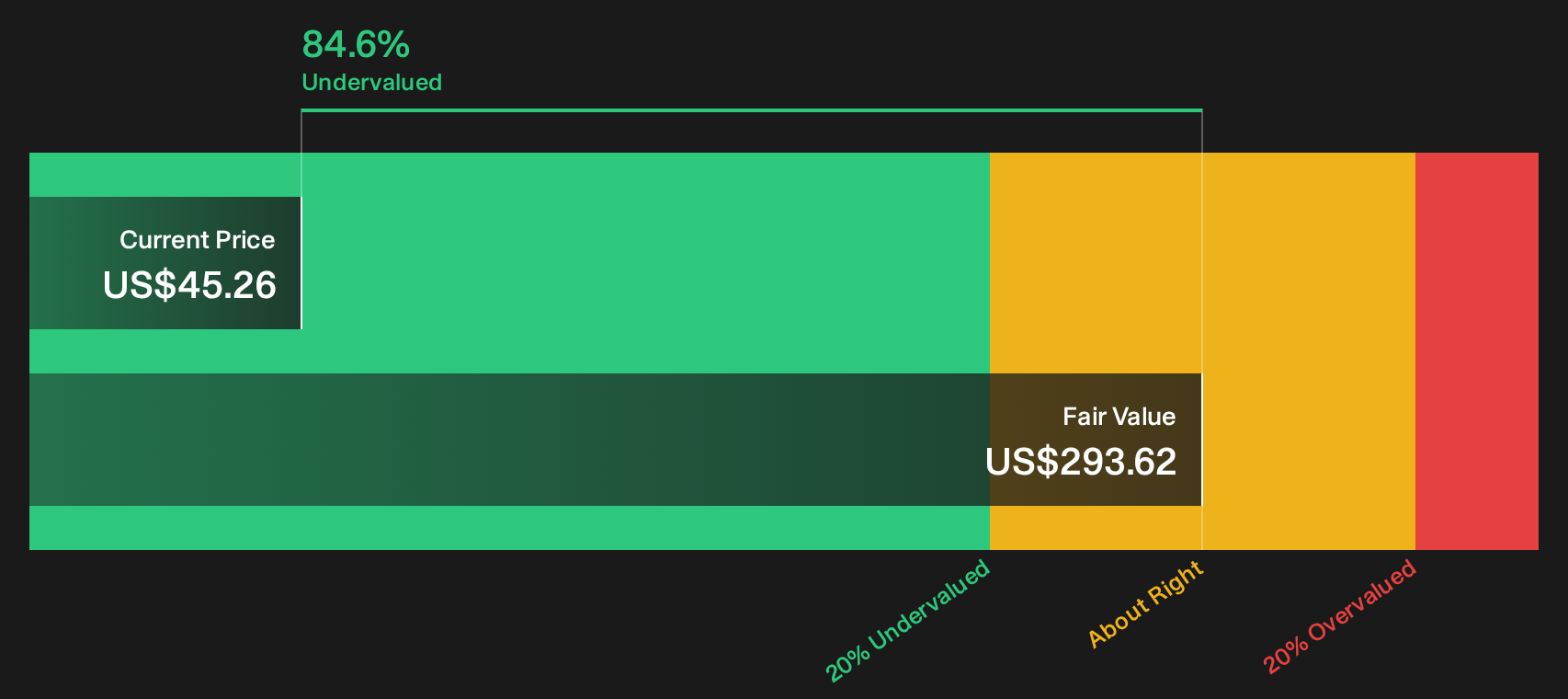
Stabilis Solutions (SLNG)
Overview: Stabilis Solutions provides LNG based production, storage, transportation, and fueling services across North America, directly linking industrial customers to midstream energy logistics.
Operations: Stabilis Solutions generates about $56 million from Oil & Gas refining and marketing, with roughly $52 million from US customers and $4 million from Mexico.
Market Cap: $88 million
Stabilis Solutions integrates LNG infrastructure into the midstream story by focusing on where secure storage and reliable fuel delivery matter most for end users.
"Although Stabilis Solutions has secured an estimated two year US$200 million bridge power contract for a U.S. data center with expected revenue from early 2027, the roughly 40% revenue decline in Q1 2026 and 31% decline in Q2 2026 after two large multiyear contracts ended show how much needs to be replaced just to rebuild the base."
The key issue now is how one shift in LNG project timing and utilization shapes whether that midstream style growth is sustained.
That inflection point is where things get interesting, so read the full narrative for Stabilis Solutions to see whether Stabilis Solutions’ stalled contracts are masking a much stronger LNG runway ahead.

Seeking Alternatives Before The Crowd?
Fresh themes are breaking out while older ideas lose momentum. Some promising stories are still under the radar for now. Do not get caught dropping in late. Act now.
- Target reliable income streams before yields get compressed by latecomers by scanning the 8 dividend fortresses that focus on robust payouts and durable cash generators.
- Spot future infrastructure workhorses early by reviewing the 42 power grid technology and infrastructure stocks that are building grid technology as electrification demand gathers pace.
- Ride early AI infrastructure momentum by checking the 55 AI infrastructure stocks that support the data centers and compute build out behind headline AI stories.
This article by Simply Wall St is general in nature. We provide commentary based on historical data and analyst forecasts only using an unbiased methodology and our articles are not intended to be financial advice. It does not constitute a recommendation to buy or sell any stock, and does not take account of your objectives, or your financial situation. We aim to bring you long-term focused analysis driven by fundamental data. Note that our analysis may not factor in the latest price-sensitive company announcements or qualitative material. Simply Wall St has no position in any stocks mentioned.
Have feedback on this article? Concerned about the content? Get in touch with us directly. Alternatively, email editorial-team@simplywallst.com