
- PRICING
- LIVE QUOTES
- LEARN
- HELP


EN
Dan Ives Is Betting Big on Gamestop Stock, but a Lot Is Riding on Its Collectibles Business
Most people view GameStop (GME) as just a video game store. But does that description fit today, given GameStop is a collectibles seller, a trading card hub, and a Bitcoin (BTCUSD) holder?
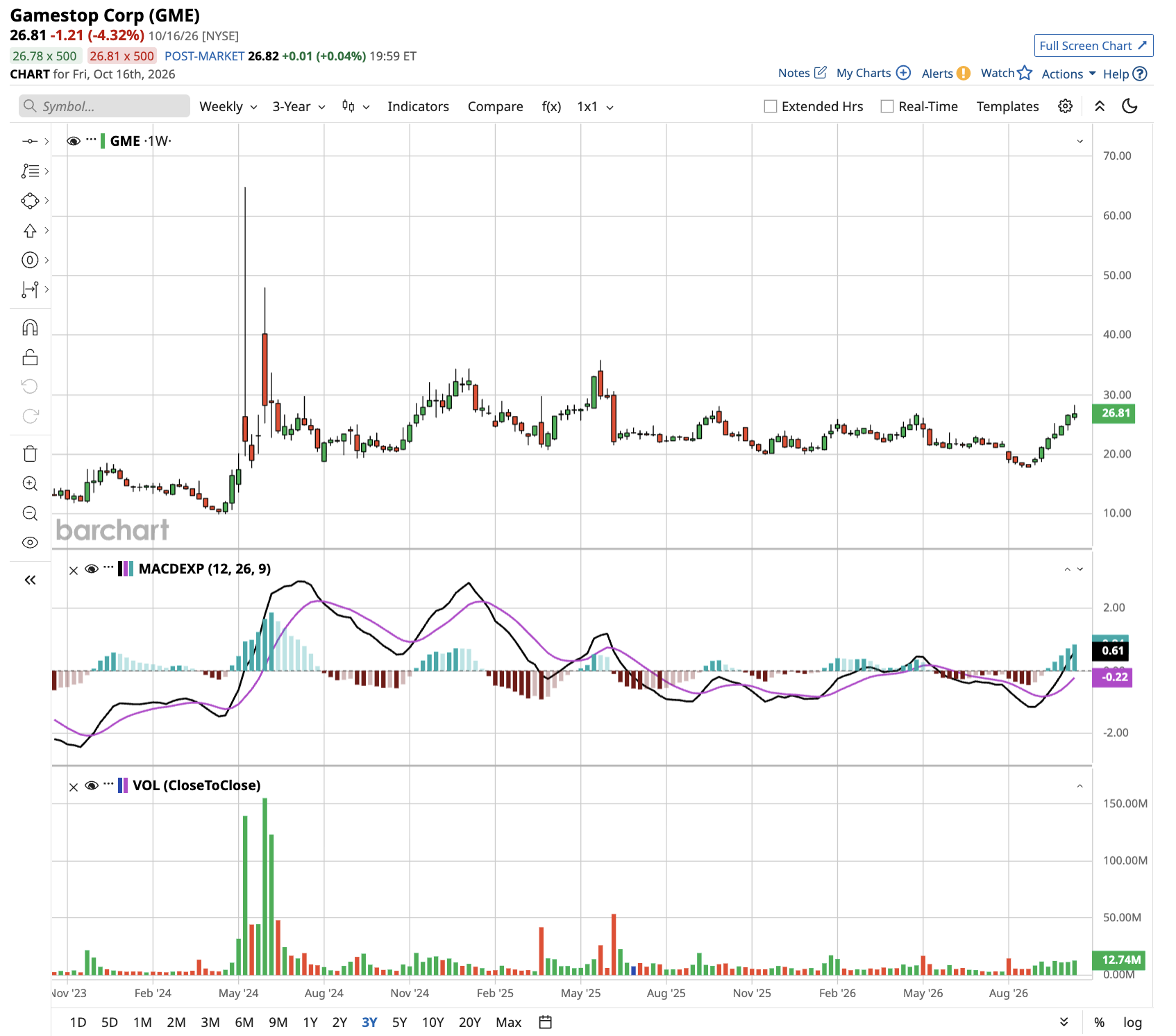
Valued at a market cap of $13.5 billion, GME stock has almost doubled over the last three years. Recently, one Wall Street analyst projected the stock to gain roughly 20% from current levels.
Dan Ives Holds His $32 GameStop Stock Price Target
According to an Investing.com report:
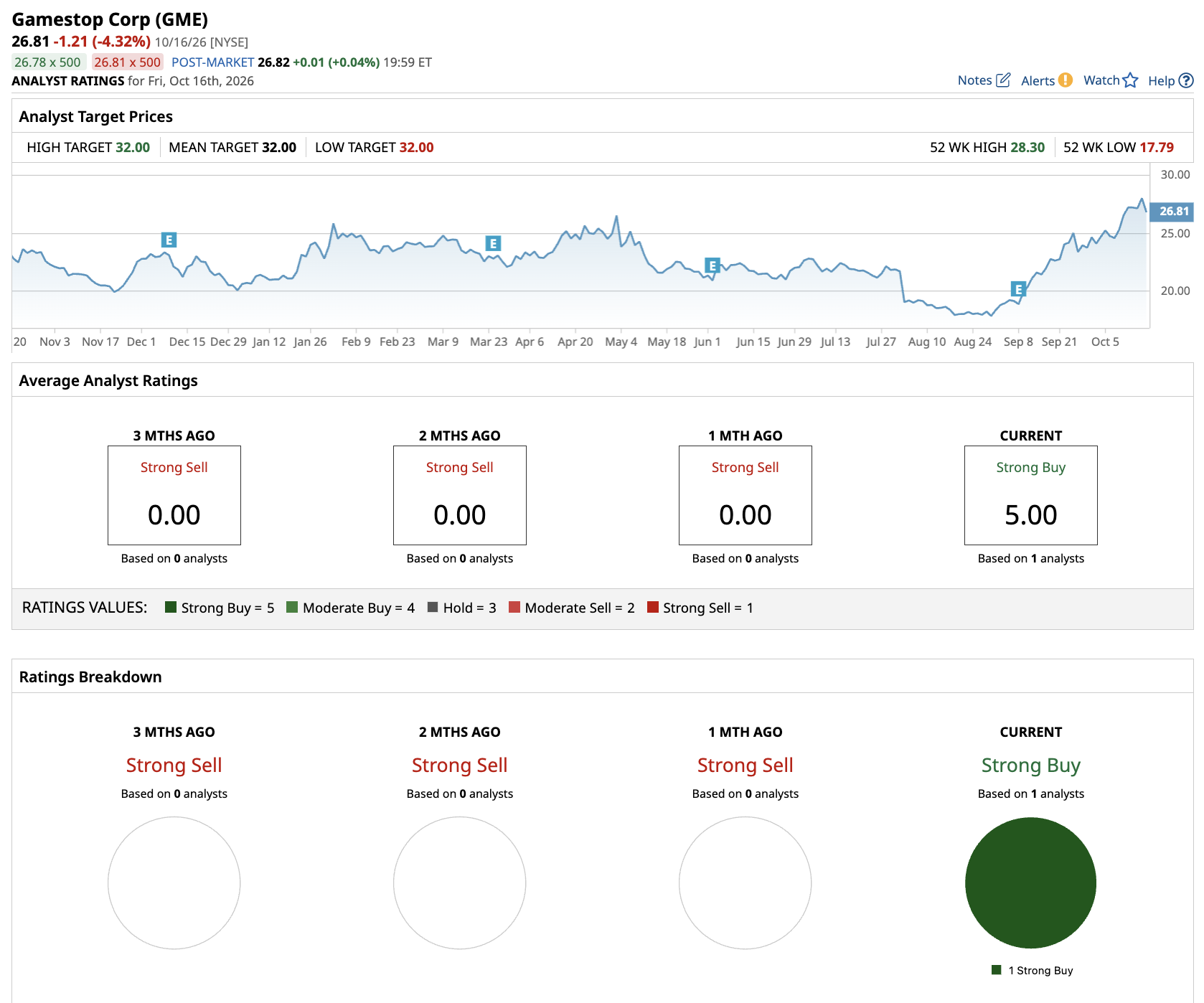
- Former Wedbush, now Yorkville Ives, analyst Dan Ives reiterated an “Outperform” rating and a $32 price target on GameStop. As of this writing, GME trades at $26.81.
- The analyst reasoned that GameStop is moving from legacy video game retail to a collectibles platform. Collectibles now account for almost 50% of the sales mix.
- Ives says the edge comes from hard-to-replicate infrastructure. GameStop has a national store network, a decades-old trade-in culture, and a loyal enthusiast base.
Then there is PSA. Through the partnership, each participating GameStop store becomes a place where collectors can get cards graded, something they would otherwise do only by mail. PSA is one of the hobby's largest graders.
It graded well over 19 million cards in 2025, and Investing.com reported that its slabs are among the most liquid in the category. Ives argues that a growing graded card inventory and trade-in capability turn single purchases into repeat, higher-value deals.
GameStop also offers Power Packs, which tie online pack openings to PSA-graded cards. Customers can vault those cards, ship them home, or resell them. For GameStop, it gives collectors a reason to engage with the brand even when they are not in a store.
The company discloses that, over a large sample, the estimated value of cards in each pack is substantially equivalent to the pack price.
Collectibles Now Drive 45% of Sales
GameStop's second-quarter results show a shift in business operations.
Collectibles net sales grew 57% year-over-year (YoY) to $356.3 million. The segment accounts for 45.1% of net sales, up from 23.4% last year.
However, total net sales fell to $790.2 million from $972.2 million over the last 12 months. GameStop tied the revenue decline to the prior-year launch of Nintendo Switch 2, planned store closures, and the sale of its France business.
GameStop reported an operating income of $160.2 million, the highest Q2 figure in company history. Last year, its operating income was much lower at $66.4 million.
Adjusted EBITDA, which is earnings before interest, taxes, depreciation, and amortization, more than doubled to $174 million from $75.7 million last year. Selling, general, and administrative costs dropped to $187.1 million from $218.8 million.
GameStop also raised its fiscal 2026 outlook. It now expects adjusted EBITDA above $650 million, up from $600 million in the prior outlook. The first half already delivered $339.7 million in EBITDA.
Net income was $298.7 million, up from $168.6 million.
But after stripping out items like digital asset gains and losses, derivative gains, and unrealized equity gains, adjusted net income was much lower at $161.1 million, still higher than $138.3 million last year.
A large chunk of reported profit did not originate from selling cards and games. GameStop booked a $166.3 million gain on a derivative asset in the quarter, tied to put-call pairs that gave the company economic exposure to eBay (EBAY) stock.
GameStop's Cash Pile and eBay Bet
GameStop ended the recent quarter with $5.4 billion in cash and related receivables. It also converted the eBay derivative into direct ownership. As of Aug. 1, GameStop held about 43.4 million eBay shares worth roughly $4.9 billion.
Cash, cash equivalents, and marketable securities fell to $5.1 billion from $8.7 billion a year earlier. On Sept. 3, the company retired about $1.4 billion of convertible notes, which reduced long-term debt to $2.8 billion. The board also approved a new $2 billion share repurchase authorization.
GameStop says it is focused on using its cash, flexible capital structure, and stock to buy assets it believes will be valued much higher under its leadership. It has no binding agreement for a specific deal, and CEO Ryan Cohen sits on the Investment Committee with two independent directors.
GameStop bought 4,710 Bitcoin for $500 million in the second quarter of fiscal 2025. This quarter it booked a $75 million loss on digital assets and related receivables as Bitcoin's price fell.
It also sold covered call options on about 2,000 Bitcoin with a $70,000 strike price. The call option contract created a $2 million derivative liability, even as the first half produced about a $13.8 million gain on the options.
GameStop pledged 4,709 Bitcoin to Coinbase (COIN) as collateral. Coinbase can rehypothecate, commingle, or sell the holdings. GameStop concluded that control passed to Coinbase, so it now holds a receivable for equivalent Bitcoin instead.
The company says its economic exposure matches direct ownership, except for the covered calls.
Is GME Stock Undervalued?
GameStop is growing its high-margin collectibles business while reducing costs. After closing 727 U.S. stores in fiscal 2025, GameStop does not expect significant closures in fiscal 2026.
My concern is that headline profit now swings with eBay and Bitcoin amid falling retail sales. In my view, Ives’s target works only if collectibles keep growing fast enough to offset the sales GameStop is losing elsewhere and if its deal-making pays off.
Analysts forecast adjusted earnings to grow from $0.33 in fiscal 2025 to $1.86 per share in 2028. If GME trades at 20x earnings, it could surge 50% over the next two years.
On the date of publication, Aditya Raghunath did not have (either directly or indirectly) positions in any of the securities mentioned in this article. All information and data in this article is solely for informational purposes. For more information please view the Barchart Disclosure Policy here.