
- PRICING
- LIVE QUOTES
- LEARN
- HELP


EN
Oracle Slumped 9% Amid a Tech Selloff and AI Buildout Concerns. Investors Should Cautiously Buy the Dip.
Oracle’s (ORCL) artificial intelligence (AI) ambitions come with a hefty price tag, and investors are now questioning how much risk they should accept to fund it. Shares tumbled nearly 9% in a single session on Oct. 14 as a broader technology selloff put the financing of AI infrastructure under scrutiny.
The pressure extended across the sector. CoreWeave (CRWV) dropped more than 15% as a selloff in its corporate bonds heightened financing concerns, while Marvell Technology (MRVL) lost more than 8%.
Hotter-than-expected inflation data added further pressure. U.S. annual inflation accelerated to 3.7% in September from 3.4% in August, raising the prospect of higher interest rates and more expensive financing for the industry’s massive infrastructure buildout.
For Oracle, this strikes at the core of its investment case. The sharp selloff, therefore, raises a more fundamental question. Has the decline created an attractive opportunity to invest in the AI expansion? Or is the lower share price a warning of the financial risks? Let’s find out.
Oracle’s Financial Check
Based in Austin, Texas, Oracle is valued at approximately $387 billion by market capitalization and provides enterprise databases, business applications, and cloud infrastructure for organizations managing data and deploying AI. Beyond its established software business, the company is expanding computing capacity to serve customers requiring infrastructure for demanding AI workloads.
ORCL stock closed on Oct. 16 at $128.23 per share. The stock has declined 33% year-to-date (YTD) and 55% for the past 52 weeks.
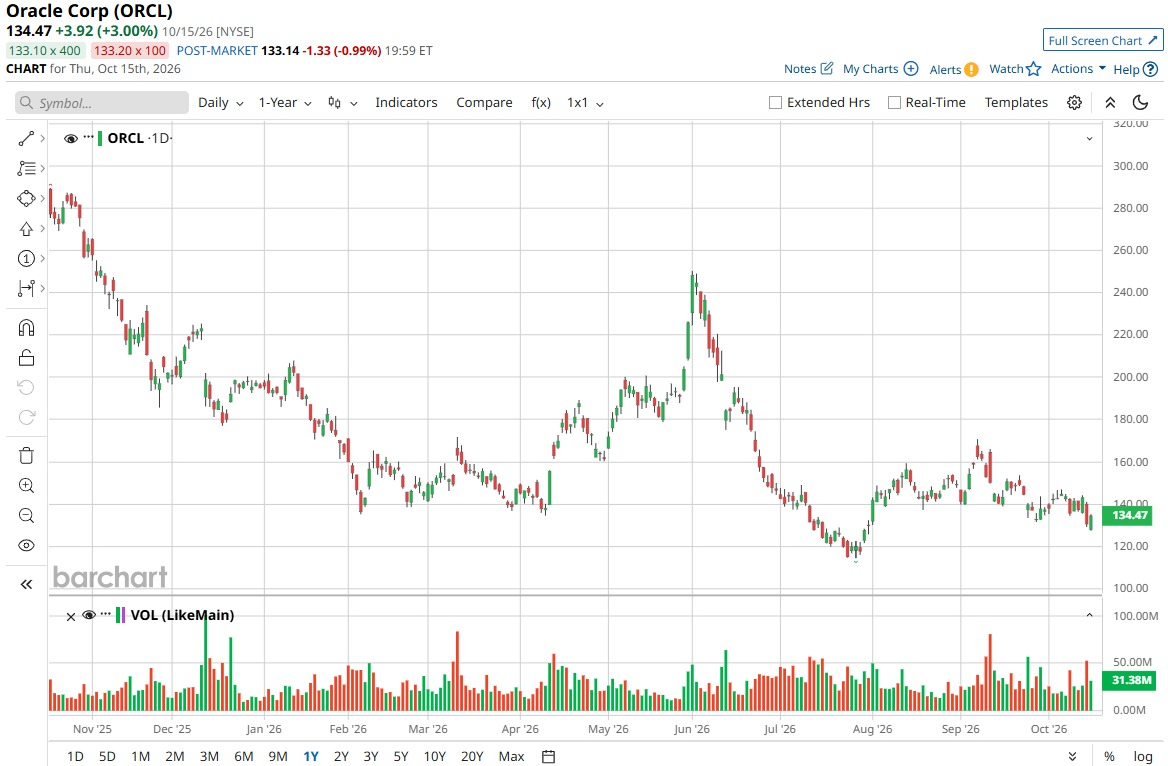
At 19.7 times trailing earnings versus the roughly 32 times sector median, Oracle looks cheaper on earnings but pricier on sales at 6 times versus about 3.5 times for the sector. Oracle's $2 annualized dividend also yields approximately 1.49%.
Oracle released first-quarter fiscal 2027 earnings on Sept. 10. Revenue rose 30% year-over-year (YOY) to $19.35 billion, beating the $19.1 billion analyst estimate. Adjusted EPS also increased 30% YOY to $1.92 and exceeded the $1.74 consensus estimate.
That earnings strength extended to operating results. Oracle reported adjusted operating income of $8.15 billion against expectations of $7.8 billion. This was a 4.5% beat, with an adjusted operating margin of roughly 42%.
Cloud infrastructure drove much of the revenue growth, jumping 121% to $7.4 billion. Cloud applications revenue increased 10% to $4.2 billion, while software revenue fell 3% to $5.5 billion.
To support that cloud expansion, the company delivered 850 megawatts of additional data-center capacity and more than 300,000 GPUs. Those GPU deliveries nearly tripled the preceding quarter’s total.
Oracle also added more than $30 billion in AI cloud contracts during the quarter. This pushed remaining performance obligations (RPO) to $664 billion, up $209 billion YOY.
However, the expansion continued to weigh on cash flow. Free cash flow fell to -$5.4 billion from -$1.87 billion in the previous quarter.
Oracle’s Next Growth Drivers
Oracle’s latest product launches and partnerships show where its next phase of growth could come from and what shareholders will help finance. On Sept. 29, Oracle introduced Fusion Claw with 25 new applications, expanding its agentic application portfolio to 75. The technology combines AI reasoning with precise enterprise computation to automate complex tasks under customer-defined controls.
Infrastructure security is advancing, too. On Oct. 13, Oracle, Microsoft (MSFT), and Marvell established an Open Compute Project working group targeting NIST FIPS 140-3 Level 3 hardware security. Their proposed server-integrated security module would protect cryptographic keys where workloads run, reducing network dependence and supporting regulatory compliance.
Oracle also launched Nexus Case Flow and Nexus Reach on Sept. 29 for financial crime investigations. These offerings target compliance workloads where efficiency must coexist with accountability.
That same day, NetApp (NTAP) and Oracle announced OCI NetApp Storage Service, with general availability planned within 12 months. Its ONTAP capabilities would help customers migrate databases, enterprise applications, and AI workloads without substantially redesigning existing storage operations.
However, expansion brings obligations beyond hardware. On Oct. 2, Oracle committed to absorbing approximately $300 million in rising Point Beach nuclear energy costs, benefiting over 1 million Wisconsin utility customers. The company's related Project Lighthouse development projects more than $11 billion in local economic benefits, 4,000 construction jobs over three years, and 1,000 ongoing positions.
These initiatives give Oracle more ways to win cloud business, but they also add to the spending shareholders must weigh. The key is how quickly those commitments translate into revenue and stronger cash flow.
Wall Street’s Case for Oracle
Oracle’s next earnings report is scheduled for Dec. 9. Analysts expect November-quarter EPS of $1.57, down 19% from $1.95 a year earlier.
Despite that projected decline, Citi sees an opportunity. In August, the firm placed Oracle on a 90-day upside catalyst watch, maintaining a “Buy” rating and a $330 price target. Citi's thesis rests on AI infrastructure demand supporting stronger cloud growth, pricing, and profitability. Citi also identified earnings and an upcoming investor day as potential catalysts.
JPMorgan offered a more measured endorsement in August, retaining an “Overweight” rating while cutting its target to $200 from $210. Analyst Samik Chatterjee noted aggressive infrastructure spending and capital requirements but maintained that Oracle could capitalize on AI expansion.
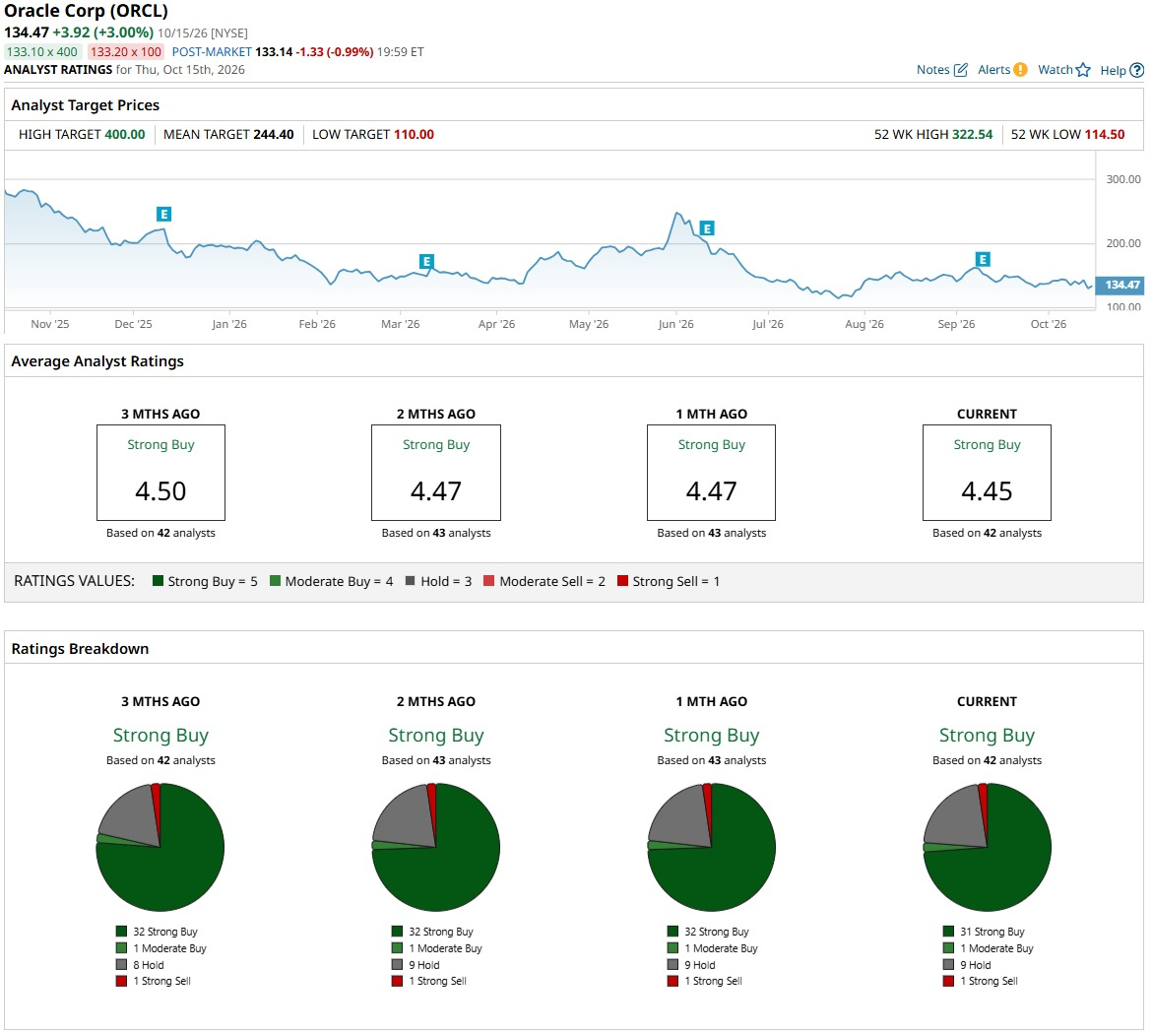
That optimism extends beyond Citi and JPMorgan. Across 43 analysts with coverage, ORCL stock holds a consensus “Strong Buy” rating. The average price target of $242.22 implies potential upside of approximately 86% from current levels.
Conclusion
Oracle looks more like a cautious buy than a stock to avoid. Strong cloud growth supports the opportunity, but heavy spending and negative free cash flow warrant smaller positions rather than aggressive buying. A gradual recovery looks more likely than a quick rebound, provided demand holds and financing remains manageable. The next earnings report will need to show that expansion is producing better financial results. Buying shares gradually makes sense here, but chasing a bounce before cash flow improves would be premature.
On the date of publication, Ebube Jones did not have (either directly or indirectly) positions in any of the securities mentioned in this article. All information and data in this article is solely for informational purposes. For more information please view the Barchart Disclosure Policy here.